Saturday, 7 February 2015

06.02.2015 Chipiona

Vendredi 6 Février 2015

Nous partons en vélo vers le nord-est, en direction d’une ville qui s’appelle Sanlúcar de Barrameda, plus à l’intérieur de l’estuaire du Guadalquivir. Une ancienne foie ferrée désafectée a été transformée en piste cyclable, c’est droit et plat. Le paysage n’est pas très beau, un mélange de maisons particulières et serres de plastique pas toujours en bonne état. Un très bel arbre en fleur met une belle note de couleur. Nous descendons sur une plage, la plage Montijo, déserte. Une des spécialités de Chipiona est le « corral », ce n’est pas un corail naturel mais de petits murs construits qui forment des pièges à poissons. C’est un système très ancien, du temps des Romains et peut-être même avant. Les poissons rentrent à marée haute par-dessus ces petits murs et, à marée basse, ne peuvent plus ressortir. Au loin, on voit une épave, un cargo qui s’est cassé en deux il y a au moins 20 ans et qui est toujours là. Nous rentrons déjeuner au bateau et nous mangeons dehors, mais bien habillés. Nous repartons après déjeuner, cette fois vers le sud, vers Rota. Nous passons au bureau du tourisme et un homme bien aimable nous explique les « corrales » et nous propose une visite guidée du phare demain. Nous roulons quelques km vers le sud, région plus jolie que ce matin, belle plage, beaucoup de maisons de vacances (vides) et une réserve naturelle qui protège, en particulier, des caméléons. Nous revenons vers 17 h 30 h, on a encore bien roulé aujourd’hui. 
    
Friday, February 6, 2015

We start cycling to the northeast, toward a town called Sanlúcar de Barrameda, a little up rivere inside the estuary of the Guadalquivir. An old disused railway has been transformed into a bike path, it is straight and flat. The landscape is not very beautiful, a mixture of private houses and plastic greenhouses not always in good condition. A beautiful tree in bloom makes a nice splash of color. We go down on a beach, Montijo beach, deserted. A specialty of Chipiona is the "corral" it is not a natural coral but small man made walls that make fish traps. This is a very old system, from Roman times and perhaps even earlier. The fish swim in at high tide over these little walls and at low tide, can no longer swim out. In the distance we see a wreck, a cargo ship that broke in two, at least 20 years ago and is still there. We return to the boat and have lunch outside, but well dressed. We leave after lunch, this time to the south, towards Rota. We go to the tourism office and a very kind man explains the "corrals" and suggests a guided tour of the lighthouse tomorrow. We ride a few km to the south, this region is prettier than this morning, a beautiful beach, lots of vacation homes (empty) and a nature reserve that protects, in particular, chameleons. We are back at Maja at about 5:30 pm, we did a good distance by bike today.


L'ancienne voie ferrée-piste cyclable
The old railways, now a bike path


Le bel arbre
The beautiful tree


Les/the "corrales"


C'est une épave, cassée en deux
It is one wreck, broken in two
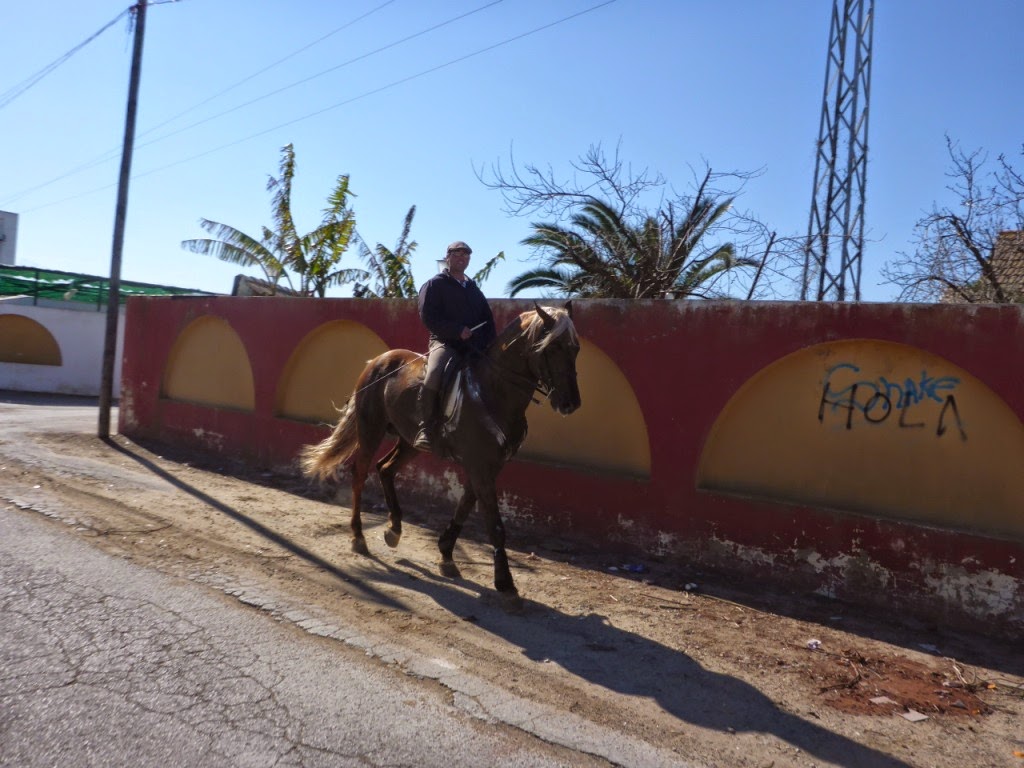

Un cavalier
A rider


Lunch au soleil
Lunch in the sun


Chipiona


Chipiona


Réserve naturelle


Chipiona


Coquelicots
Poppies
06.02.2015. Chipiona


Friday, 6 February 2015

05.02.2015 Chipiona

Jeudi 5 Février 2015

Très beau mais glacial: il fait 3 ⁰ ce matin et le plus aujourd’hui sera 11 ⁰. Jens travaille avec la nouvelle éolienne, elle tourne bien mais donne très peu d’électricité, il y a un problème. A 10 h, quand le bureau de la marina ouvre, il va payer et nous partons. Il fait beau avec un vent du nord-ouest force 3-4, très bien pour nous. Nous longeons la grande digue puis, après avoir passé deux bouées qui marquent des bancs de sable, nous pouvons mettre une destination directement à Chipiona, le port où nous allons, à 30 mn (54 km) d'ici, nous comptons mettre à peu près 6 heures. Très bonne traversée, au soleil, relaxe, la météo a annoncé que le vent va baisser dans l’après-midi. Cela fait une différence, pour moi en tout cas, de savoir que le vent ne va pas augmenter. Nous passons près de bateaux de pêche, ils ont leur filet à l’avant de leur bateau et reculent pour le tirer.  Nous faisons bien attention aux casiers mais l’un d’eux a une corde assez longue qui flotte et nous allons passer juste dessus, c’est moi qui suis aux commandes à ce moment-là, et je mets tout de suite au point mort, comme cela l’hélice ne tourne pas quand on passe. Ça se passe bien, mais comme Jens tentait sa chance en pêchant, l’hameçon s’accroche dans cette corde et il faut couper le fil de pêche au couteau. Nous arrivons dans l’estuaire du Guadalquivir et voyons nettement la différence de couleur des eaux, la mer et la rivière. Nous rentrons dans le port de Chipiona et allons tranquillement nous amarrer au ponton d’accueil, c’est plus calme qu’il y trois jours à Mazagón. Il est 16 h 20, nous avons mis exactement 6 heures. Après l’ »ankerdram », nous montons les vélos et allons voir la ville mais le vent est vraiment froid et nous rentrons vite.

Thursday, February 5, 2015


Very nice weather but really cold, 3 ⁰ this morning and today the maximum will be 11 ⁰. Jens is working with the new wind turbine, it runs well but gives very little electricity, there is a problem. At 10 am, when the marina office opens, he goes and pays and we leave. It's nice, with a northwest wind strength 3-4, very well for us. We follow the big breakwater and, after passing two buoys that mark sandbanks, we can set a destination directly to Chipiona, the harbor where we're going, 30 nm (54 km) away, we think it will take us about 6 hours . Very good crossing in the sun, relax, the weather forecast announced that the wind will drop in the afternoon. It makes a difference, to me anyway, to know that the wind will not increase. We pass near fishing boats, they have their net in front of their boat and drive back to pull it up. We are careful with the lobster pots but one of them has a fairly long rope that is floating and we are going to sail just on it, it is I who am in command at that time, and I immediately put the engine in neutral, so the propeller does not rotate when passing the rope. It goes well, but as Jens tried his luck fishing, the hooks “fishes” the rope and we have to cut the fishing line with a knife. We arrive in the estuary of the Guadalquivir and can clearly see the difference in color of the waters, the sea and the river. We enter the harbor of Chipiona and tie quietly at the reception pontoon, it's quieter here than three days ago in Mazagón. It is 4:20 pm, it took us exactly 6 hours. After the "ankerdram" we prepare our bikes and ride to see the city but the wind is really cold and we return home quicly.


Bye, bye Mazagón


Nous sortons en longeant la digue
We pass the long breakwater


Un bateau qui tire son filet en arrière
A fishing boat which pulls its net driving back


Elégance de Paris


Elégance de Paris (2)


Parfait
Just perfect


Mer bleue et Guadalquivir vert
Blue sea and green Guadalquivir


Ponton d'accueil
Waiting pontoon


Maja au ponton d'accueil
Maja at the waiting pontoon


Les mouettes aiment bien les pontons
Seaguls like the pontoons


Nous montons les vélos
We prepare our bikes


Le phare de Chipiona
Chipiona lighthouse


05.02.2015. Chipiona


Thursday, 5 February 2015

04.02.2015 Mazagón

Mercredi 4 Février 2015

Il fait un temps splendide, mais il souffle un fort vent du nord-ouest et nous avons froid :  6⁰ la nuit et une dizaine de degrés le jour. Toute l’Espagne grelotte, des routes sont coupées par la neige, il gêle où il ne gêle pas d’habitude … Je suis habillée avec pleins d'habits, bandeau sur les oreilles, capuche et écharpe, j'ai encore un peu mal à la gorge et aux oreilles après le long rhume attrapé à la maison à Noël. Nous décidons d’aller en vélo à Huelva, la grande ville à une dizaine de km d’ici  (pensons-nous). Jens vérifie sur la carte et les 10 km se transforment en 12-13 km et quand nous sortons de Mazagón, une pancarte annonce 18 km ! Et en fait on fait au moins 23 km pour aller donc 46 km aller-retour. En partant, nous passons à la poste (ouverte de 8 h 30 à 11 h) , Jens doit envoyer des papiers à l'université à Bergen. En allant nous avons le vent contre nous et nous mettons deux heures. La route est bonne, assez plate mais en arrivant à Huelva, elle devient, sans prévenir, autoroute donc interdite aux piétons, vélos, mobylettes et tracteurs. Une piste cyclable longe la rivière et est bien agréable mais rallonge un peu le chemin. A un moment je sens que ma roue de devant fait boum-boum : j’ai roulé sur un clou avec une grosse tête. Et, bien sûr, quand Jens le retire, mon pneu est à plat. Jens le répare avec une rustine, il a toujours tout ce qui faut dans son sac à dos. Et on arrive à Huelva après avoir longé le port sur plusieurs km. La ville est active, a un grand port aux quais bien occupés mais à 14 h, tout ferme. Nous trouvons un café qui sert des tapas sur une terrasse au soleil et, surtout, à l’abi du vent. Nous nous régalons : beignets d’aubergine, morue grillée, pois chiches à la morue et champignons farcis, le tout excellent et bon marché. Chaque tapa coûte 2 €. Avec trois bières (elles sont petites) et deux cafés, nous payons 15 €. A côté du café une quinquaillerie vend de tout : brouettes, paniers, petits meubles, cages à oiseaux, casseroles etc. Beaucoup de ces objets sont exposés sur le trottoir. A 13 h 45, deux hommes commencent à tout rentrer, la boutique va fermer de 14 h à 17 h. A 17 h, ils vont tout ressortir, puis, à 20 h 30, tout rentrer de nouveau pour pour la nuit. Nous marchons un peu dans la ville puis commençons notre retour, poussés par le vent. On a eu notre dose d’exercice et de vent frais aujourd’hui. Rentrée au bateau, une bonne douche est bien agréable. La météo est bonne et je pense que nous partons demain. Le vent se calme en fin de soirée, mais il fait vraiment froid.

Wednesday, February 4, 2015

It is really sunny today, but it blows a strong northwest wind and it is cold: 6⁰ at night and about ten degrees during the day. Spain is shivering, roads are cut off by snow, it frozes where it does not freeze usually ... I put on a lot of clothes, headband, hood and scarf, my ears and throat are still a little sore after the long cold I catched at home at Christmas. We decide to go cycling to Huelva, the big city about ten km from here (so we think). Jens checks on the map and the 10 km turn into 12-13 km and when we go out of Mazagon, a sign announces 18 km! And in fact it is at least 23 km so we do about 46 km, round trip. We stop first at the Post Office (open 8:30 am to 11 am), Jens has some papers to send to the University in Bergen. On our way to Huelva we have the wind against us and it takes us two hours. The road is good, fairly flat but on arriving in Huelva, it becomes, without warning, a highway so forbidden to pedestrians, bicycles, motorcycles and tractors. A bike path along the river is nice but adds a few km. At one point I feel that my front wheel makes boom-boom: I rode on a nail with a big head. And, of course, when Jens removes it, my tire is flat. Jens fixes it with a patch, he has allways everything he needs to fix a tyre in his backpack. And we arrive in Huelva after riding along the harbour for several kilometers. The city is active, has a large harbor with long quays but at 2 pm, everything closes. We find a café serving tapas on a terrace in the sun and, even better, sheltered from the wind. We really enjoy this lunch: eggplant fritters, grilled cod, chickpeas and cod, and stuffed mushrooms, all excellent and cheap. Each tapa costs 2 €. With three beers (they are small) and two coffees, we pay 15 €. Beside the café a hardware store is selling everything: wheelbarrows, baskets, small furniture, bird cages, pots etc. Many of these objects are exposed on the sidewalk. At 1:45 pm, two men begin to take everything inside the shop, they close from 2 pm to 5 pm. At 5  pm, they will take everything out again, and then, at 8:30 pm, they will take everything inside again for the night. We walk a bit in the city and then start riding back, pushed by the wind. We had our dose of exercise and fresh air today. Back to the boat, a good shower is nice. The weather is good and I think we're leaving tomorrow. The wind is calming down in the evening, but it is really cold.


Surprise


La route entre Mazagón et Huelva
The road between Mazagón and Huelva


Autoroute interdite aux vélos et tracteurs
Motorway forbidden to cycles and tractors


Statue de Christophe Colomb, il est parti d'ici en août 1492
Christopher Clombus satue: he left from here in August 1492


Piste cyclable 
Bike path


Jens répare ma chambre à air
Jens is fixing my tube


Jens sur la terrase du "Café Central"


Une place, Huelva
A square, Huelva


Plus de femmes assassinées!
(Campagne contre la violence faite aux femmes)
No more murdered women! 
(campain against violence against women)


Long pont
Long bridge


Centaurea
Bleuet ... rose
Pink cornflower
04.02.2015. Mazagón


Wednesday, 4 February 2015

03.02.2015 Mazagón

Mardi 3 Février 2015

Gris et venteux encore aujourd’hui. Nous montons les vélos et allons faire des courses à un supermarché un peu en dehors de la ville. Mazagón doit être animé l’été mais de nombreuses maisons sont fermées, ainsi que des cafés et des restaurants. Dans la marina, nous sommes seuls, je crois. Puis ensuite nous longeons la mer vers l’Est où il y a une grande plage. Mais de belles maisons empêchent d’y accéder, leurs terrains se touchent et ne laissent pas de passage public vers la plage. De place en place, mais bien éloignés les uns des autres,de rares passages existent. C’est rosse, c’est empêcher l’accès à la plage à tout le monde. Nous marchons un peu sur la plage mais il fait froid et il n’y a pas de bouts de verre. Nous rentrons, déjeunons et l’après-midi nous partons, toujours en vélo, vers l’Ouest. Même chose, de grandes belles maisons entourées de mur, se réservent la plage. Mais dans un de ces beaux jardins, je vois un arbre tropical. Nous allons voir le port et le ponton où Maja cabriolait hier. Nous sommes bien contents de rentrer au chaud ensuite, le chauffage marche bien.  Le vent va durer, donc nous restons encore ici demain.

Tuesday, February 3, 2015

Still gray and windy today. We mount our bikes and go shopping at a supermarket just outside the town. Mazagón must be busy in the summer but many houses are closed, as well as cafes and restaurants. In the marina, we are alone, I think. Then we follow the sea to the east where there is a long beach. But beautiful homes there prevent access to the beach.  From place to place, but far away from each other, rare public passages exist. It's not fair to prevent access to the beach to everyone. We walk a little on the beach but it's cold and there are no pieces of glass. We return to Maja, lunch and in the afternoon we leave, still cycling, towards the West this time. Same thing, big beautiful houses surrounded by walls, reserve the beach for themselves. But in one of those beautiful gardens, I see a tropical tree. We go and see the harbor and the pontoon where Maja was jumping up and dowm yesterday. We are glad to return to a warm boat, the heating works well. The wind will be strong also tomorrow, so we are going to stay one more day here.


La marina est grande et nous sommes seuls, tous les autres bateaux sont vides
The marina is huge and we are alone, all the other boats are empty


Une rue
A street


La plage est derrière ces maisons, mais on ne peut pas y accéder ici
The beach is behind theses houses, but we can't access it here


Jens


Jeannette


Un bateau de pêche rentre
A fishing boat is coming back


Les pétroliers font la queue derrière la digue
Tankers are waiting back the breakwater


Une rue
A street


Le ponton d'accueil où Maja dansait hier
The waiting pontoon where Maja was jumping up and down yesterday


Arbre tropical: Brachychiton populneus!
Tropical tree


Le même
The same one


Tuesday, 3 February 2015

02.02.2015 Mazagón

Lundi 2 Février 2015

Jens va payer la marina et donner la clé que nous avons oubliée de rendre à Lucia et Claudio à Vila Real à John (qui les connait) puis nous partons. En sortant de la marina, un couple nous dit au revoir, ils ont l’air sympa et c’est dommage que nous ne les ayons pas connus plus tôt. Il fait gris et le vent est faible. Nous sortons à marée presque basse, pas de problème, mais l’écosondeur y perd son latin. Il marque 200 m de profondeur quand nous avons peut-être 2 m, c’est sans doute la boue qui le trompe. Nous passons devant Nautiparque, où Maja est restée à terre presque deux mois et sortons en mer. Il faut aller assez loin avant de tourner vers l’Est, mais c’est bien marqué avec des bouées. Nous voyons un couple de fous de bassan, quels beaux oiseaux, et nous voilà partis. Cela semble bon, Maja navigue bien au moteur plus foc. Nous mangeons des oranges données samedi par la femme de John qui en a trop dans son jardin et nous en a données, puis un peu plus tard un bon petit lunch, en route. Tout va bien les trois premières heures, mais les deux dernières … Le vent, du nord-ouest force et force, et bien sûr les vagues aussi. Elles sont différentes, ces vagues, des grandes vagues de la Mer du Nord. Elles sont plus plates, plus rapprochées et de temps en temps il y en a une ou deux plus grosses. Et là, Maja se vrille dans l’eau, roule d’un côté puis de l’autre. Heureusement j’ai tout bien fixé ce matin avant de partir, mais c’est un peu beaucoup pour la matelote Jeannette, surtout pour le premier jour après un si long arrêt. Je n’aime pas ça (heuphémisme) et trouve le temps bien long ces deux dernières heures. Je ne vais pas dans mon trou mais descend dans le salon, je ne veux plus voir les vagues et essaye de garder mon calme. La bonne nouvelle, c’est qu’avec ce vent nous allons plus vite que prévu, on avait pensé arriver à Mazagón vers 5 h 30 et on y arrive à 4 h 30. Nous croisons un pipeline sous-marin et voyons plusieurs pétroliers qui attendent pour décharger leur pétrole. Et, enfin, nous passons derrière l’immense digue et la mer est plus calme. Mais le vent redouble et nous arrivons dans la marina par un violent coup de vent de force 6 et plus. Nous essayons de nous mettre au ponton d’attente à l’entrée de la marina mais Maja bondit dans tous les sens et le ponton se condole comme un fou. Je saute à terre (je ne sais pas comment j’y arrive !) mais Jens me rappelle à bord tout de suite, ce n’est pas possible, Maja et le ponton se cognent et les défenses bondissent en dehors de l’eau. Je remonte et nous allons plus à l’intérieur de la marina. Il y a de nombreuses places libres et c’est plus à l’abri. Ouf ! Bien contents d’arriver, le « ankerdram » est bien mérité. Par moment, naviguer, c’est comme le fou qui se donne des coups de marteau sur la tête, c’est si bon quand ça s’arrête ! Petit tour en ville, ville balnéaire bien morte en hiver, le vent est très fort et froid, on rentre vite.

Monday, February 2, 2015

Jens pays the marina fees and gives the key we have forgotten to give back to Lucia and Claudio in Vila Real to John (who knows them) then we go. Leaving the marina, a couple waves goodbye, they look nice and it's too bad that we have not known them before. It is gray and the wind is light. We go out almost at low tide, no problem, but the depth sounder is lost. It says 200 m deep when we maybe have 2 m, this is probably due to the mud. We pass Nautiparque where Maja stayed ashore almost two months and go out at sea. We have to go pretty far before turning East, but it is well marked with buoys. We see two gannets, beautiful birds, and we sail away. It seems good, Maja is under jib and engine. We eat oranges given to us on Saturday by John's wife who has too much in her garden and then later a good lunch on the way. The first three hours are very nice, but the last two ... The wind from the northwest becomes stronger and stronger, and of course the waves too. They are different, those waves, from the big waves of the North Sea. They are flatter, closer and occasionally there are one or two much larger. And there, Maja twists in the water, rolling from one side to the other. Luckily I have all secured this morning before we left, but it's a bit much for the crew, Jeannette, especially for the first day after a long stop. I do not like it (euphemism) and I find the time is passing very slowly those two hours. I'm not going into my hole but down in the saloon,  I don’t want to see the waves and I am trying to keep my composure. The good news is that with this wind we go faster than expected, we were expecting to arrive at Mazagon at 5: 30 pm and we  reach it at 4:30 pm. We cross a submarine pipeline and see several tankers waiting to unload their oil. And finally, we go behind the very long breakwater and the sea is calmer. But the wind forces again and we arrive in the marina by a strong force 6 wind and even more. We try to go along the waiting pontoon at the marina entrance but Maja is jumping in all directions and the pontoon is undulating like crazy. I jump on the pontoon (I don’t know how I manage it) but Jens calls me back on board right away, this is not possible, Maja and the pontoon are bumping into each other and the fenders leap out of the water. I go back on Maja and we go inside the marina. There are many available berths and it's safer here. Phew! Glad to get there and  the "ankerdram" is well deserved. At times, to navigate is like the fool who gives himself hammer blows on the head, it's so good when it stops! We walk a little around town, a seaside town quite dead in winter, the wind is very strong and cold, so we go home quickly.


L'éolienne
The wind turbine


Bye, bye Ayamonte


Tout va bien
Everything OK


Il ne fait pas chaud
It's cold


Jens


Casiers à homards
Lobster pots


Nous allons croiser un pipeline
We are going to cross a pipeline


Un pétrolier au bout du pipeline
A tanker at the end of the pipeline


Vagues
Waves


Ouf! Enfin à l'abri de la longue digue
Phew! At least sheltered by the long breakwater


Un petit rayon de soleil sur la marina à Mazagón
A little sunshine on Mazagón marina


Ankerdram


Un palmier échevelé
Blowing in the wind


La marina de Mazagón
Mazagón marina


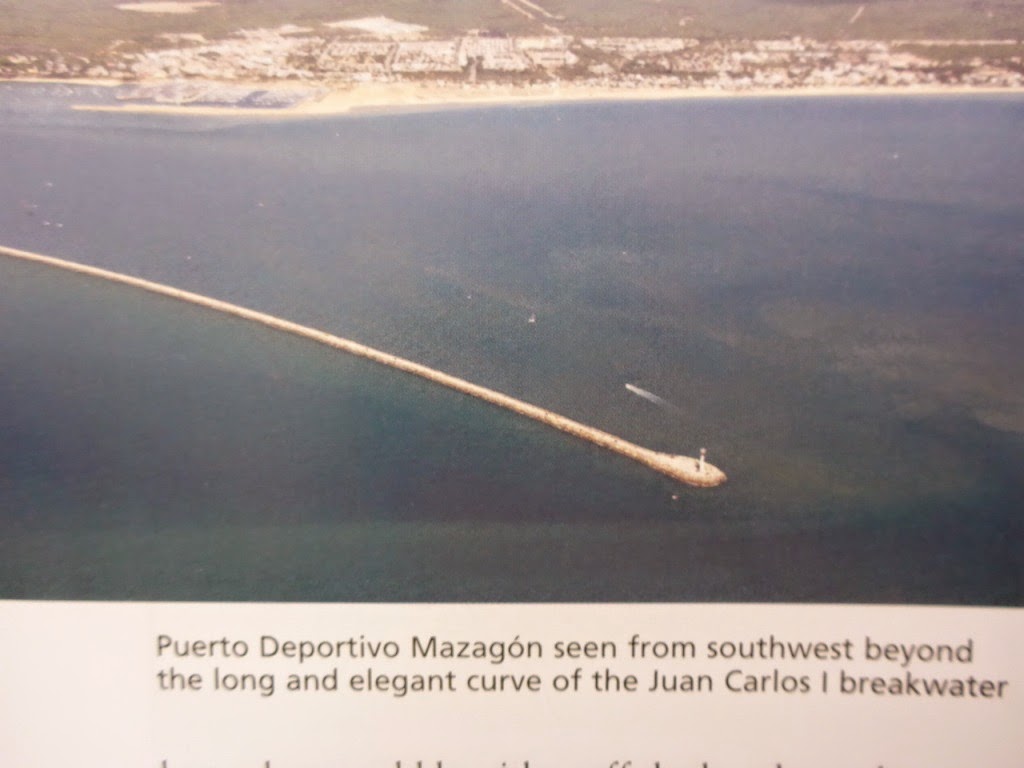
La jetée fait 10 km
The breakwater is 10 km long


Capucine
Nasturtium
Blomkarse
Tropaeolum
02.02.2015. Mazagón