Thursday, 10 July 2014

09.07.2014 Dublin

Mercredi 9 Juillet 2014

Le mardi à Campbeltown, Jens est allé porter une lessive à laver, a fait des courses (beaucoup de nourriture mangeable en route: noix, yaourts, soupes …) et ensemble, nous sommes alles faire le plein de diesel. La pompe est utilisée habituellement par des grands navires, on se sent un peu petit en bas de ce grand quai. J’ai écrit le blog du lundi. Il pleuvait très fort et la ville, toute grise, n’était pas folichonne. Je suis allée acheter un nouveau pantalon, d’abord dans une boutique de la Croix Rouge (habits usagés) mais je n’ai pas trouvé et ensuite à la ”Factory Shop”, une sorte de Sparkjøp, boutique bon marchée. Je me suis acheté un beau blue-jeans pour 12 pounds, (120 kr ou 15€). Nous faisons une petite promenade à Campbeltown, il fait beau maintenant puis nous mangeons un bon lunch et partons à 14 h. Nous passons le phare de Campbeltown qui nous avait si reconfortés en 2012 après une longue traversée, des Iles Scillies (au sud-ouest de l’Angleterre) jusqu’à Campbeltown (65 h, je crois). D’abord très calme dans la baie et sur le Firth of Clyde, le grand ”fjord” qui nous mène au nord de la mer d’Irlande. Il débouche sur le North Channel, l’endroit étroit où l’Atlantique “rentre” dans la mer d’Irlande. C’est un endroit reputé pour ses courants très fort, d’où l’importance de partir au bont moment. Le vent souffle du nord-ouest, assez variable, entre force 2 et 4, parfois 5. La météo a annoncé des pointes à 6, ce que je n’aime pas beaucoup, mais en fait on ne les a que rarement et très courtes. Les vagues sont courtes et, me semble-t-il, plus “méchantes” que les grandes vagues de la mer du Nord. Maja et Jens vont bien, mais je ne me sens pas très à l’aise. En plus, Jens m’annonce que la corde qui relie la grand voile à la bôme est un peu cassée. Peut-être est-ce la combinaison de tout cela, mais j’ai peur et ai une espèce d’attaque de panique. Pas rigolo. Je sais qu’il n’y a pas de danger, je me répète: “Maja va bien, Maja va bien” mais cela n’aide pas. Je me couche, ai froid, tremble etc… Et cela dure un bon moment. Jens fait chauffer une soupe mais je n’ai guère faim. A la fin je m’endors. A 22 h, je me réveille et prends une pillule contre le mal de mer. Ça aide, je relaxe un peu et peux reprendre mon poste. Jens a barré tout seul depuis 14 h jusqu’à 23 h 30, maintenant il faut que j’y aille. Nous sommes plus au sud, le vent a baissé  et les vagues sont moins grandes. Mais nous avons le courant contre nous et nous n’avançons pas vite. Nous allons à la voile quand il y a assez de vent et démarrons le moteur (en gardant les voiles) quand le vent baisse. La nuit passe tranquillement. Nous longeons la côte d’Irlande et voyons bien les lumières de Belfast et, en plus, nous avons un beau clair de lune. La journée de mercredi se passe bien. Nous pouvons nous faire un vrai petit-déjeuner, du thé et un knekkebrød (du pain craquant). Il fait beau, la mer est plus calme et nous avançons bien. J’ai retrouvé mon calme.
Nous arrivons à l’entrée de la baie deDublin à 16 h mais il faut encore naviguer au moins 1 h 30 pour atteindre la marina au fond de la baie. Un chenal est réservé aux grands navires et les bateaux de plaisance doivent le longer au sud. Comme nous arrivons du nord, il faut donc croiser ce chanal. Le traffic est dense. Il faut attendre un moment calme, entre des grands navires, pour traverser. Cela se passe très bien. Nous reconnaissons les deux cheminées qui étaient notre marquee de reconnaissance quand nous allions en vélo. Le port est animé, l’Irlande étant une ile et commerçant principalement par bateaux. La marina est au fond du port, sur le côté du dernier basin. De l’autre côté du bassin, on voit un traffic incessant de containeurs-ships et de ferries.
Nous atteignons la marina “Poolbeg Yacht and Boat Club” à 18 h. Elle parait pleine, mais le “commodore” (le chef de la marina) vient nous dire qu’il y a une place à l’intérieur. Il nous attend, prend nos cordes et nous souhaite la bienvenue. Deux minutes après un “gentleman” vient nous souhaiter aussi la bienvenue, c’est le monsieur qui nous avait emmenés à Howth en juillet 2012 pour acheter du materiel. Plusieurs personnes nous reconnaissent et nous disent bonjour. Nous allons nous inscrire au bar-bureau et un autre gentleman nous paye une … Guiness, bien sûr. Accueil très sympathique.
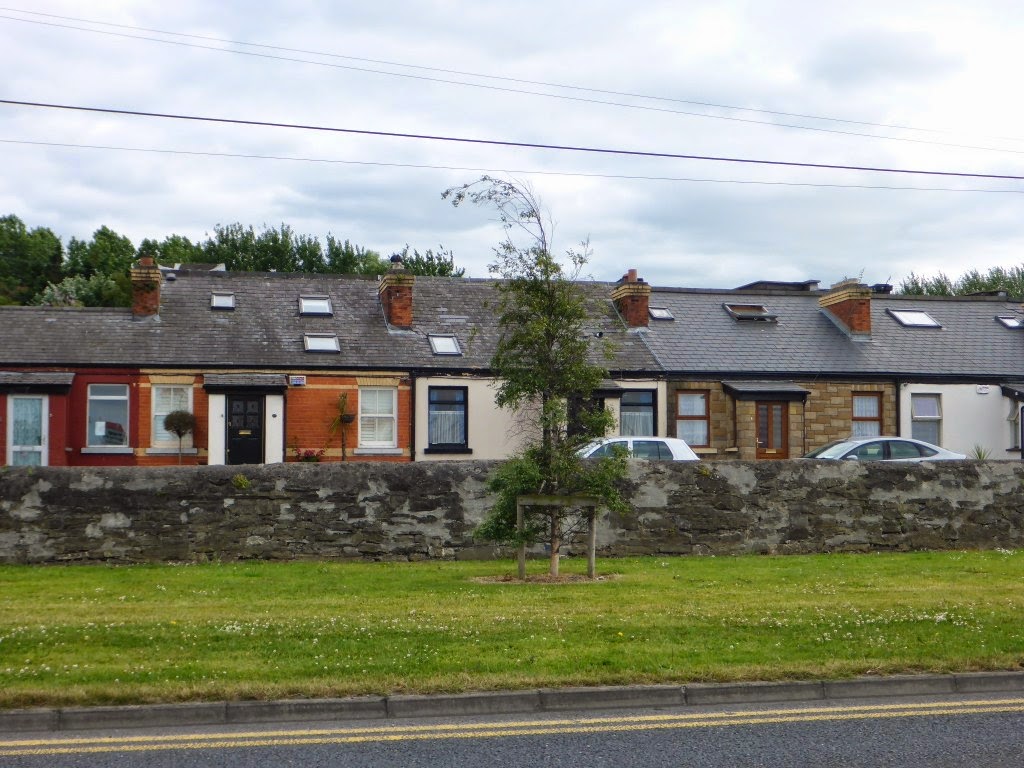
Petite promenade dans le village de Ringsend (qui est une partie de Dublin maintenant). Nous revoyons les toutes petites maisons mitoyennes le long du port. Nous passons par le parc et sommes surprise de voir tant de monde dehors. Il fait beau et assez chaud, 21 ⁰.
Nous sommes bien fatigués et la promenade est courte. J’écris deux lignes sur le blog pour dire que nous sommes bien arrivés à Dublin.Diner dehors sur Maja au soleil, après diner un vieux Maigret pour Jens et un sudoku pour moi, mais à 22 h, on ne tient plus, on va se coucher. 

Wednesday, July 9, 2014

Tuesday at Campbeltown, Jens went to a laundry to wash clothes, has been shopping (lots of food for the trip: nuts, yogurt, soups ...) and together we went to fill up with diesel. The pump is usually used by large ships, we felt small down this large dock. I wrote the blog for Monday. It was raining heavily and the city, all gray, was not very engaging. I went to buy new pants, first in a shop of the Red Cross (used clothes) but I didn’t find my size and then to the "Factory Shop", a kind of Sparkjøp, cheap shop. I bought beautiful jeans for 12 pounds (120 kr or 15 €). We went for a short walk in Campbeltown, it is sunny now, then we eat a good lunch and left at 2 pm. We passed the Campbeltown lighthouse which had so comforted us in 2012 after a long voyage, the Scillies Islands (south-west of England) to Campbeltown (65 hours, I think). At the start it is very quiet in the Bay and on the Firth of Clyde, the great "fjord" which leads us to the northern Irish Sea. It leads to the North Channel, the narrow place where the Atlantic "enter" in the Irish Sea. It is a place known for its strong currents, hence the importance of timing it right with the tide. The wind blows from the northwest, quite variable, between strength 2 and 4, sometimes 5. The weather forecast announced peaks at force 6, I do not like that very much, but in fact we had only rarely 6 and for very short periods . The waves are short, and for me they seems more "evil" than the big waves of the North Sea. Maja and Jens are going well, but I do not feel very comfortable. In addition, Jens told me that the rope that connects the mainsail to the boom is a bit broken. Perhaps this is the combination of all this, but I'm afraid and have a kind of panic attack. Not funny. I know that there is no danger, I repeat: "Maja is doing well, Maja is doing well" but that does not help. I am cold, trembling, tense etc ... I lie down. And it lasts a long time. Jens heats a can of soup but I am not hungry. At the end I fall asleep. At 22 pm, I wake up and take a pill against seasickness, it helps, I relaxe a bit and can resume my post. Jens has been at the wheel  alone from 2 pm to 11:30 pm, now I must go back to work. We are further south, the wind has dropped and the waves are smaller. But we have the current against us and we are not moving fast. We sail when there is enough wind and just start the engine (keeping the sails up) when the wind drops. The night passes quietly. We pass along the coast of Ireland and clearly see the lights of Belfast and, in addition, we have a beautiful moonlight. Wednesday goes well. We can get a real breakfast, tea and knekkebrød (crispbread). It is beautiful, the sea is calm and we are doing well. I regain my calm.
We arrive at the entrance of the Dublin bay at 4 pm but we have to navigate at least 1 h and 30 minutes to reach the marina at the bottom of the bay. A channel is reserved for large ships and pleasure boats must not use it but follow it a little south. As we come from the north, it is necessary to cross this channel. The traffic is dense. We have to cross at a quiet moment between large vessels to pass through. This is going very well. We recognize the two tall chimneys which were our marks when we went by bike. The port is busy, Ireland is an island and traders mainly by boats. The marina is at the bottom of the port on one side of the last basin. On the other side of the basin, we see a constant traffic of containers-ships and ferries.
We reach the marina "Poolbeg Yacht and Boat Club" at 6 pm. It seems full, but the "Commodore" (the head of the marina) tells us that there is a place inside. He is expecting us, takes our ropes and wishes us welcome. Two minutes later a "gentleman" comes also to welcome us, the man who took us in his car to Howth in July 2012 to buy equipment. Many people recognize us and say hello. We register at the bar-office and another gentleman pays us a ... Guinness, of course. Very friendly welcome.
Stroll through the village of Ringsend (which is now part of Dublin). We see again all the small terraced houses along the harbor. We go through the park and are surprised to see so many people out. It's nice and warm enough, 21 ⁰.
We are very tired and the walk is short. I write two lines on the blog to say that we have arrived at Dublin. Diner on Maja out on the sun, after that an old Maigret for Jens and a sudoku for me, but at 10 pm, we can’t stay awake anymore and we go to bed.


Nous prenons du diesel
We take diesel


Promenade. Campbeltown
Walk


Un bateau de Bergen
A ship from Bergen


Le phare. Campbeltown
The lighthouse


Belle lune et lumières de Belfast
Beautiful moon and Belfast lights
  

Un fou de Bassan
A gannet


La bouilloire est bien fixée
The kettle is well fixed


Tout est dans l'évier
Everything is in the sink


Belle mer
Nice sea


Mon travail: monter le pavillon de courtoisie d'Irlande
My jobb: to raise the Irish courtesy flag


Les bateaux se suivent pour rentrer dans le port de Dublin
The ships are following each other to enter Dublin harbor


Les deux grandes cheminées, marque pour les marins et les cyclistes
The two tall chimneys, seamen and cyclists' mark


Il nous souhaite la bienvenue
He welcomes us


Déjà au bar
Allready in the bar


Maja


Les petites maisons
The small houses


Club Med 2. Dublin


Wednesday, 9 July 2014

09.07.2014 Dublin

Juste un mot pour dire que nous sommes bien arrivés à Dublin aujourd'hui mercredi 9 juillet à 18 h. Partis à 14 h de Campbeltown  le mardi, donc après 28 h de navigation.
Plus de détails demain.

Just a word to say that we arrived safely today, wednesday at Dublin at 6 pm. We left Campbeltown at 2 pm yesterday, which means we have sailed 28 h.
More details tomorrow


Tuesday, 8 July 2014

08.07.2014 Campbeltown- ?

Mardi  8 Juillet.

Il a plu toute la nuit et toute la matinée mais maintenant il fait beau.
Nous partons à 15 h, pour avoir le courant avec nous. Allons vers le sud. Essayons de faire un grand bout. Bonne météo, vent du nord, pas trop fort.

A bientôt

Tuesday, July 8

It has been raining all night and all this morning but now it is sunny.
We are leaving at 3:00 pm to have the current with us. We are going south. We will try to make a long leg. The wether forecast is good, light to moderate wind from the north.

We will be in touch later on.


07.07.2014 Campbeltown 55 25 N 05 32 W

Lundi 7 Juillet 2014

Averses et éclaircies, vent variable du sud-ouest. Nous allons prendre le petit-déjeuner à un café. On peut prendre le “full English breakfast”: œufs, bacon, saucisses, boudin (!) et haricots. Mais on s’en tient au plus léger œufs et toasts. Le café est agéable et apparemment populaire avec les chauffeurs de bus et camions. Ils viennent acheter leur petit-déjeuner qu’ils emportent.
Nous sommes prêts tôt mais un bateau qui rentre dans le canal prend un temps fou. On attend plus d’une heure avant de partir. Les Suisses sortent aussi et nous allons parallèlement un moment. Mais ensuite ils prennent un autre fjord, plus large et plus à l’est. Ils n’ont pas envie de prendre le même fjord que nous, plus étroit et donc avec plus de courant. Mais aujourd’hui, avec ce vent faible et un coefficient faible de courant, il n’y a pas de probleme. Nous allons au moteur et c’est très calme tout le long, je peux même écrire le blog d’hier.
Nous sommes partis à 11 h et arrivons à Campbeltown exactement à 18 h. Nous reprenons presque la même place au ponton. D’autres voiliers arrivent après nous et le pontoon est plein. Petit tour en ville, nous reconnaissons la ville, nous étions passés ici en remontant de France en septembre 2012. Un cargo norvégien de Bergen est dans le port.
Nous allons diner au Royal Hotel, Jens prend un plat typiquement écossais, du haddock pané dans une panure à la bière et je prend de l’agneau. Mais quand la serveuse apporte le poisson de Jens, elle demande pour qui est le “fish and chips”. Et c’est vrai que malgré son nom “fancy”, c’est juste un fish and chips.
Après diner nous faisons une longue promenade le long de la baie. Campbeltown est au fond d’une baie, bien protégée et une belle promenade suit la baie. Il fait doux et il ne pleut pas. De grandes et belles maisons sont au bord de la mer alors qu’en ville cela ne fait pas riche, de nombreuses boutiques sont fermées et les maisons et immeubles sont gris, gris.

Monday, July 7, 2014

Showers and clear spells, light  wind from southwest. We take breakfast at a cafe. You can take the "full English breakfast": eggs, bacon, sausages, black pudding and beans (!). But we stick to lighter eggs and toast. The cafe is very cozy and apparently popular with buses and trucks’ drivers. They come to buy their breakfast and take it out.
We are ready early, but a boat entering the canall takes a long time. We wait more than one hour before leaving. The Swiss leaves also and we have a parallel course. But then they take another fjord, wider and farther east. They did not want to take the same fjord as us, narrower and therefore with more current. But today, with the weak wind and a low coefficient of current, there is no problem. We go with the engine and it is very quiet all along, I can even write the blog for yesterday.
We left at 11 am and arrive at Campbeltown exactly at 6:00 pm. We take almost the same place at the pontoon. Other yachts arrive after us and soon the pontoon is full. Small walk in town, we recognize the city, we passed her going back to France in September 2012. A Norwegian cargo ship from Bergen is in the harbor.
We  dine at the Royal Hotel, Jens takes a traditional Scottish dish of breaded haddock in a beer batter and I took the lamb. But when the waitress brings the fish to Jens, she asks who has ordered the "fish and chips". And it is true that despite the fancy name, it's just a fish and chips.
After dinner we take a long walk along the bay. Campbeltown is at the bottom of a bay, well protected and a beautiful promenade follows the bay. It is not cold and it is not raining. Large and beautiful houses are along the sea while in town small hoses look much poorer, many shops are closed and the houses and buildings are gray, gray.


Le/the café. Ardrishaig


Dernière écluse
Last lock


Jens a grimpé cette échelle en sept. 2012
Jens has climbed this ladder in sept. 2012


J'écris le blog en route
I am writing the blog under way


Belle campagne avant Campbeltown
Nice countryside before Campbeltown


Phare à l'entrée de la baie à Campbeltown
Lighthouse at the bay entrance, Campbeltown


Un côté est navigable, l'autre non (pas de profondeur)
One side is navigable, the other no (shallow water)


C'est un mannequin


Maja. Campbeltown


Campbeltown


Un drôle d'engin sur le port
A strange thing in the harbor


Bonne nuit, les mouettes
Good night, seaguls


Campbeltown by night


Monday, 7 July 2014

06.07.2014 Ardrishaig 56 00 N 78 05 W

Dimanche 6 Juillet 2014

Il fait beau. Après une bonne douche, nous partons à 8 h 45, deux bateaux sont avec nous dans la première écluse, un Norvégien et un Suisse. C’est un peu serré mais avec des “fenders” (défenses?) partout, ça va. Le canal de Crinan ne fait que 15 km mais il a 15 écluses qu’il faut opérer nous-mêmes. Donc on n’a pas le temps de s’ennuyer. Tout est plus petit que sur le Canal de Calédonie: il est plus étroit, moins profond et les écluses sont plus petites. Mais il est est très joli, plus bucolique.
Une pancarte annonce un pont et c’est écrit qu’il faut klaxonner pour que le pont s’ouvre. Jens est tout fier d’utiliser sa corne de brume (je ne sais pas si le klaxon s’appelle comme ça, mais ça fait bien) et le pont s’ouvre.
A la deuxième écluse, il faut attendre, un bateau descend. Nous nous amarrons à un pontoon tous les trois et attendons. Un bonhomme vient nous dire que lui aussi attend et que, malheureusement, son bateau est si grand qu’il occupera toute la place et que, nous trois, nous devrons attendre. Mais Jens et le Norvégien protestent, ce n’est pas vrai. On trouve un compromis: le bateau suisse va aller avec lui et nous, les deux Norvégiens, nous attendons encore. Bon arrangement. Ellida 6 (le bateau norvégien) et nous allons passer presque toutes les écluses ensemble, sauf la dernière. A la première écluse où nous allons ensemble, Ellida 6, qui est un grand voilier (44 pieds), rentre d’abord et nous après. Mais on est vraiment serré. Donc on change de tactique: à l’écluse suivante, nous rentrons d’abord et lui ensuite, et cela va beaucoup mieux. C’est très sympa, il fait beau et ils ont un volontaire qui ouvre et ferme les portes et emplit les basins. Quand nous sommes en haut d’une écluse et que Jens peut aller à terre, il va l’aider. Mais c’est du travail, même pour moi qui ne pousse aucune porte (sauf une fois pour faire une photo!). On grignote une tartine en route, vite, vite, entre deux écluses. Le temps passe vite. C’est dimanche et les gens se promènent ou font du vélo sur le chemin de hallage.
Ellida 6 va sortir du canal et continuer vers Tarbert, deux heures plus loin. Nous, nous allons passer la nuit dans le dernier bassin du canal, à Ardrishaig. Les Suisses, que nous retrouvons à la dernière écluse,aussi. Quand Ellida 6 passe et sort, nous leur souhaitons bon vent, nous avons eu une excellente coopération avec eux.
Il n’est que 15 h 30, mais on se sent fatigue. Quand on demande au Suisse s’il va continuer, il répond qu’il a faim, soif et qu’il en a eu assez pour aujourd’hui.
Mais ils ont un problem: ils n’ont plus de bière. Nous les invitons donc à partager notre “ankerdram”.
Jens va faire des courses pendant que je fais le blog, une petite Coop est ouverte puis il nous mijote un bon petit diner. Nous sommes bien fatigues. Une petite promenade et au lit à 22 h 30.
Pour la première fois, j’écris ce blog en route, le lundi 7 juillet, entre Ardrishaig et Campbeltown. C’est assez calme et bien que le bateau bouge un peu, je peux écrire sans avoir le mal de mer.

Sunday, July 6, 2014

A new sunny day. After taking a shower, we leave at 8:45 am, two boats are with us in the first lock, a Norwegian and Swiss. It is a little tight but with fenders everywhere it is OK. The Crinan Canal is only 15 km long but it has 15 locks that we must operate ourselves. So we don’t have time to get bored. Everything is smaller than on the Caledonian Canal: it is narrower, shallower and the locks are smaller. But it is very pretty, more bucolic.
A sign announces a bridge and it says you need to honk for the bridge to open. Jens is proud to use his foghorn (I do not know if the horn is called that, but it sounds real maritime) and the bridge opens.
At the second lock, boat is going down. We moor at a pontoon all three and wait. A guy tells us that he also is waiting to go up and that, unfortunately, his yacht is so large that she will occupy all the space in the lock and that the three of us will have to wait another turn. But Jens and Norwegian protest, this is not true. They find a compromise: the Swiss boat will go with him and we, the two Norwegians, will wait. Good arrangement. Ellida 6 (the Norwegian boat) and we pass almost all the  locks together, except the last one. At the first lock where we go together, Ellida 6, which is a big yacht (44 feet), comes first and we second. But it is really tight. So we changed tactics: the next lock, we go first and then her, and it is much better. It works very well and they have a volunteer who opens and closes doors and filled the basins. When we are up a lock Jens can go ashore and helps him. But it is hard work, even for me who don’t push door (except once for a photo!). We nibble a sandwich under the way, quickly, between two locks. Time flies. It's Sunday and people walk or ride bikes on the towpath.
Ellida 6 wants to go out of the channel and continue to Tarbert, two hours south. We are going to spend the night in the last canal basin, Ardrishaig. The Swiss, we meet again in the last lock, too. When Ellida 6 passes on her way out, we wish them good luck, we had excellent cooperation with them.
It is only3:30 pm, but we feel tired. The Swiss, when asked whether he will continue, answered that he is hungry, thirsty and he has had enough for today.
But they have a problem: they have no more beer so we invite them to share our "ankerdram".
Jens goes shopping while I write the blog, at a small Coop which is open then prepares us a nice dinner. We are tired. A short walk and in bed at 10:30 pm.
For the first time, I start writing this blog on Monday, July 7, between Ardrishaig and Campbeltown. It's pretty quiet and the boat moves just a little, I can write without being seasick.


Crinan canal


Canal Crinan


Ellida 6 et nous
Ellida 6 and us


Belles fleurs
Beautiful flowers


On est vraiment serré
We are quite tight


Comme cela, ca va mieux
It is better this way


Jens pousse pour ouvrir une porte d'écluse
Jens i pushing to open a lock gate


Il ouvre l'entrée de l'eau dans l'écluse
He is opening the flow of water into the lock


Je pousse (juste pour la photo)
I am pushing (just for the picture)


Ellida 6 continue(s)


Ardrishaig


Sunday, 6 July 2014

05.07.2014 Crinan 56 05 N 05 33W

Samedi 5 juillet 2014

Jens a calculé qu’il faut partir Vers 11 h pour avoir le courant avec nous. Les gens de White Lady (des Shetland) viennent nous voir, nous leur montrons Maja et nous buvons une tasse de thé (turc) ensemble. Nous sympathisons bien. A 11 h nous partons. Plusieurs bateaux sortent aussi, c’est bon signe. Il fait beau, peu de vent. Le début est très tranquille, au moteur. Nous passons Oban, où nous nous étions arrêtés il y a deux ans. Nous étions à la marina sur une ile en face d’Oban. Nous continuons et arrivons dans un endroit aux courants très forts. Sur la carte, il y a même de symboles (un petit tortillon) de tourbillons dangereux. Mais aujourd’hui. Il y a peu de courant et peu de vagues. Mais nous le sentons quand même. L’eau bouillonne et Maja va à plus de 10 nœuds. Nous arrivons à Crinan à 15 h 40. Nous devons attendre 15 minutes avant de pouvoir rentrer dans l’écluse où nous sommes avec un voilier Suisse. Nous montons une écluse et décidons de passer la nuit dans le basin à Crinan. Nous prenons un café sur le quai puis nous allons faire une promenade le long du canal et revenons par la forêt. La soirée est calme et ensoleillée. La dernière fois ici que nous étions ici, avec Petter et Kirsten, il pleuvait.

Saturday, July 5, 2014

Jens has calculated we must leave at 11 am to have the current with us. The people from White Lady (Shetland) come to visit us, we show them Maja and we drink a cup of (Turkish) tea together. We sympathize well. At 11 am we leave. Several boats leave too, is a good sign. The weather is nice, little wind. The beginning is very quiet, with the engine. We pass Oban, where we stopped two years. We were at the marina on an island in front of Oban. We continue and arrive in an area with very strong currents. On the map, there are even symbols for dangerous whirlpools. But today, there is no danger, there is little current and small waves. But we feel it the same. Water bubbles and Maja goes over 10 knots. We arrive at Crinan at 3:40 pm. We have to wait 15 minutes before going into the lock where we are with a sailboat from Switzerland. We climb a lock and decide to spend the night in the basin at Crinan. We have coffee on the dock and then we'll take a walk along the canal and back through the forest. The evening is calm and sunny. Last time we were here, with Petter and Kirsten, it was raining.


Andrew, Linsey, Barry. Shetland


Oban


La marina sur l'ile en face d'Oban
The marina on the island in front of Oban


Un phare
A lighthouse


Le courant
The current


10,2 noeuds
10,2 knots


Les tortillons symboles de turbulences
The rounds signs, symbols of turbulences


L'entrée du canal à Crinan
The canal entrance at Crinan


Il y a 15 écluses sur le canal de Crinan
There is 15 locks on the Crinan canal


Promenade dans la forêt
Walk in the forest


Très beau paysage
Beautiful landscape


Soirée calme dans le bassin de Crinan
Quiet evening in the Crinan bassin