Vendredi 7 mars 2017
Jens parle avec le « capitaine » d’un voilier de 12 m, arrivé hier soir. Ils ont passé
le Détroit de Gibraltar hier, par très fort vent, F 8-9 et vagues de 3-4m. Une
vague a rempli leur cockpit. Il faut être fou ! Nous discutons, partir ou
ne pas partir. Jens parle avec un marinero, un voisin et les deux disent que
même avec un fort vent les vagues ne seront pas très grandes. Et ce matin, ici,
il y a peu de vent. Je me laisse convaincre … Et nous partons à 9 h 30. Déjà
pour sortir du port, il faut passer les vagues de face, Maja monte et descend,
et en plus, les pêcheurs ont installé un grand filet à thon tout près de la
sortie du port. Barbate est un grand centre de la pêche au thon. Ce filet fait
2 km. Nous passons près de la bouée orange qui en marque la fin. Puis nous
tournons vers le nord-ouest. Au début, peu de vent puis le vent augmente, c’est
une alternance de coups de vent et de périodes plus calmes. Mais les acalmies
se font de plus en plus rares et nous avons un fort vent tout le reste du
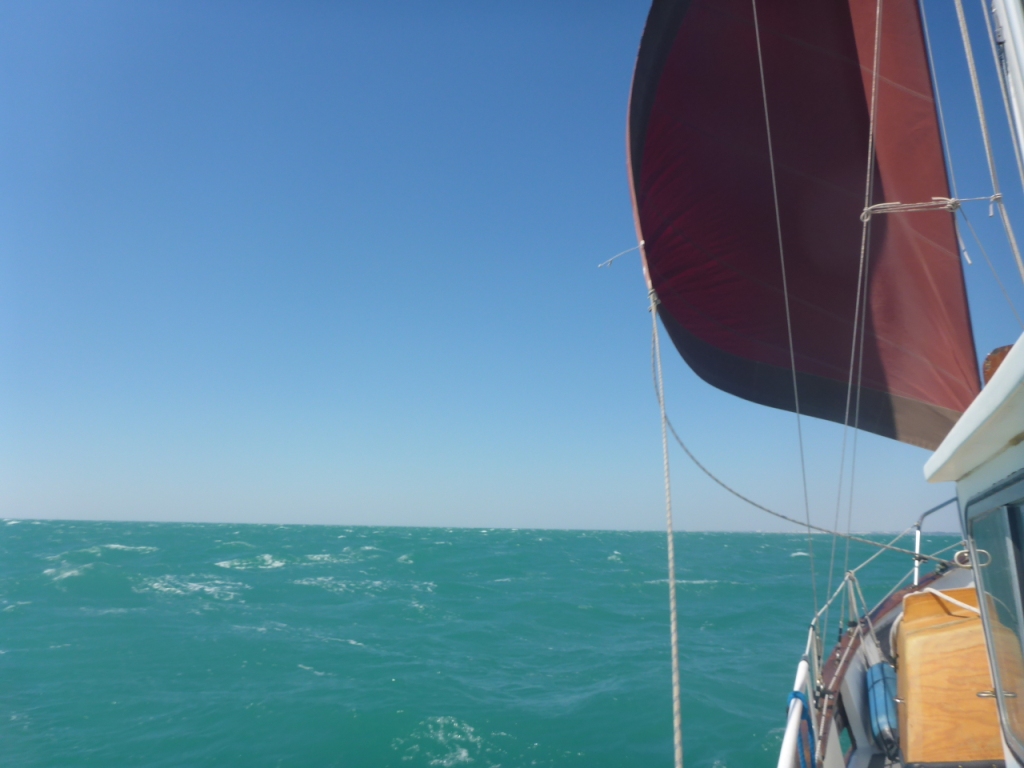
chemin. Nous allons avec le foc seulement et avons une bonne vitesse. Nous
entendons un échange entre deux navires ancrés, peut-être à Gibraltar. L’un prévient
l’autre que son ancre chasse et qu’il n’a pas de moteur, un mécanicien est en
train de faire des réparations. Et l’autre répond que lui non plus n’a pas de
moteur, pour la même raison. On ne sait pas ce qui est arrivé après. Pour
passer le phare de Trafalgar, il faut aller loin en mer, il y a des rochers. Et
là, comme nous sommes plus loin de la terre, donc moins protégés, les vagues
sont plus grosses, 2m, Jeannette est dans son trou. Jens barre beaucoup
manuellement, le pilote a du mal. La roue (le volant) aussi a du mal et fait
des drôles de bruit. Je me pense : « Pourvu qu’elle ne nous
lâche pas », mais en fait on a la barre franche, la barre directe, dehors,
en réserve. Quand nous sommes entre Barbate et Trafalgar, nous somme presque
vent arrière et le foc, par moment, fasseye (c’est le mot qu’on utilisait en
dériveurs et je m’en rappelle encore, depuis les années 70 !),
c'est-à-dire se gonfle et se dégonfle, ne sait pas s’il va être à droite ou à
gauche. Et quand il se regonfle, cela donne un coup violent, cela ne doit pas
être bon pour le mât. Il faut que tout soit vraiment solide, la force du vent
et les mouvements des vagues font une pression énorme. Puis après Trafalgar,
nous tournons plus vers le nord et avons le vent plus sur le côté. Maja est
alors mal équilibrée, dans les coups de vent, elle remonte vers le vent. Jens
réduit alors le foc et cela va mieux. Il s’aperçoit aussi que l’hélice n’est
pas dans une bonne position. Normalement, quand on va à la voile, on la met en
position de marche arrière, mais avec ce vent, cela n’a pas l’air d’aller bien.
Il la met en marche avant et cela va mieux. A un moment, il voit sur la carte
encore un grand filet pour les thons. Sur la carte, on peut passer entre le
filet et la terre. Mais le filet n’est pas exactement où il doit être et il n’y
a pas beaucoup de place entre lui et la terre. Il n’est pas question, avec ce
vent, de retourner plus loin en mer pour le passer et Jens décide donc de
passer dessus. Nous allons à la voile, donc l’hélice ne tourne pas et ça passe.
Nous déjeunons de knekkebrød et d’eau. La radio annonce, toutes les
demi-heures, un avis de grand frais (force 8) pour la zone Détroit de
Gibraltar-Cadíz, juste où nous sommes et on ne comprend pas bien pour quand.
Cela ne remonte pas le moral de la matelote. En parlant de matelote, je pense à
mon amie Margret de « Longway » qui connait toutes ces émotions. Nous
approchons de la Baie de Cadíz, immense baie. Nous espérions que dans la baie
nous serions un peu à l’abri, mais pas du tout. La baie est orientée
nord-ouest/sud-est et pour aller à la
marina nous tournons vers le sud-est, exactement contre le vent. Et le vent est
maintenant force 7, heureusement les vagues sont petites. Mais aller contre un
force 7, ce n’est pas évident. Il faut mettre bien plus de puissance que
normal, sinon on n’avance pas. Le vent nous envoie des embruns qui passent sur
la cabine de pilotage et arrivent jusque dans le cockpit. J’en connais une qui
sera bien contente d’arriver. Nous
avançons lentement mais enfin on arrive à l’entrée de la marina « Puerto
America » qui est très étroites et avec ce vent et les vagues, il faut bien
viser. Mais Jens connait bien sa Maja et nous passons, enfin plus de vagues,
mais toujours un vent violent. Jens téléphone et le gars dit d’abord d’aller au
quai d’attente, donc s’amarrer là et se ré-amarrer une deuxième fois. Jens
demande si on peut aller directement à une place et il est d’accord. Deux
marineros nous attendent et nous amarrent. Il est 17 h 30. Ouf !
Ouf ! Ouf ! Rude journée pour la reine, encore. J’ai décidé, quand
j’étais dans mon trou, qu’en deux jours (le Détroit de Gibraltar et
aujourd’hui), nous avons fait notre quota de forts vents pour un mois. Qu’on se
le dise.
Distance Barbate-Cadiz: 36 mn/nm
Total Bergen-Cadiz:7830 mn/nm (14 094 km)
Friday, March 7, 2017
Jens speaks with a yacht
"captain", a 12 m boat, arrived last night. They passed the Strait of
Gibraltar yesterday, by very strong wind, F 8-9 and waves of 3-4m. A wave
filled their cockpit. They must be crazy! We discuss, to leave or not to leave.
Jens talks with a marinero, a neighbor and both say that even with a strong
wind the waves will not be very large. And this morning there is little wind. I
let myself be convinced ... And we leave at 9:30 am. Already to leave the
harbor, we have to pass the waves from the front, Maja goes up and down, and in
addition, the fishermen have installed a large tuna net near the harbor exit.
Barbate is a great center for tuna fishing. This net is 2 km long. We pass by
the orange buoy that marks its end. Then we turn northwest. In the beginning,
little wind then the wind increases, it’s an alternation of strong winds and
calmer periods. But the acalmies are becoming more and more rare and we have a
strong wind all the rest of the way. We go with the jib only and have a good
speed. We hear an exchange between two anchored ships, perhaps in Gibraltar.
One warns the other that his anchor is dragging and that he has no engine, a
mechanic is doing repairs on it. And the other replies that he also had no
engine, for the same reason. We don’t know what happened afterwards. To pass Trafalgar
light house, you have to go far at sea, there are rocks. And there, as we are
farther away from land, therefore less protected, the waves are bigger, 2m, Jeannette
is in her hole. Jens is steering mostly manually, the auto-pilot has problem.
The steering wheel also has trouble and makes strange noises. I think by
myself: "I hope that it will not
let us down," but in fact we have the tiller, outside, in reserve. When we
are between Barbate and Trafalgar, we are almost downwind and the jib, at times,
inflates and deflates, doesn’t know whether it
will be on the right or or on the left. And when the wing fills it up again, it
gives a violent blow, it must not be good for the mast. Everything must be
really solid, the force of the wind and the movements of the waves put enormous
pressure on the boat. Then after Trafalgar, we turn more towards north and have the wind
more on the side. Maja is then badly balanced, in the gusts, she turns towards
the wind. Jens then reduces the jib and it gets better. He also realizes that
the propeller is not in a good position. Normally, when we are sailing, we put
it in the reverse position, but with this wind, it doesn’t work. He puts it in
forward position and it gets better too. At one point, he sees on the map another
large net for tuna. On the map, you can pass between the net and land. But the
net is not exactly where it should be and there is not much room between it and
the land. There is no question, with this wind, to go back to sea to pass it
and Jens decides to pass on. We are sailing, so the propeller doesn't turn and
we pass. We have lunch of knekkebrød and water. The radio announces, every half
hour, a “gale warning” (force 8) for the Strait of Gibraltar-Cadiz area, just
where we are and we don’t understand well for when. That doesn’t help with the
matelote’s moral. Speaking of matelote, I think of my friend Margret of
"Longway" who knows all these emotions. We approach the bay of Cadiz,
immense bay. We hoped that in the bay we would be a little protected, but not
at all. The bay is oriented north-west / south-east and to go to the marina we
turn towards southeast, exactly against the wind. And the wind is now force 7,
fortunately the waves are small. But going against a force 7 is not obvious. We
have to put more power than normal, otherwise we do not move forward. The wind
sends us sprays that passe on the cockpit and arrive in the cockpit. I know one
who will be very happy to arrive. We go slowly but finally we arrive at the marina
"Puerto America" entrance which is very narrow and with this wind
and these waves, you have to aim. But Jens knows his Maja well and we pass, no
more waves, but still a violent wind. Jens phones and the guy says first to go
to the waiting dock, so we have to dock there and then move to our place. Jens
asks if we can go directly to a place and he agrees. Two marineros await us and
take our lines. It's 5:30 pm. Phew! Phew! Phew! Hard day for the queen, again.
I decided, when I was in my hole, that in two days (the Strait of Gibraltar and
today), we made our quota of strong winds for one month. That’s Jeannette’s
law.

Bye, bye Barbate
La bouée otage qui marque la fin du long filet à thons
The orange buoy which marks the end of the long tuna net
La tour del Tajo, où nous sommes allés en vélo
The Tajo tower, where we have been on bike
Le phare de Trafalgar
Trafalgar light house
Vagues
Waves
A gauche
To the left
A droite
On the right
Une vague
A wave
Fort de Santi-Pietri
Santi-Pietri fort
Le foc réduit
The reduced jib
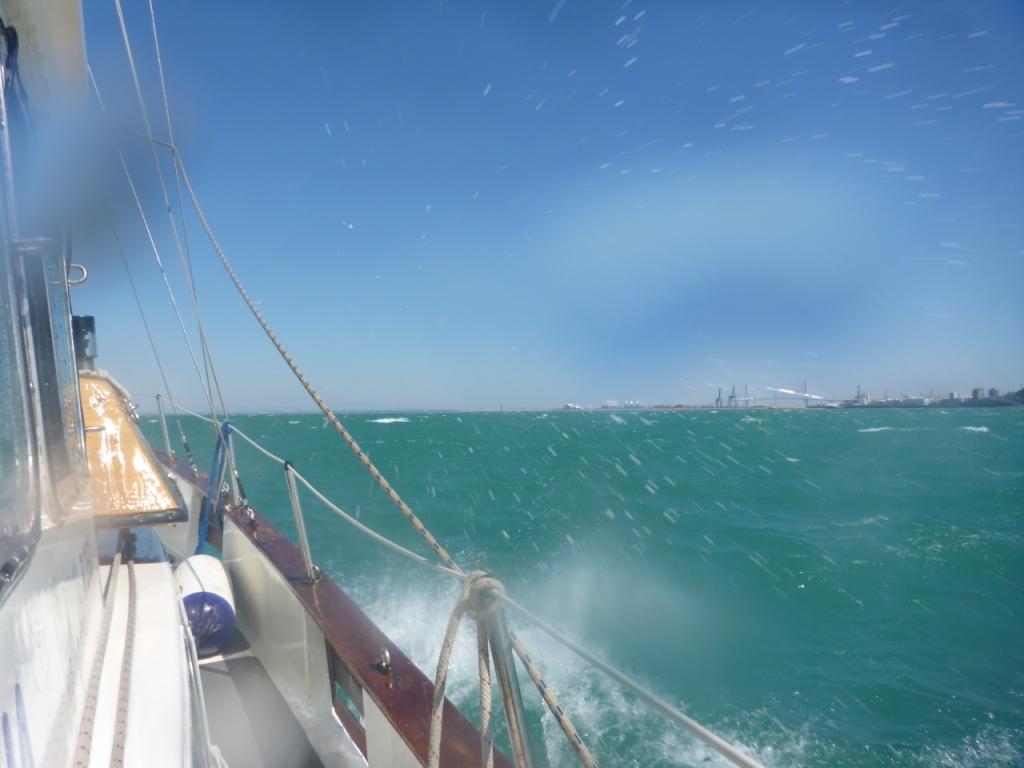
On voit de loin le nouveau pont de Cadiz
Il n'était pas fini en février 2015
We can see from a long distance Cadiz new bridge
It was not finished in February 2015
Cadiz
On approche doucement de la jetée
We are approching slowly the sea wall
Nous allons contre le vent
We are going against the wind
Enfin au port
At least in the harbor
Maja
Une petite promenade pour se dégourdir les jambes
A short walk to stretch our legs
Un Anglais arrive après nous
An English yacht arrives after us
06.04.2017. Vejer de la Frontera