Wednesday, 22 March 2017

20-21.03.2017. Formentera-Cartagena

Lundi 20 mars et mardi 21 mars 2017

Nous partons à 9 h 15 par un temps très calme et un peu brumeux. Nous passons le Cap de Barbaria où nous étions allés en vélo samedi. Nous allons au moteur seulement, il n’y a pas de vent du tout. A midi et demi, Jens nous prépare un lunch de roi que nous dégustons au soleil.Nous faisons une sieste chacun et allons droit devant. Formentera disparait et nous sommes seuls. En fin de soirée, le vent se lève mais juste dans le nez. Jens change donc un peu de cap pour l’avoir un peu sur le côté. Nous allons plus à l’ouest, moins au sud et en scientifique distingué, il prend des repères avec le GPS et calcule si on gagne ou on perd en faisant comme cela. Apparemment, on gagne un tout petit peu, on fait un peu plus de chemin mais on gagne un peu en vitesse. Nous dinons, haricots blancs, cette fois et flan comme dessert. A 19 h, évènement, un navire nous croise, c’est notre première rencontre aujourd’hui. Nous le voyons sur l’écran puis en vrai, au soleil couchant. La nuit, notre vitesse baisse, nous avons tout contre nous. Le vent, faible mais quand même contre, les vagues qui se sont levées et du courant. Par moment la vitesse baisse à 3,5 nœuds (6 km/h) … on n’est pas arrivé. Maja bouge, cette fois d’avant en arrière, elle monte et descend, et cela la freine bien. Nous changeons toutes les deux heures comme d’habitude mais, pendant mon quart de 3 h à 5 h, je réveille Jens. Deux navires vont nous dépasser et vont passer bien près. Le premier passe et le deuxième « Langeland » nous appelle à la radio pour nous demander si c’est OK qu’il passe à un demi-mile (900 m) de nous. Jens répond qu’il n’y a pas de problème et il passe. Jens se recouche et je le laisse dormir jusqu’à 6 h. Pendant mon quart, le vent tourne et ce n’est plus la peine d’aller si à l’ouest. Je change de direction pour aller directement vers Cartagena. On voit beaucoup plus de bateaux maintenant car on s’approche d’un grand port, Cartagena. Je n’ai pas dormi du tout pendant mes deux périodes de repos mais dort bien après 6 h. Nous passons le Cap de Palos avec son grand phare et voyons le mur de béton tout au long de La Mar Menor. Après ce cap, la côte est sauvage et non-construite. Le vent est faible mais une houle arrive de loin, du sud-est. Nous passons près d’élevage de poissons, bien marqués par des grosses bouées jaunes mais juste après, passons bien près de toutes petites bouées jaunes qu’on ne voit qu’au dernier moment. Pour être surs qu’on ne risque pas de prendre une corde dans l’hélice, je mets au point mort et Jens regarde bien. Nous arrivons à Cartagena à 16 h 15, bien contents d’arriver, les deux dernières heures les vagues ont augmenté et Maja bouge pas mal. Nous allons prendre du diésel et un marinero nous montre une place dans la marina. Nous avons fait 140 miles nautiques en 31 heures. Nos voisins de droite sont hollandais, un couple assez jeunes avec trois petits enfant. Et en face, toute une famille d’Anglais, grands-parents, enfants et petits enfants, et leur bateau s’appelle « Sacre Bleu » ! Petit tour en ville, mais il fait gris et il n’y a guère de monde en ville. Maintenant, nous sentons vraiment que nous sommes sur le retour vers la Norvège. Nous longeons la côte et allons le faire bien longtemps. Et, en plus, c’est la première fois que nous nous arrêtons à un port que nous avions déjà visité en descendant il y a deux ans.

Distance Formentera-Cartagena: 140 mn/nm
Total Bergen-Cartagean: 7493 mn/nm (13 487 km)

Monday, March 20 and Tuesday March 21, 2017

We leave at 9:15 am in a very calm and lightly misty weather. We pass the Cap de Barbaria where we went by bike on Saturday. We are motoring only, there is no wind at all. At half-past twelve, Jens prepares us a king's lunch, which we enjoy in the sun.We take a nap each and progress straight ahead. Formentera disappears and we are all alone. At the end of the evening, the wind rises but right in the nose. So Jens changes course a little bit to get the wind more on the side. We go more west, less south and as a good scientist, he takes landmarks with the GPS and calculates whether one wins or one loses by doing this. Apparently, we win a little bit, we make a little more distance but we gain a bit in speed. We dine, white beans, this time and flan as dessert. At 7 pm, a ship is crossing our path, it is our first meeting today. We see her on the screen first then in real, just when the sun goes down. At night, our speed drops, we have everything against us. The wind, weak but still against, the waves that are bigger now and the current. At times the speed drops to 3.5 knots (6 km / h) ... and we still have a long way to go. Maja moves, this time back and forth, she goes up and down, and this slows her. We change every two hours as usual but during my shift from 3 am to 5 pm I wake up Jens. Two ships will overtake us and will pass close by. The first passes and the second "Langeland" calls us on the radio to ask if it is OK that she passes half a mile (900 m) from us. Jens answers that there is no problem and he passes. Jens goes back to bed and I let him sleep until 6 am. During my watch, the wind turns and it is no longer worth going so much west. I change direction to go directly to Cartagena. We see a lot more ships now because we are approaching a large port, Cartagena. I did not sleep at all during my two first rest periods but slept well after 6 am. We pass the Cap de Palos with its big lighthouse and see the concrete wall all along La Mar Menor. After this cape, the coast is wild and un-built. The wind is weak but a swell arrives from a distance, from the south-east. We pass close to a fish farm, well marked by large yellow buoys but immediately after, we pass very close to small yellow buoys that we see only at the last moment. To be sure that we don’t risk taking a rope in the propeller, I put to the motor in neutral and Jens looks carefullyin the water. We arrive in Cartagena at 4:15 pm, happy to arrive, the last two hours the waves have increased and Maja moves quite a bit. We take diesel and a marinero shows us a place in the marina. We did 140 nautical miles in 31 hours. Our neighbors on the right are Dutch, a fairly young couple with three small children. And opposite, a whole family of Englishmen, grandparents, children and grandchildren, and their boat is called "Sacre Bleu"! Short walk in town, but it is gray and there are not many people out. Now, we really feel that we are on the our way back to Norway. We're following the coast and we're going to do it for a long time. And, in addition, this is the first time we stop at a port that we had already visited going down, two years ago.


Bye, bye Formentera


Cabo de Barbaria


Notre trace et Maja (le rond) entre Formentera et Cartagena
Our trace and Maja (the circle) between Formentera and Cartagena


Lunch préparé par Jens
Lunch made by Jens


Beau ciel
Beautiful sky


Un peu plus de vent
A little more wind


Jens calcule si le nouveau cap nous fait gagner du temps ou non
Jens is calculating if the new course will help us or not


19 h. Premièr bateau que nous rencontrons
7 pm. First ship we meet


Et là on le voit en vrai
Here she is, in real


Les vagues sont contre
The waves are against us


Deux navires nous dépassent
Two ships are overtaking us


Le mur de béton de La Mar Menor
The concrete wall along La Mar Minor


La Mar Menor


Cabo de Palos


La houle du sud-est arrive sur la côte
The south-east swell reaches the coast


Encore deux caps à passer
Two more capes to pass


Comment voir des petits trucs comme cela?
How is it possible to see smal things like that?


Côte sauvage
Wild coast


Ancienne mine redevenue verte?
Old mine becoming green again?


On longe une longue digue avant d'entrer dans le port
We are following a long seawall before entering the harbor


Lui aussi rentre au port
A fisher going home


Marque rouge 
Red mark


Marque verte
Green mark


Je retire le pavillon de courtoisie catalan mais remonte l'espagnol
I take down the Catalan courtesy flag but hoist the Spanish one up again


Diésel


Cartagena


Une jolie mauve
A pretty mallow
Malva
22.03.2017. Cartagena


Tuesday, 21 March 2017

21.03.2017 Cartagena, Espagne/Spain

Mardi 21.03.2017

Bien arrivés à Cartagena.
Je rattrape le blog demain
A bientôt

Tuesday, March 21, 2017

We are arrived in Cartagena.
I'll catch up the blog tomorow
See you soon

19.03.2017. Formentera

19.03.2017. Puerto de Sabina, Formentera

Dimanche 19.mars 2017

Nous partons à 10 h 30, en vélo bien sur, vers l’est. On ne va pas aller jusqu’au phare de ce côté, le phare de La Mola,, c’est trop loin mais on va aller tant qu’on peut sans s’épuiser. Petites routes toutes plates le long des marais salants, puis dans la campagne et même dans une forêt. Noous passons le village de Sant Ferrant, village tout en longueur le long de la route. Nous prenons une petite route parallèle à la grand route puis cette grande route à la fin. Nous allons jusqu’à Es Calo, une petite baie où les pêcheurs tiraient leurs bateaux sous des abris, genre « naust » en Norvège. Nous pensions trouver un village, mais plus rien, sinon des édifices tout blancs pour les vacanciers et des restaurants, tous fermés à cette saison. Fruits secs et eau puis retour par la grand route, et là on bat tous nos records, 22 km de moyenne. Jens dit que je pédale comme une dératée au retour. Nous faisons quelque courses à un supermarché ouvert à Sant Ferrant. Lunch au bateau puis Jens me fait un album de photos pour mes fleurs. Il est sur notre page, à gauche de la photo de Maja, où il y a déjà les bleus et les photos de Sifnos. J’y travaille bien, puis blog, diner de poulet froid et salade, c’est mon délice et au lit. Nous partons demain pour Cartagena,  de retour sur le continent ibérique.

Sunday, March 19, 2017

We leave at 10:30 am, by bike of course, towards east. We do not go to the lighthouse on this side, La Mola lighthouse, it's too far away but we'll go as long as we can. Small roads all flat along the salt marshes, then in the countryside and even in a forest. We pass the village of Sant Ferrant, a village all along the road. We take a small road parallel to the main road then this fast road at the end. We go as far as Es Calo, a small bay where fishermen pulled their boats under  shelters, a little like “naust”  in Norway. We thought we would find a village, but nothing, only white buildings for holidaymakers and restaurants, all closed at this season. Dried fruits and water then back by the main road, and there we beat all our records, 22 km/hour in average. Jens says that I pedal like a crazy on our way back. We do some shopping at an open supermarket in Sant Ferran. Lunch at the boat then Jens makes me a photo album for my flowers. It is on our page, on the left of Maja's picture where there are already the blues and Sifnos photos. I work well, then blog, cold chicken and salad for dinner, it’s very good and in bed. We leave tomorrow for Cartagena, back on continental Spain.


Marais salants
Salt marshes


Les pistes sont bien signalées
The path are well marked


C'est plat
It's flat


Forêt
Forest


Vignes
Vineyards


Le village de Sant Ferran
San Ferran village


C'est un morceau d'un sac comme cela qu'on a eu dans l'hélice
It's a piece of one of those bags that we had on the propeller


Vieux moulin à vent pour pomper de l'eau
Old windmill to pump up water


Beau paysage
Beautiful landscape


La grand route
The fast road


Les abris à bateaux. Es Caló
The boats shelters
Naust


Un enfant qui apprend à ramer
A boy learning to row


Tout est fermé
Everything is closed


Terrasse fermée, mais belle vue
Closed terrace, but nice view


Supermarché ouvert
Open supermarket


Maja


Nos tours: 1. au sud (Cap de Barbaria)
2. à l'est (Es Caló)
Our ides: 1. South (Cap de barbaria)
2. East (Es caló)


Glaïeul sauvage?
Wild gladiolus?
19.03.2017. Formentera


Sunday, 19 March 2017

18.03.2017. Puerto de Sabina, Formentera

Samedi 18 mars 2017

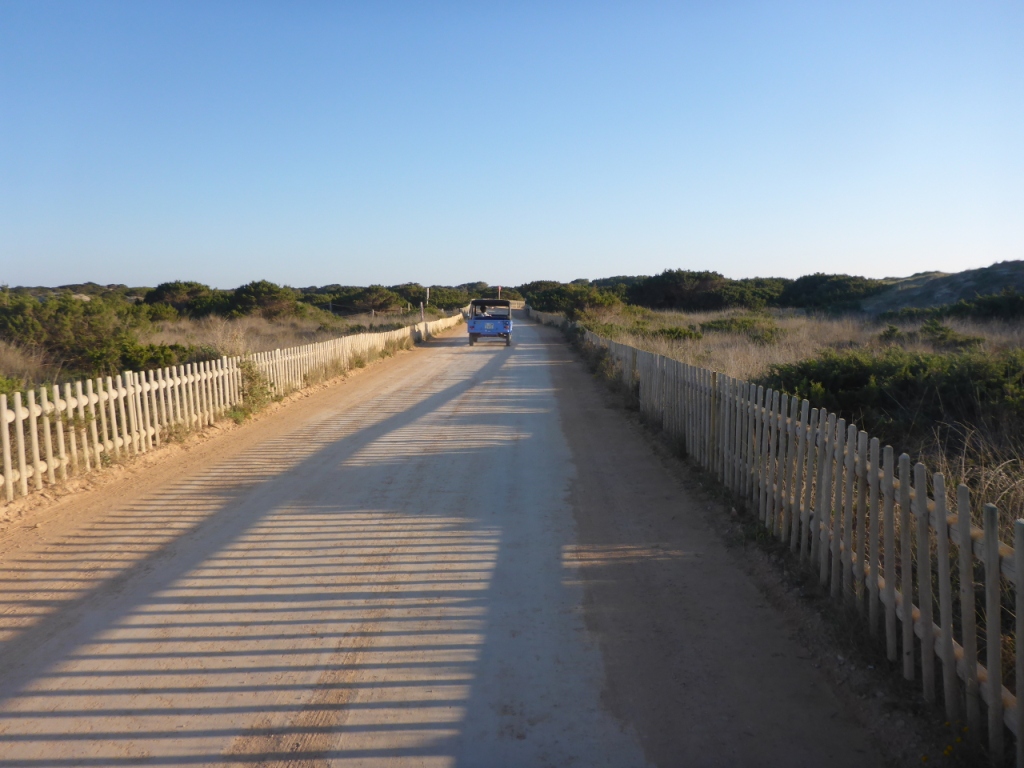
Couchée tôt et je me réveille à 8 h 30, quelle bonne nuit. Jens est déjà habillé et est parti acheter du pain. Il fait doux, et la nuit n’a pas été froide comme à Ménorque. On entend et on voit un traffic de ferries incroyable. Deux ferries rapides arrivent d’Ibiza à 9 h 30 et un part à la même heure. A 10 h, c’est un grand ferry qui arrive. Et cela continue toute la journée. Et on voit des gens arriver et partir. L'été la marina est bondée et les marineros passent leur temps à dire aux gens de repartir, qu'il n'y a plus de places. Je vais chercher des bleus et n’en trouve qu’un, mais comme consolation je vois un petit bateau de pêche qui s’appelle « La Maja I ». Nous partons en vélo, on n’est pas ici pour rigoler, selon la formule consacrée, pour aller tout au sud de l’ile, au Cap de Barbaria. Nous prenons des petites routes, mais c’est très bien indiqué avec des pancartes spéciales pour les vélos. Nous roulons, roulons … et arrivons à la déchèterie de l’ile, fermée par une grande grille. Un monsieur nous renseigne et dit que nous ne sommes pas les premiers à arriver ici. C’est qu’à un virage, la pancarte dit d’aller tout droit mais on peut l’interprêter comme continuer sur la même route, alors qu’en fait, il faut continuer droit sur une petite route et ne pas suivre le virage. Bon. On fait demi tour et retrouvons la petite route. C’est assez plat et un petit détour n’est pas tragique. La campagne est belle, mais la majorité des champs sont abandonnés. Formentera était connue pour sa production de blé, mais on n’en voit plus guère trace. Autour du phare, ici aussi c’est un peu lunaire et dans la lande il y a un grand trou, naturel je crois. Fruits secs et eau et retour par la grand route, toute directe et rapide. Nous mettons presque le double de temps en allant (arrêts fleurs, arrêts carte, toutes petites routes) qu’en rentrant par la route droite et plate, là ça roule. Retour à Maja à 15 h, bien ensoleillés et aérés. Je commence le long blog de la traversée Ménorque-Formentera, mais vers 17 h, je prends une pause et nous allons en vélo vers les marins salants qui, eux non plus, ne sont plus exploités. Des petites barrières protègent les dunes et la piste est large et plate. Dire que l’été de nombreuses voitures peuvent y aller, mais il y a une sorte de péage et peut-être qu’ils en limitent l’accès. Retour à Maja et Jens nous mijote un bon plat de poulet et de légumes au four. Je finis le blog à 20 h 30, nous dinons et passons une bonne soirée. 
    
Saturday, March 18, 2017

I went to bed early and wake up at 8:30 am, after a goog night sleep. Jens is already dressed and has gone to buy bread. It is mild, and the night was not as cold as in Menorca. We hear and see an incredible ferry traffic. Two fast ferries arrive from Ibiza at 9:30 am and one leaves at the same time. At 10 am, a big ferry arrives. And it goes like that all day long. And we see people coming arriving and leaving. In sommer, the marina is always full and the marineros are busy saying "Sorry, there is no more place". I go to look for “blues”, find only one, but as a consolation, I see a small fishing boat called "La Maja I". We go by bike, we are not here to be lazy, to go at the southern tip of the island, to Cap de Barbaria. We take small roads, but they are very well marked with special signs for bicycles. We ride, ride ... and come to the waste dump of the island, closed by a large gate. A gentleman tells us that we are not the first ones to arrive here. At a swing, a sign says to go straight but you can interpret it as continuing on the same road, when in fact you have to go straight on a small road and not follow the swing . Good. We turn back and find the small road. It's pretty flat and a little detour is not a big problem. The countryside is beautiful, but the majority of fields are abandoned. Formentera was known for its wheat production, but we don’t see much of it now. Around the lighthouse, here also it is a little lunar and in the moor there is a large hole, natural I believe. Dried fruits and water and return by the main road, all direct and fast. We used almost twice as much time going (stops for flowers, stops for reading the map, very small roads) that by returning by the straight and flat road, here we are making good speed. Back to Maja at 3 pm, with our share of sun and wind. I start the long blog of the crossing Menorca-Formentera, but at around 5 pm I take a break and we go by bike to the salt marches, which are no longer exploited. Small barriers protect the dunes and the track is wide and flat. It’s strange that it is allowed to cars and in summer there can be many of them, but there is a kind of toll and maybe they restrict access to them. Back to Maja and Jens cooks us a good dish of chicken and vegetables in the oven. I finish the blog at 8:30 pm and we have dinner and a nice evening.


Maja. Le grand batiment derrière est la gare de ferries
Maja. The huge building back is the ferry terminal


Deux ferries rapides Ibiza-Formentera
Two fast ferries Ibiza-Formentera


Une cousine
A cousin


Drame: un portable est tombé à l'eau
Il arrive à le repêcher
Drama: a mobile phone fell into the sea
He manages to fish it up again


Petite route
Small road


Champs en friche
Uncultivated fields


Une vieille machine, du temps où il y avait du blé
An old machine, from the time where wheat was cultivated here


Le standard baisse
The standard goes down


Des arbres dont les branches sont supportées par des batons
(cela fait de l'ombre l'été pour les bêtes)
The branches of this tree are supported by poles
(it gives shade to the animals in sommer)


Un parc de panneaux solaires
A solar pannels park


On s'est trompé de route. On arrive au dépot d'ordures
We took the wrong road. We arrive at the dump


Nous allons au phare là-bas
We are going to the lighthouse overthere


Fruits secs et eau
Dry fruit and water


Un joli lézard
A pretty lizard


Le trou (2 m de profondeur)
The hole (2 m deep)


La lagune à Puerto de Sabina, très peu profonde
The laguna at Puerto de Sabina, very shallow


Promenade de l'après-midi. Les marais salants
Afternoon ride. Salt marshes


Un beau chat au milieu de nulle part
Il y a un restaurant, fermé, tout près
A big cat in the middle of nowhere
There is a closed restaurant near by


Plage
Beach


Petite barrières qui protègent les dunes
Small barriers which protect the dunes


Freesia sauvages ?
Wild freesia?
18.03.2017. Formentera