Friday, 13 November 2015

12.11.2015 Baie de Karaloz/Karaloz Bay. Kekova 36 11 N 29 53 E

Jeudi 12 novembre 2015

Beau et calme. Nous montons à l’arche pour voir si elle est naturelle ou construite et vue de près, on voit qu’elle est naturelle. Nous montons, c’est vite dit, on grimpe comme on peut dans le maquis, sur les rochers, on se griffe, on s’agrippe, c’est vraiment du tout terrain. Nous nous baignons puis Jens va remonter l’ancre de derrière avec l’annexe.Quand c’est fait, j’appuie sur le bouton « up » et le winch tire le tout, l’annexe, l’ancre et le bonhomme. Juste comme on va partir, un gulet passe tout près et une des femmes nous salue et m’envoie même un baiser, surprise, je lui en renvoie un. Nous partons à 11 h 30 pour ressortir en mer, longer Kekova par le sud et rentrer dans une autre baie, au sud de Kekova.  Cette ile n’est pas si longue que je croyais, elle fait 5,5 km de long et est inhabitée. A un moment, on voit quelque chose qui flotte et on croit que c’est un sac en plastique avec une espèce de boule. Mais quand on voit ce sac en plastique plonger et nager, on s’aperçoit que c’était une tortue ! Nous arrivons à la baie de Karaloz à midi et demie, on a navigué une heure, pas trop dur aujourd’hui. On croirait rentrer dans un fjord en Norvège, c’est sauvage et désert et en plus, on voit un héron, le premier depuis plusieurs mois, on voit très peu d’oiseaux de mer ici, même les mouettes sont rares. On se met tout au fond du « fjord » qui tourne vers le sud. Jens met l’ancre devant et une longue ligne à terre que nous marquons avec la grosse bouée rouge. Nous nageons du bateau et déjeunons. Petit tour avec l’annexe et nous voyons arriver un yacht portant le pavillon américain qui ancre près de l’entrée du fjord. Nous entendons des chêvres bêler mais celles-ci n’ont pas de cloche. Nous sommes entourés de montagne mais nous avons quand même internet, c’est surprenant.

Thursday, November 12, 2015

Still beautiful and quiet weather. We go up to the ark to see if it is natural or constructed and seen closely, we see that it is natural. We go up, it's easy to say, we climb in the bush, on the rocks, we grab what we can, our legs are scratched, it's really bush walking. Once down, we swim and Jens goes with the tender to take the anchor up. This done, I press the "up" button and the winch pulls it all, the tender, the anchor and the man. Just as we leave, a gulet passes near and women greet us and one even sent me a kiss, surprise, I return one to her. We leave at 11:30 am and come out on the open sea, along Kekova south side to go into another bay, south of Kekova. This island is not as long as I thought, it is only 5.5 km long and is uninhabited. At one point, we see something that floats and we think it is a plastic bag with a kind of round  ball on top. But when we see this plastic bag dive and swim, we realize that it was a turtle! We arrive in Karaloz Bay at half past twelve, we motored one hour, not too hard today. It looks like we are going into a fjord in Norway, it is wild and deserted and even more, we see a heron, the first one in several months, we see very few sea birds here, even seagulls are rare.  We go at the end of the "fjord" which turns south. Jens sets the anchor in front and a long line to land that we mark with the big red buoy. We swim from the boat and have lunch. We row a little tour with the tender and we see a yacht carrying the American flag come in and anchors near the fjord entrance. We hear goats bleating but they have no bells here. We are surrounded by mountains but we still get internet, it’s surprising.


On marche là dedans
Bush walking


La grande arche est naturelle
The big arch is natural


Un puit, près de la plage
A well, near the beach


L'ancien port
The old harbor


L'ancien port
The old harbor


L'ancien port
The old harbor


Jens va remonter l'ancre
Jens is going to take up the anchor


Le winch ramène tout
The winch is pulling everything


Bye, bye Tersane


L'ile de Kekova
Kekova Island


La mer
The sea


Grottes
Caves


Le/The "fjord"


L'entrée
The entrance


Un yacht arrive
A yacht is coming in


Il y a des idiots partout
There are idiots eveywhere


Notre longue ligne à terre marquée avec la bouée rouge
Our long line to land marked with the red buoy


Il n'y avait pas de bouts de verre à Tersane, mais j'ai trouvé une perle de verre
There was no pieces of glass at Tersane, but I found a glass pearl


Karaloz


Cyclamen. Tersane


Thursday, 12 November 2015

11.11.2015 Tersane, Ile de Kekova/KekovaIsland

Mercredi 11 novembre 2015

Une précision : le nom Tersane veut dire chantier naval, apparemment ils construisaient des bateaux ici entre 300 et 600 ans après J-C.

Beau et calme. Quand nous nous levons, nous remarquons que l’eau est toute sale, il flotte plein de mousse marron qui dérive vers la plage et après 10 minutes, c’est parti et l’eau est de nouveau claire et turquoise. Nous avons la visite d’un groupe de kayaks accompagné d’un bateau à moteur, ils restent une demi-heure puis s’en vont. Nous allons à terre et allons voir les ruines, les photos montreront comme il y en a beaucoup mais il n’y a aucune explication ou guide ici. Mais pourquoi construire sur cette ile qui est si rocailleuse ? Les constructions datent de 200-600 ans après J-C. Quand nous marchons, nous sentons une odeur forte que nous avions sentie la première fois sur l'ile de Gemiler (l'ile de Saint Nicolas), puis nous l'avons sentie avec Kristian et Lene pendant notre grande promenade et Lene a trouvé dans un livre d'arbres ce que c'est: cette odeur vient des caroubiers, c'est une odeur lourde, entêtante, pas très agréable. Un petit bateau arrive avec un couple d’une cinquantaine d’années, turc, et je suppose qu’ils vont cueillir des olives, ils restent toute la journée et sont rejoints un peu plus tard par une jeune fille amenée en bateau par un jeune homme. Nous rentrons au bateau pour nous baigner et déjeuner. Un autre petit bateau turc vient au fond de la baie, assez près de la plage et un pêcheur met un filet, en rond. Après peu de temps il le remonte et je ne vois aucun poisson. Pendant que je fais le blog, Jens va à terre se balader tout seul. Il parle avec les gens turcs et c’est vrai qu’ils sont allés cueillir des olives. La jeune fille parle un peu anglais et Jens lui demande combien il faut d’olives pour faire un litre d’huile. Elle demand elle-même à l’homme plus agé (son père, je pense) et elle dit à Jens qu’il en faut 8 kg.  Un peu plus tard un beau gulet arrive avec un jeune couple et le capitaine. La jeune femme est voilée et habillée long. Le jeune homme se déshabille et se baigne, mais pas elle. La fin de la journée est, comme hier, annoncée par les cloches des chêvres qui descendent de la montagne. Ce sont de belles bêtes, grandes et en bonne forme, au poil brillant et ce soir, certaines grimpent sur le haut de la montagne et y restent quelques minutes à admirer le paysage. La nuit est étoilée et on voit dans l’eau des phosphorescences, comme des diamants qui apparaissent et disparaissent.

Wednesday, November 11, 2015

A precision: the name Tersane means boatyard, it looks like they built boats here between the second and the sixth century AD.

Beautiful and quiet weather. When we get up, we notice that the water is dirty, full of brown foam which floats in direction of the beach and, after 10 minutes, it's gone and the water is clear and turquoise again. We have a visit from a group of kayaks accompanied by a motorboat, they remain half an hour then leave. We are going on land to see the ruins, the photos show that there are many but there is no explanation or guide here. But why build on this island that is so rocky? The buildings date back to 200-600 years AD. When we walk, we smell a strong smell we had smelt the first time on Gemiler Island (Saint Nicolas’ Island), then we smelt it again with Kristian and Lene during our long walk and Lene found in book about trees what it is: that smell comes from the carob trees, it is a heavy smell, heady, not very nice. A small boat comes with a couple in their fifties, Turkish, and I suppose they come to collect olives, they stay all day and are joined later by a girl brought by boat by a young man. We return to the boat to go swimming and eat lunch. Another small Turkish boat comes to the bottom of the bay, close enough to the beach and a fisherman puts down a net making a large circle. After a short time he pulls it up and I see no fish. While I do the blog, Jens goes ashore to walk alone. He talks with the Turkish people and it's true that they went to pick olives. The girl speaks some English and Jens asks her how much olives do they need to make one liter of oil. She asks the older man (her father, I think) and she tells Jens it takes 8 kg. Later a beautiful gulet arrives with a young couple, and the captain. The young woman is veiled and dressed with a long dress. The young man undresses and bathes, but not her. The end of the day, like yesterday, is announced by the bells of the goats coming down from the mountain. They are beautiful animals, big and in good shape, with brilliant fur; a few ones climb on top of the mountain and stay there a few minutes to admire the scenery. The night is starry and we see in the water phosphorescences, like diamonds that appear and disappear.


L'eau
The water


Les kayaks


Les ruines


Un caroubier
A carob tree
Johannesbrødtre


Là c'est un peu plat et il y a de la terre, peut-être cultivaient-ils quelque chose ici?
It's a little flat and there is soil, maybe they cultivated something here?


Ruine


Ruine. On se demande si la grande arche en haut est construite ou naturelle?
On reviendra demain
Ruin. We wander if the big arch on top is man made or natural?
We'll come back tomorrow


Citerne
Cistern


Cette plante à très gros oignons est partout
This plant with big onions is everywhere


Ruine


Ruine


Jens


Ruine


Dedans. Grenier?
Inside. Granary?


On revient à la plage
We are back at the beach


L'eau où les chêvres vont boire
The water where the goats are drinking


Le bateau des cueilleurs d'olives
The olive pickers boat


Le pêcheur
The fisherman


Le jeune couple dans le gulet
The young couple in the gulet


Les cueilleurs d'olives s'en vont
The olive pickers are leaving


Les chêvres admirent le paysage
The goats are admiring the landscape


Je sais, je sais, mais c'est un nouveau et il n'y a pas grand chose d'autre ici
Et il est si joli
I know, I know, but it's a new one and there are not many flowers her
And it's so pretty


Wednesday, 11 November 2015

10.11.2015 Tersane, Ile de Kekova/Kekova Island 36 10 N 29 50 E

Mardi 10 novembre 2015

Aujourd’hui, à 9 h 05, toute la Turquie s’immobilise, les sirènes retentissent, les voitures s’arrêtent et klaxonnent et tout le monde observe une minute de silence pour rendre hommage à Ataturk, mort le 10 novembre 1938, le père de la Turquie moderne. Comme nous sortons du bateau pour aller voir la cérémonie sur la place de Kaş, un couple qui regarde Maja se présente comme les propriétaires du catamaran qui est amarré un peu plus loin et surprise, ils sont mexicains ! Nous allons voir la cérémonie puis allons prendre qui un thé qui un café ensemble. Ils ont vendu leur maison à Mexico, acheté le bateau en France cet été et naviguent depuis, partis de La Rochelle et arrivés ici, à Kaş. Nous sympathisons et espérons nous revoir plus tard. Jens va ensuite faire des courses pendant que je prends les dernières photos de Kaş, puis nous vidangeons les toilettes pour avoit un tampon sur notre carte bleue et partons à midi. Nous longeons la côte vers l’est, d’abord par temps très calme pui, où c’est plus ouvert, une houle du sud nous arrive sur le côté et Maja roule. J’ai bien rangé tout … sauf la théière qui tombe, heurte l’escalier et se casse. Il me faut nettoyer les morceaux de verre (et ils ne sont pas polis, ceux-là) et le thé, à quatre pattes, dans une Maja qui roule bien.  Nous rentrons ensuite derrière l’ile de Kekova, une longue ile de 8 km qui protège la côte et forme un grand bassin sans vagues. On a repéré une petite baie, Restane sur Kekova, et nous allons voir. C’est joli, calme et plein de ruines. Le vent est du sud maintenant mais tourne souvent au nord le soir et la nuit. Donc, Jens a la solution : il place Maja au milieu de la baie et met deux ancres, une devant et une derrière. On a vu des photos de cette baie en été, plusieurs dizaines de gulets sont ancrés parallèles, serrés les uns contre les autres et ont une ligne à terre, mais maintenant on a de la place. Nous ramons à terre, nous baignons à la petite plage de sable et admirons les ruines. Deux gulets viennent mais repartent après quelques minutes et deux pêcheurs partent aussi. A 17 h, nous avons la baie pour nous tout seuls, quel luxe. Nos seuls compagnes sont des chêvres qu’on voit et qu’on entend (elles ont des cloches)qui descendent de la montagne, vont boire et se coucher, je suppose. Blog, diner à l’intérieur, le vent est frais, lecture et admiration du ciel étoilé qu’on voit bien parce qu’il fait noir comme dans un four ici.

Tuesday, November 10, 2015

Today at 9:05 am the whole Turkey stops, sirens sound, cars stop and honk and everyone observes a minute of silence to pay tribute to Ataturk, the father of modern Turkey who died Nov. 10, 1938. As we leave the boat to see the ceremony on Kaş square, a couple looking at Maja presents themselves as the owners of the catamaran which is moored a little further and surprise, they are Mexican! We go to see the ceremony then we take a tea or a coffee together. They sold their home in Mexico, bought the boat in France this summer and since then has been sailing, from La Rochelle to Kaş. We sympathize and hope to see them again later. Jens goes shopping while I take the last pictures of Kaş, we empty the toilet to get a stamp on our blue card and leave at noon. We motor along the coast to the east, first the sea is all quiet, then when it is more open, a southern swell arrives on the side and Maja starts rolling. I put everything away  ... except the teapot that falls, hits the stairs and breaks. I need to clean the pieces of glass (and they are not polished, those ones) and tea, on all fours, in a rolling Maja. We then got back behind the island of Kekova, an 8 km long island that protects the coast and forms a large basin without waves. We spotted a small bay, Restane on Kekova, and we try it first. It's pretty, quiet and full of ruins. The wind is from the south, but now often turns north in the evening and during the night. So Jens has the solution: he places Maja in the middle of the bay and puts two anchors, one in front and one back. We saw pictures of the bay in summer, tens of gulets are anchored parallel, tight against each other and have a land line, but now there is room. We row ashore, we swim at the small sandy beach and admire the ruins. Two gulets come but leave after a few minutes and two fishermen also leave. At 5 pm, we have the bay to ourselves, what a luxury. Our only companions are goats we see and hear them (they have bells), they come down from the mountain, to drink and sleep, I suppose. Blog, dinner inside, the wind is fresh, reading and we admire the starry sky, we see it very well because it's dark as pitch here.


The cérémonie
The ceremony


La minute de silence
The minute of silence


Paulina, Miguel de/from Mexico


La tombe royale, 400 ans av. J-C
The King's tomb, 400 years BC


Le catamaran de Miguel et Paulina et Maja
Miguel and Paulina's catamaran and Maja


Un mur
A wall 


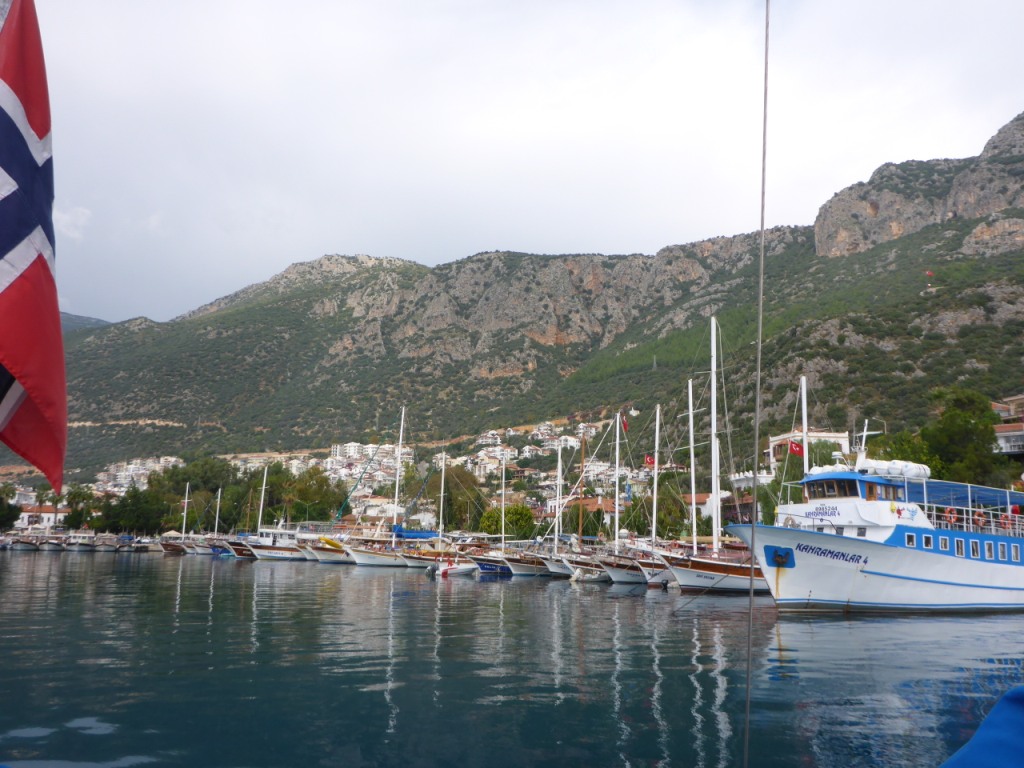
Bye, bye Kaş


Nous longeons la côte
We motor along the coast


Nous passons entre deux iles
We go between two islands


Nous approchons
We are near now


La baie de Tersane
Tersane bay


La baie vue de la plage
The bay seen from the beach


La plage et la ruine d'une église byzantine
The beach and the ruin of a Byzantine church


Maja est ancrée aux deux bouts
Maja is anchored at both ends


Ruine et chêvres
Ruin and goats


Quelques lumières sur le continent, au nord
A few lights on mainland, north of here


Kekova 
PS: le trait rouge est faux, on est passé au nord de l'ile d'Içada 
Kekova
PS: the red line is wrong, we passed north of Içada 


Tersane, Kekova


Kaş