Friday, 17 April 2015

16.04.2015 Cartagena

Jeudi 16 Avril 2015

Bonne nuit tranquille. Nous commençons à prendre le petit-déjeuner, bien emmitoufflés parce qu’il ne fait pas chaud quand on voit arriver un super voilier, le « Wind Star » qui se met à un quai. Nous mordons une bouchée de tartine et on voit arriver un bateau de croisière « Aida », c’est drôle je suis sure de l’avoir déjà vu, à Bergen je crois. Il se met juste derrière nous. On a du spectacle, ce matin. Nous allons nous enregistrer à la marina et on peut rester à la place où nous sommes. Nous allons nous promener en ville, il fait beau mais pas très chaud à cause du vent. Vers 11h, nous cédons à la tentation : depuis que nous sommes en Espagne du sud, nous rêvons d’une « tostada de tomate », du pain grillé avec des tomates crues concassées et de l’huile d’olive. Et on ne l’a pas encore eu. Donc aujourd’hui, on prend un second petit-déjeuner. C’est bon !  Rentrés au bateau, nous demandons à déménager: « Aida » a un moteur qui marche tout le temps pour faire de l’électricité et cela fait du bruit. On change donc de place en fin de matinée, mais on est, bien sûr, le long d’un ponton. Jens va mettre une lessive à laver et cela sèche bien avec le vent. L’après-midi, nous faisons un tour en vélo dans la Cartagena moderne, sur une bonne piste cyclable. Quand nous rentrons, « Aida » est en train de partir et « Wind Star » est déjà parti. Ils ne restent pas longtemps dans une ville. Bon petit diner au soleil sur Maja et soirée calme.

Thursday, April 16, 2015

Good quiet night. We begin to take breakfast outside although with a lot of cloths because it's quite chilly when we see a super yacht, the "Wind Star" coming in the harbor. We bite a mouthful of bread and see a cruise ship "Aida", it's funny I'm sure I have already seen her, in Bergen I think. She berths right behind us. Good untertainment, this morning. We go to register at the marina and we can stay in the place where we are. We walk around town, the weather is nice but not very hot because of the wind. Around 11 am, we give in to temptation: since we are in southern Spain, we dream of a "tostada de tomate", a toast with crushed raw tomatoes and olive oil. And we did not had it yet. So today we take a second breakfast. This is good! Back to the boat, we ask to move: "Aida" has an engine that runs all the time to make electricity and it is noisy. Thus we change place in the late morning, but we are, of course, along a pontoon. Jens puts on a laundry and it dries well with the wind. In the afternoon, we take a bike ride in the modern Cartagena, on a good bike path. When we come back, "Aida" is about to leave and "Wind Star" is already gone. They do not stay long in a city. Good diner in the sun on Maja and calm evening.


Il ne fait pas chaud
It's not very warm


Wind Star


Aida


Catagena


L'homme sans tête
The man without a head


La tostada de tomate


Aida, Maja


Le linge sèche bien
The laundry is drying well


Une rue
A street


Une rue piétonne
A pedestrian street


Catagena


Thursday, 16 April 2015

15.04.2015 Cartagena

Mercredi 15 Avril 2015

Jens va voir les vagues après le petit-déjeuner et revient en pensant qu’elles sont encore grosses. Il va visiter Antonio et on décide d’attendre encore un peu. Il va payer la marina, qui nous fait un bon prix et moi je vais faire des photos du bateau norvégien « Oslo Bulk 2 » qui est en train de charger du gypse. Puis, vers 11 h, Jens va revoir les vagues et revient en disant qu’elles ont bien diminuer et qu’on peut partir. Nous le faisons donc et, en sortant du port, voyons que le Oslo Bulk 2 est en fait enregistré à Singapore. Et nous sortons du port. La houle d’hier est encore bien présente, 1m-1,5 m et de trois-quart en face. Maja reprend ses habitudes de cabrioler dans tous les sens, cela bouge bien, ça va mais il faut faire attention de bien se tenir tout le temps, et il pleut et il va pleuvoir toute la journée. Nous allons au moteur, une petite heure avec le foc dans l’après-midi, c’est tout. Je suis perchée sur la chaise de pilotage et me cramponne, mais au moins j’ai le temps de faire mes exercices pour ma main. Pour rentrer ou sortir du «trou» (qui n’est plus mon trou, Jens y fait souvent une petite sieste), il faut que Jens m’aide. On ne voit personne, sauf un bateau de pêche, la visibilité est mauvaise et on se croirait en Norvège en Novembre. Mais, en début d’après-midi, je vois un couple de fous de bassan, ces grands oiseaux qui sont si beaux. Le temps passe, entre siestes, manger un peu et écouter de la musique. Quand le jour tombe, nous voyons enfin le soleil, 5 mn et un peu tard. Nous approchons de Cartagena et voyons par AIS que plusieurs navires sont ancrés devant le port à attendre, le premier étant un navire d’EDF-Suez. Nous les longeons et entrons dans le port à 21 h 30. Le port de Cartagena est une baie naturelle bien protégée. Nous trouvons la marina, et, ô bonheur, on voit qu’ils ont des pontons flottants où on peu se mettre en long. On se met à une place libre, entre des grands voiliers et on verra demain s’il faut déménager. Bien contents d’arriver après dix heures de navigation et 50 MN (90 km).

Wednesday, April 15, 2015

Jens goes to see the waves after breakfast and returns thinking they are still big. He visits Antonio and decides to wait a little. He pays the marina, which makes us a good price and I take pictures of the Norwegian ship "Oslo Bulk 2" which is being loaded with gypsum. Then around 11 am Jens goes again to see the waves and comes back saying they have decreased and that we can leave. We do so, and coming out of the harbor, see that the “Oslo Bulk 2” is actually registered in Singapore. And we leave the port. The swell of yesterday is still present, 1m-1.5m from three-quarter front. Maja resumes her habits of cavorting in every direction, it is moving well, it’s OK but we have to be very careful to hold on all the time, and it's raining and it's going to rain all day. We are motoring, we have one hour with the jib in the afternoon, that's all. I am perched on the pilot chair and hold on all the time, but at least I have time to do exercises for my hand. To enter or exit the "hole" (which is not my hole anymore, Jens uses it often to take a nap) Jens must help me. We don’t see anyone except a fishing boat, the visibility is bad and it is like in Norway in November. But by early afternoon, I see a couple of gannets, these large birds that are so beautiful. Time passes, between naps, eating a bit and listening to music. When night falls, we finally see the sun, 5 minutes and a little late. We are approaching Cartagena and see on  AIS several ships anchored at the harbour entrance, waiting, the first one being an EDF-Suez ship. We pass along them and enter the harbor at 9:30 pm. The harbor of Cartagena is a sheltered natural bay. We find the marina, and, oh joy, we see that they have floating pontoons where we can tie along. We find a place between big sailing boats and we'll see tomorrow if we have to move. Glad to arrive after ten hours of navigation and 50 NM (90 km).


Oslo Bulk 2


Bye, bye Garrucha


En bas
Down


En haut
Up


Un bateau de pêche
A fishing boat


Jens dans mon "trou"
Jens in my "hole"


Je fais mes exercices
I am doing my exercises


Cabo Tiñoso


Les navires qui attendent devant Cartagena
The big ships waiting in front of Cartagena


Première fois qu'on voit le soleil aujourd'hui
We see the sun for the first time today


Nous entrons dans le port de Cartagena
We enter Cartagena harbor


Garrucha


14.04.2015 Garrucha

Mardi 14 Avril 2015

Il fait beau, enfin. Nous partons cette fois vers le nord, en vélo. La promenade le long de la mer parait bien plus belle sous le soleil. Nous pouvons être en T-shirt et sandales et le soleil chauffe bien. Nous allons vers Vera, la prochaine ville et station balnéaire. La belle promenade pavée s’arrête et devient un chemin de terre, mais ça va. Nous faisons une étape pour manger une orange, toujours les oranges données par Angeles à Almuñécar. Jens s’assoit par terre mais je trouve une meilleure place, sous la douche. Arrivés à une jolie presqu’ile boisée, nous rentrons vers l’intérieur des terres et rentrons par la route directe. Un bon tour de 18 km en tout. Quand nous arrivons au bateau, un homme espagnol qui vit aussi sur son bateau (nous sommes les deux seuls bateaux habités) vient nous voir et nous demande si on le reconnait. On hésite un peu, lui peut-être mais le bateau pas du tout. Il rit et nous dit qu’on était ensemble à Ayamonte en Novembre et bien sûr qu’on ne reconnait pas le bateau parce qu’il en a changé depuis. On discute un peu et nous rentrons déjeuner. En fin d’après-midi, nous l’invitons ainsi que sa compagne à prendre un verre. Ils nous racontent qu’ils ont échangé leur maison contre un bateau de 13 m. Le problème, c’est que l’ancien propriétaire du bateau, un Basque, ne veut pas venir habiter ici, il trouve qu’il fait trop chaud, alors il leur a donné 6 mois pour vendre la maison et payer le bateau. Antonio et Asunción sont d’ici, de Garrucha mais vivent maintenant sur leur bateau, Txo, avec leurs deux enfants de 12 et 9 ans. Txo veut dire le mousse en basque. Ils vont aller aux Baléares, Italie et Grèce cet été et rêvent de traverser l’Atlantique l’année prochaine. Nous passons encore un bon moment avec des gens sympathiques. J’ai remarqué que depuis ce matin, un grand pavillon rouge, jaune et bleu flotte sur leur bateau. Je demande pourquoi et il me répond que c’est le drapeau de la République d’Espagne, démocratiquement élue le 14 Avril 1931 et renversée ensuite par Franco lors de la guerre civile de 1936. Nous allons ensuite voir leur bateau, grand et bon bateau tout nouveau pour eux. La météo prévoit une amélioration de l’état de la mer, moins de vagues et nous allons peut-être partir demain.

Tuesday, April 14, 2015

The weather is nice, finally. We start this time to the north by bike. The promenade along the sea looks more beautiful in the sun. We can be in T-shirt and sandals and the sun is warming well. We go to Vera, the next town and seaside resort. The beautiful paved promenade stops and becomes a dirt road, but it’s OK. We make a stop to eat an orange, still the oranges given to us by Angeles in Almuñécar. Jens sits on the ground but I find a better place under the shower. Arrived in a pretty wooded peninsula, we turn left to go inland and return by a direct road. A good ride of 18 km in all. When we get to the boat, a Spanish man who also lives on his boat (we're the only two inhabited boats) comes to us and asks us if we recognize him. We hesitate a bit, maybe him but not the boat. He laughs and told us we were together in Ayamonte in November and of course we don’t recognize the boat because it is not the same one. We talk a bit and we go on Maja to have lunch. In the late afternoon, we invite him and his wife for a drink. They tell us that they have exchanged their house for a 13 m boat. The problem is that the former owner of the boat, a Basque, will not come to live here, he finds it too hot, so he gave them six months to sell the house and pay the boat. Antonio and Asunción are from Garrucha but now live on their boat, Txo, with their two children aged 12 and 9 years. Txo means the younger sailor on a sailboat, in Basque. They will go to the Balearic Islands, Italy and Greece this summer and dream of crossing the Atlantic next year. We spend a good time with those nice people. I noticed this morning, a big red, yellow and blue flag floatting on their boat. I asked why and he told me that it is the flag of the Spanish Republic, democratically elected on April 14, 1931 and then overthrown by Franco during the civil war of 1936. We go to see their boat, a big and good boat, all new to them. The weather is expected to improve tomorrow, the waves are calming and we may leave tomorrow.


Garrucha


Chemin le long de la mer
Path along the beach


Jeannette


Arrêt orange
Orange stop


Bien installée sous la douche
Comfortably seated under the shower


Promenade pavée de nouveau
Paved promenade again


La petite presqu'ile boisée
The little wooded peninsula


Retour par une route directe
Back on a direct road


Asunción, Antonio


Txo avec le drapeau de la République de 1931
Txo with the 1931 Republican flag


Un joli buisson en fleur. Vera
A pretty bush in bloom. Vera


Tuesday, 14 April 2015

13.04.2015 Garrucha

Lundi 13 Avril 2015

Le temps n’est vraiment pas beau, toujours gris, venteux du nord et la mer est bien agitée. Dès que nous sommes levés, vers 8 h, nous remarquons un ballet incessant de camions sur la grande digue. Ils arrivent et déchargent une poudre blanchâtre sur la digue. Des pelleteuses en font un grand tas et l’on voit des tapis roulants, inoccupés pour le moment, qui peuvent charger des navires. Jens va nous inscrire au bureau de la marina et nous avons enfin une clé pour la porte du quai. Puis nous mettons à exécution notre projet d’essayer les vélos. Jens me monte mon vélo, d’habitude je le fais toute seule, me baisse la selle donc je peux mettre les pieds parterre même arrêtée et on essaye. Je peux mettre la main gauche sur le guidon mais pas le tenir vraiment mais cela aide un peu pour démarrer, puis je fais du vélo d’une main. Cela semble bon, on n’a pas fait de vélo depuis Marbella, le 19 Février. Nous partons en longeant la mer vers le sud et nous arrêtons au bureau du tourisme pour avoir un plan et nous renseigner sur cette activité sur la digue. Les camions apportent du gypse qui provient d’une mine à Sorbas, à une trentaine de km d’ici et qui est exporté par bateau. Nous continuons, cela va bien, passons à Mojácar Mar, une grande station balnéaire chic et déserte et montons dans la montagne vers le village de Mojácar, un village blanc perché sur une colline. La montée n’est pas trop raide et assez courte. Nous laissons nos vélos à l’entrée du village et montons le dernier raidillon à pied. Ce village est très touritique et bus après bus déchargent des retraités espagnols. Une maison sur deux est un café ou un restaurant, mais c’est joli et la vue d’en haut est magnifique. Nous avons soif et faim et une « clara » accompagnée de trois tapas est la bienvenue, puis nous redescendons et rentrons à Garrucha par une route plus directe par l’intérieur. Arrivés au bateau, nous lisons un peu le journal et faisons une petite sieste, et ensuite bricolage pour Jens, il change un panneau solaire qui ne marche plus, et double blog pour moi, samedi et dimanche. 

Monday, April 13, 2015

The weather is not really beautiful, always gray, windy from the north and the sea is rough. As soon as we got up at around 8 am, we note an incessant ballet of trucks on the big dike. They arrive and unload a whitish powder on the dike. Big excavators make a huge pile and we see treadmills, currently unoccupied, which can load vessels. Jens go to the marina office to register us and we finally get a key to the dock gate. Then we execute our plan to try the bikes. Jens puts up my bike, I usually do it all alone, lowers the saddle so I can put my feet on the ground even when I stop. I can put my left hand on the handlebars but not hold it really but it helps a bit to start, and then I ride my bike with one hand. It’ OK and it seems good, we have not used our bikes since Marbella, on February 19. We start along the sea to the south and stop at the tourist office for a map and to ask about the activity on the dike. Trucks transport gypsum that comes from a mine in Sorbas, about thirty miles from here and which is exported by ship. We continue, it goes well, go to Mojácar Mar, a large and deserted chic seaside resort and climb into the mountains to the village of Mojácar, a white village perched on a hill. The climb is not too steep and quite short. We leave our bikes at the entrance of the village and go up the last steep path on foot. This village is very touristic, bus after bus are unloading groups of Spanish pensioners. Every second house is a cafe or restaurant, but it's pretty and the view from the top is magnificent. We are hungry and thirsty and a "clara" accompanied by three tapas is welcome, and we go down, we ride home in Garrucha by a more direct route inland. Arrived at the boat, we read the newspaper and do a nap, and then work on the boat for Jens, he changes a solar panel that doesn’t work, and double blog for me, Saturday and Sunday.


Le ballet des camions 
The ballet of trucks


Le bout de la digue
The dike end


Jens prépare mon vélo
Jens makes my bike ready


Mojácar


La vue d'en haut
The view from the top


En descendant
Riding down


Garrucha, la rue qui longe la mer s'appelle Malecón, comme à La Havana
Garrucha, the street along the sea is called Malecón, like in La Havana


Ici aussi les arbres sont taillés en couronne
Here too the trees are pruned as crowns


Solidage?
Goldenrod?
Gullris?
Solidago?
Mojácar


Monday, 13 April 2015

12.04.2015 Garrucha

Dimanche 12 Avril 2015

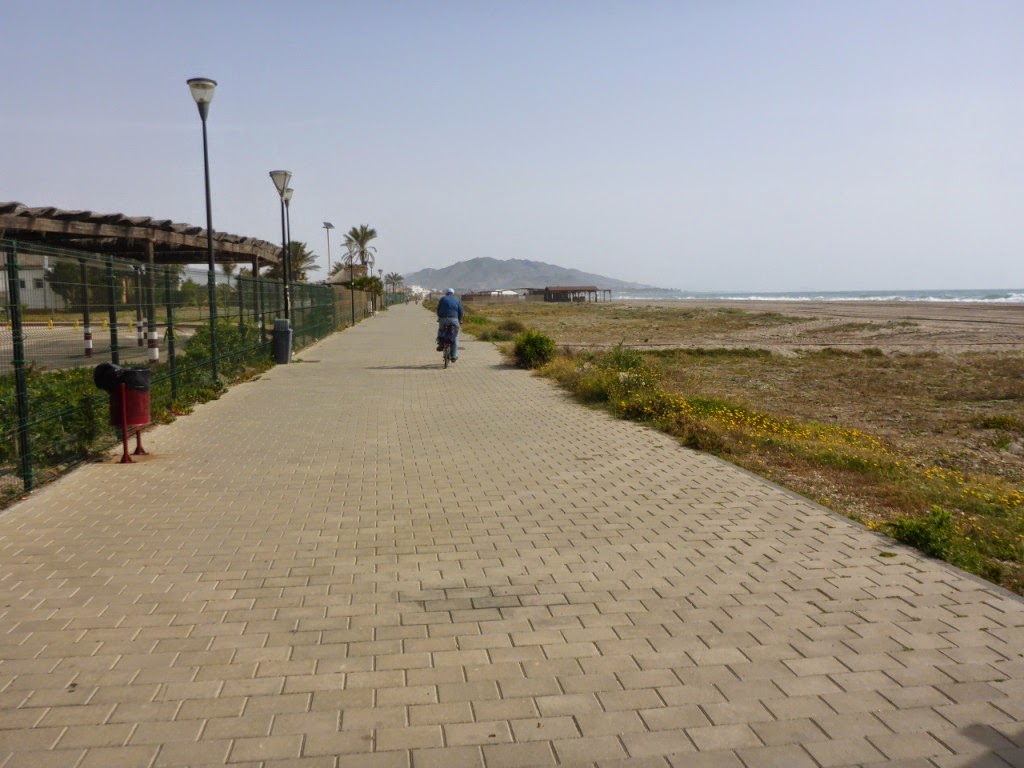
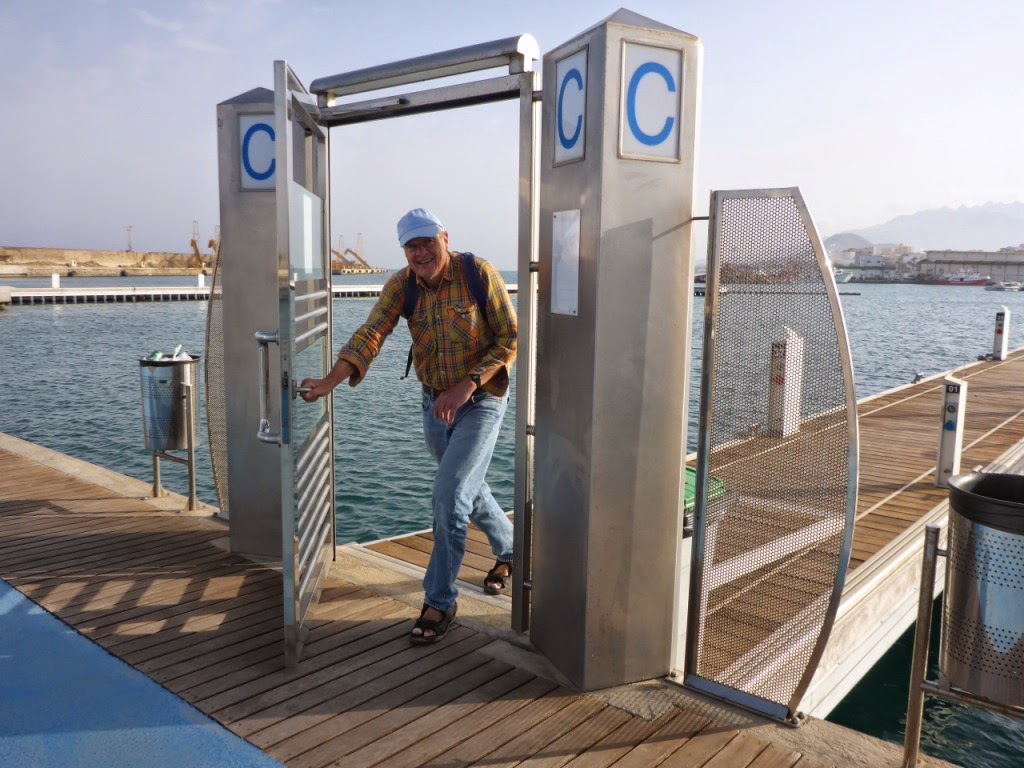
Temps gris et venteux. Nous allons faire une promenade vers le nord, maintenant la côte est orientée nord-sud. Une promenade longe la mer et la plage est très large, moitié lande, moitié plage. Nous voyons une dame qui cherche quelque chose dans l’espèce de lande, je lui demande ce qu’elle trouve là : des escargots, de gros escargots de Bourgogne qui sortent quand il pleut, et elle en a beaucoup dans un sac. Nous marchons une bonne heure puis rentrons pour déjeuner. Le soleil sort un peu et on mange dehors. Après la lecture du journal, nous repartons cette fois sous le soleil et vers le sud. Plus de gens sont dehors et c’est bien plus agréable que ce matin. Garrucha est un port de pêche et une station balnéaire assez ancienne et modeste. Quand nous rentrons, je fais une photo de Jens contournant la porte du ponton, demain nous nous inscrivons officiellement et nous aurons une clé. Nous changeons de place et nous rapprochons de la porte parce que le quai est bien plus propre là. A l'autre bout le quai est couvert de caca de mouette. Nous dinons dehors, au soleil mais avec une petite laine, le vent est frais. Au menu, un bel avocat donné par Angeles à Almuñecar et des spaghettis. Nous parlons de sortir les vélos demain, on verra …
 
Sunday, April 12, 2015

Gray and windy. We go for a walk to the north, now the coast is oriented north-south here. A nice promenade goes along the sea and the beach is very wide, half heath and half beach. We see a woman who is looking for something in the Heath, I ask what she is finding: snails, big snails that come out when it rains, and she has a lot in a bag. We walk an hour and then return for lunch. The sun comes out a little and we can eat out on Maja. After reading the newspaper, we leave this time under the sun and to the south. More people are out and it's much nicer than this morning. Garrucha is a fishing port and a seaside resort rather old fashion and not too big. When we return, I make a picture Jens bypassing the door of the pontoon, tomorrow we are going to register officially and we’ll get a key. We move Maja and find a place near the gate because the quai is much cleaner here. At the other end, the quai was dirty with seagulls shit. We dine outside in the sun, but with a jumper, the wind is fresh. On the menu, a good avocado given by Angeles in Almuñecar and spaghetti. We are talking of taking the bikes out tomorrow, we'll see ...


Gris
Grey


Une  lagune
A laguna


Pas très animé
Not very busy


La plage
The beach


Une lettre de différence
One letter difference


Il fait beau maintenant
The weather is nice now


On a changé de place
We moved


Jens contourne la porte
Jens is bypassing the gate


Et voilà
And here he is


Vipérine commune
Viper's bugloss
Ormehode
Echium vulgare