Saturday, 5 July 2014

04.07.2014 Dunstaffnage (un peu au nord d'Oban/ a little north of Oban)

Vendredi 4 juillet 2014

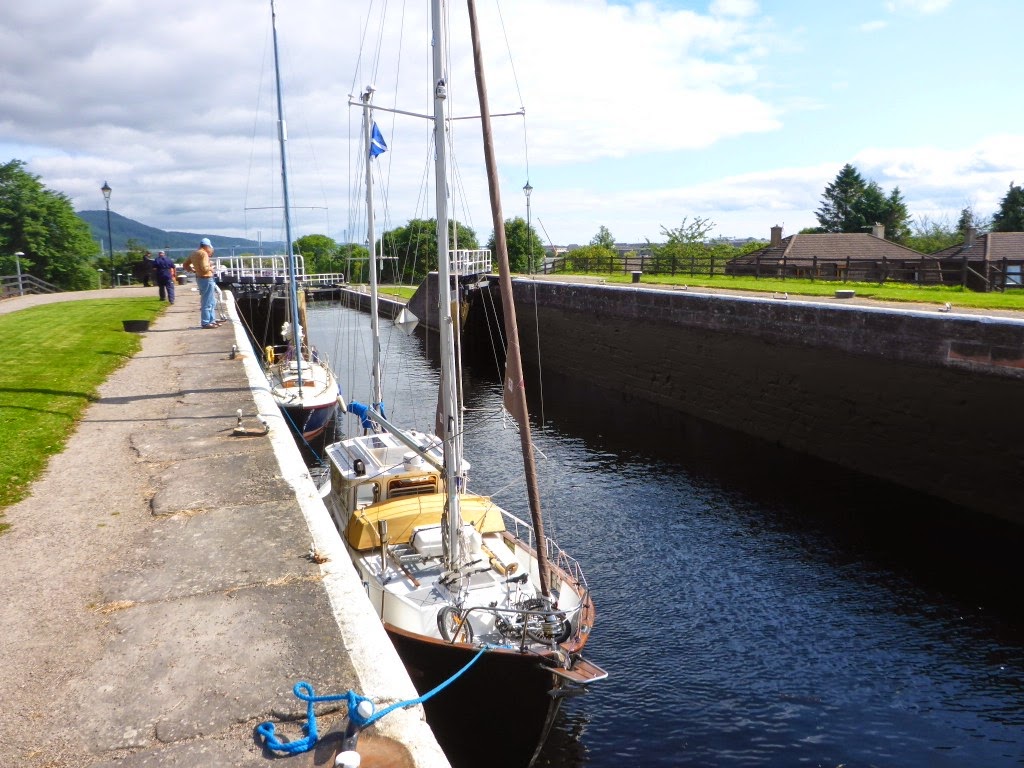
Un vrai temps de cochon! Il pleut des cordes et il souffle un très fort vent. Et nous devons descendre l’Escalier de Neptune, cinq écluses l’une après l’autre. Donc on s’équipe de cirés et bottes et allons-y. Nous démarrons à 8 h et cela nous prend 3 heures. Mais c’est très sympa. Nous discutons, sur le quai et en tenant nos cordes, avec nos “voisins”, le bateau des Shetland. Jens et moi, nous tenons bien Maja et laissons filer les cordes au fur et à mesure qu’elle descend. Puis nous la tirons à l’écluse suivante et recommençons. Tout le monde est trempé et dégoulinant, mais il ne fait pas froid. La famille des Shetland, parents et un grand fils, viennent de Collivoe sur l’ile de Yell. C’est de ce village que nous étions partis pour les iles Féroes en 2011.
Torunn et Øyvind se joignent à nous en bas de l’escalier.
Après ces cinq écluses, deux ponts s’ouvrent et nous n’avons plus qu’une écluse, puis c’est un grand fjord.  Nous rendons la clé des toilettes, on a presque oublié. Torunn et Øyvind sortent en premier et disparaissent vite, ils vont plus vite que nous. White Lady, le bateau des Shetland s’arrète pour prendre du diesel et sortira plus tard. Tout le monde est au moteur, le vent est droit contre nous et assez fort, force 5.
La première partie sur le fjord (ou plutôt loch) est assez calme. Nous nous faisons “a nice cup of tea”. Nous passons un endroit très étroit, Corran Narrows où il y a du courant mais ça va. Mais après … nous avons les vagues, courtes et rapprochées, juste dans le nez. La pauvre Maja cabriole comme un chameau fou. Elle monte sur une vague et tombe dans le trou suivant et comme cela des centaines de fois! Les vagues la freinent et nous n’allons pas vite. Nous n’avions pas prévu ce remue-ménage et il faut vite amarrer tout sinon il y aura de la vaisselle cassée. C’est assez désagréable mais pas dangereux, le bateau va bien. A un moment, Øyvind nous appelle par radio pour nous dire que plus loin sur le fjord, cela va mieux. C’est sympa. Et c’est vrai, il y a moins de vagues plus loin et, en plus, le vent baisse. En un quart d’heure le vent passe de force 5 (un bon cinq) à un petit force 3. La pluie s’arrète et le soleil fait son apparition. Nous nous arrétons un peu avant Oban, à une grande marina, Dunstaffnage. En préparant les cordes pour amarrer Maja, j’arrache la jambe de mon (vieux) pantaloon. Je ne suis guère presentable pour arriver dans cette marina un peu chic.
Nous allons faire une petite promenade et quelques courses à la boutique du village. Puis diner sur le bateau, au soleil, mais avec une petite laine, il ne fait pas chaud. Comme nous finissons de diner, nous voyons arriver White Lady.  Ils sont partis à peu près deux heures après nous et n’ont pas eu de vagues. Quelle chance. Nous allons les voir après diner, ils nous invitent à prendre un verre et nous passons un bon moment ensemble.    

Friday, July 4, 2014

What a weather! It's pouring and a strong wind is blowing. And we have to go down the Neptune stairs, five locks one after another. So we put on our rain gear and and rubber boots and let's go. We start at 8 am and it takes us 3 hours. But it is quite funny, people talking to each other. We discuss on the quai with our "neighbors," the Shetland sailboat. Jens and I hold Maja well and let slip the ropes gradually as it descends. Then we pull her to the next lock and we start again. Everyone is soaked and dripping, but it is not cold. The Shetland family, parents and an adult son, are from Collivoe on the island of Yell. It is from this village that we left for the Faroe islands in 2011.
Torunn and Øyvind join us at the bottom of the stairs.
After five locks, two bridges open and we pass the last lock, then we are in a large fjord. We give back the key for the toilets, we almost forgot. Torunn and Øyvind go out first and disappear quickly, they are faster than us. White Lady, the Shetland boat, stops to take diesel and will leave later. Everyone uses the motor, the wind is right against us and strong, a good force 5.
The first part of the fjord (or rather loch) is pretty quiet. We make a nice cup of tea. We pass a very narrow place, Corran Narrows, where there is strong current, but that's okay. But after that ... we have waves, short and close, right in the nose. Poor Maja danses like a crazy camel. She rides on a wave and falls into the next hole, and this hundreds of times! The waves stop her and we're not going fast. We did not anticipate these movements and must quickly tie everything else there will be broken crockery. It is quite unpleasant but not dangerous, the boat does well. At one point, Øyvind calls us on the radio to tell us that further along the fjord, it gets better. It's nice. And it's true, there are fewer waves further and, in addition, the wind drops. In a quarter of an hour the wind passes from force 5 (a good five) to a small force 3. The rain stops and the sun comes out. We stop just before Oban, at a large marina, Dunstaffnage. In preparing the ropes for mooring Maja, I make a big hole in my (old) pants. I am hardly presentable in this marina which seems a little fancy.

We go for a walk and do some some shopping at the village shop. Then dinner on the boat, outside, on  the sun, but with a sweater, it is a little bit cold. As we finish dinner, we see White Lady coming inn. They left about two hours after us and did not have waves at all.  Lucky people. We go and visit them after dinner, they invite us for a drink and we spend a good time together.


White Lady, le bateau des Shetland
White Lady, the Shetland boat


Il pleut
It is raining


Il pleut
It is raining


Il pleut
It is raining


Dernière écluse
Last lock


Le ferry à Corran Narrows
The ferry at Corran Narrows


Vagues
Waves


Vagues et pluie
Waves and rain


Repos
Rest


Tour
Tower


Elégance de Paris
Paris elegance


Jens a acheté un bidon
Jens bought a jerry can


White Lady arrive
White Lady comes in


Maja, Dunstaffnage


La/the marina


Mer et montagne
Sea and mountains


Friday, 4 July 2014

03.07.2014 Corpath (fin du Canal Calédonien/end of the Caledonian Canal)

Jeudi 3 Juillet 2014

Nous partons à 8 h 30, maintenant nous allons descendre. Si il n’y a qu’une écluse, nous restons sur le bateau et quand nous sommes en bas, un éclusier retire nos deux cordes et nous les lance sur le bateau. Si il y a plusieurs écluses, on peut aller à terre et tirer Maja mais il ne faut pas oublier de revenir sur le bateau à l’avant dernière écluse. Sinon, à la dernière écluse, Maja est en bas (plusieurs mètres en bas), nous en haut et pas moyen de descendre.
Nous decendons donc et Jens, toujours social, discute avec le voisin … et oublie de lâcher la corde! Elle est si tendue quand il s’en apperçoit qu’il ne peut pas défaire le nœud et est obligé de la couper avec son couteau suisse (le même que Mac Gyver). Sinon tout va bien, il fait un temps moyen avec toujours beaucoup de vent.
Le dernier groupe d’écluses avant la fin du Canal Calédonien s’appelle l’Escalier de Neptune, cinq écluses à la queue leuleu. Torunn et Øyvind décident de descendre aujourd’hui, mais nous préférons nous arréter. Il y a toujours des pontons avant les écluses pour attendre. Nos voisins de pontons viennent (et sont) des Shetland.
Après le lunch, nous allons en vélo à Fort William, à 6 km. Jolie promenade par des pistes cyclables ou des petites routes. A Fort William nous prenons qui un café, qui un thé. La rue principale est piétonne et du café on peut observer les piétons;; beaucoup de touristes du sud, Italie, Espagne … Ils viennent se rafraichir, je pense.
Le mont Ben Nevis, point culminant d’Ecosse (1343 m) est caché dans les nuages.
Nous rentrons, dinons et invitons Torunn et Øyvind à prendre un verre à un pub qui est juste en face de leur ponton. Bien qu’ils soient descendus cinq écluses et que nous nous soyons en haut, nous ne sommes séparés que par quelques centaines de mètres. Les hommes prennent “a pint of beer” et les dames … un petit verre de vin blanc. Encore une bonne soirée avec ces nouveaux amis.

Thursday, July 3, 2014

We start at 8:30 am and now we're going down. If there is only one lock, we stay on the boat and when we get down, a lock keeper takes our two ropes out of the hooks on land and throws them onto the boat. If there are several locks, we can go ashore and pull Maja from lock to lock but we must remember to come back on the boat before the last lock. Otherwise, at the last lock, Maja is down (several meters down), we up and there is no way to go down.
We start to go down and Jens, always social, is chatting with the neighbor ... and forgets to let go the rope! It is so tense when he realizes it, that he can’t undo the knot and is forced to cut it with his Swiss Army knife (the same as MacGyver). After that everything goes well, the weather is not too bad but still very windy.
The last set of locks before the end of the Caledonian Canal is called Neptune Stairs, a group of five locks. Torunn and Øyvind decide to go down “the stairs” today, but we prefer to stop at the top. There is always pontoons before the locks to wait.
After lunch, we ride to Fort William, about 6 km away. Nice ride by bike paths and small roads. At Fort William we take a coffee and a tea. The main street is pedestrian and from the café we can observe the pedestrians; many tourists are from southern Europe, Italy, Spain ... They come here to cool down, I think.
Mount Ben Nevis, the highest point of Scotland (1343 m) is hidden in the clouds.
We return, dine and invite Torunn and Øyvind for a drink in a pub which is just in front of their pontoon. Although they are five locks down and we are up, we are separated by only a few hundred meters. The men take a pint and the ladies ... a small glass of white wine. Another good evening with these new friends.


Les fleurs roses sont des digitales
The pink flowers are fox-gloves


Elevages de saumon et neige sur la montagne
Salmon farm and snow on the mountain


Un phare à la fin du loch Lochy
A lighthouse at the end of loch Lochy


Torunn et Øyvin sur leur bateau, Toviti
Torunn and Øyvind on their boat, Toviti


Dans un jardin
In a garden


Le bateau des Shetland
The Shetland boat


Maman canard et ses petits
Duck Mum with her children


Les petits
The small ones


Ruines. Fort William


Grande rue. Fort William
Main street. Fort William


Fort William


Signe bilingue, gaélic-anglais
Bilingual sign, Gaelic-English


Thursday, 3 July 2014

02.07.2014. Laggan

Mercredi 2 Juillet 2014

Il fait beau mais il souffle un très fort vent. L’écluse devait ouvrir à 9 h 20 mais plusieurs bateaux descendent et nous, qui montons, devons attendre. L’éclusier vient parler à chaque capitaine qui va passer l’écluse et explique bien où chacun va se mettre et comment s’amarrer. Et nous rentrons dans la première écluse. On ne sent pas tant le vent dans l’écluse.  Nous sommes 6 bateaux. Jens et moi sommes tous les deux à terre et tirons Maja d’écluse en écluse. Il y en a 5. La dame d’un voilier norvégien qui monte dans l’écluse en même temps que nous, nous dit qu’elle connait bien Jan-Otto, le premier propriétaire de Maja!
La montée des cinq écluses nous prend bien 1 h 30 puis nous continuons. Nous passons le Loch Oich. Le vent redouble, nous avons des pointes à 17 m/s (force 7-8!). Nous l’avons droit dans le nez mais sur le “loch” les vagues sont toutes petites. Heureusement que nous ne sommes pas en mer! Et maintenant il pleut. Nous reconnaissons le “manoir” où nous avions pris notre “morning tea” en 2012. Nous nous arrètons un peu plus loin, l’écluse suivante est fermée le temps du déjeuner. Nous déjeunons donc aussi. Nous repartons, pont, écluses et arrivons à Laggan où nous nous étions arrètés en 2012. La péniche-pub est toujours là mais elle est fermée. La pluie faiblit et s’arrète. Nous allons faire une longue promenade le long du canal. Il fait froid et le chauffage dans Maja est apprécié quand nous rentrons. Léger diner, salade, fomages et pain. La dame du voilier norvégien vient nous invité à venir prendre un verre après diner. Nous allons donc sur leur bateau, un Naïade 44 pieds (Maja en fait 30). C’est un très beau bateau. Torunn et Øyvind sont de Bergen et connaissent très bien Jan-Otto, le docteur Leer (docteur de famille) et Svein  Aaland, un bon copain de Jens au club de bateau. Ils nous expliquent l’origine du nom ”Maja”. C’est que la première femme de Jan-Otto avait un nom qui commençait par Ma. Lui s’appelant Jan, ils ont pris leurs deux premières syllables MA + JA, donc Maja.  Nous passons un très bon moment ensemble, Torunn, Øyvind et nous deux. Eux vont ensuite vers les Orcades et les Shetland.

 Wednesday, July 2, 2014

The weather is  nice but it is blowing a very strong wind. The lock was supposed to open at
9: 20 am but several boats are going down  and we who are going up must wait. The lock keeper goes and talks to each captain that will pass the lock and explains where each will go in the lock and how to moor. And we enter the first lock. It does not feel as windy in the lock. We are 6 boats. Jens and I are both on the ground and draw Maja from lock to lock. We go up 5 locks, it is like big stairs. The lady of a Norwegian sailboat that goes into the lock at the same time as us, tells us that she knows well Jan-Otto, Maja’s first owner!
Climbing the five locks takes us over 1 h and 30 minutes, then we continue. We pass the Loch Oich. The wind is even stronger now, we have gusts at 17 m / s (force 7-8!). We have it right in the nose but on the loch the waves are tiny. Fortunately, we are not at sea! And now it's raining. We recognize the "castle”" where we had our "morning tea" in 2012. We stop a little further, the next lock is closed at lunch time. We also have lunch. We continue, bridges, locks, and arrive at Laggan where we stopped also in 2012. The barge- pub is still there but it is closed. The rain stops. We take a long walk along the canal. It's cold and heating in Maja is appreciated when we return. Light dinner, salad, bread and cheese. The Norwegian lady on the sailboat invites us to have a drink after dinner. So we go on their boat, a Naiad 44 feet (Maja is 30 feet). This is a beautiful boat. Torunn and Øyvind are from Bergen and know Jan-Otto, Dr. Leer (our family doctor) and Svein Aaland, a good friend of Jens at the boat club. They explain the origin of the name "Maja". Jan-Otto’s first wife had a name that started with  Ma and his name starts with JA so they took their first two syllables MA + JA, so it became Maja. We spend a great time together with Torunn and Øyvind. They plan to go to Orkney and Shetland.


L'écluse se remplit, nous montons
The lock is filling up, we are going up


La même chose
The same


Nous montons
We go up


En bas
Down


En haut
Up


Le vent est à 17 mètres/seconde (force 7!)
The wind is up to 17 meter/second (force 7)


Loch Oich


C'est là que nous avions pris notre "morning tea" en 2012
It is there that we had our morning tea in 2012


Laggan


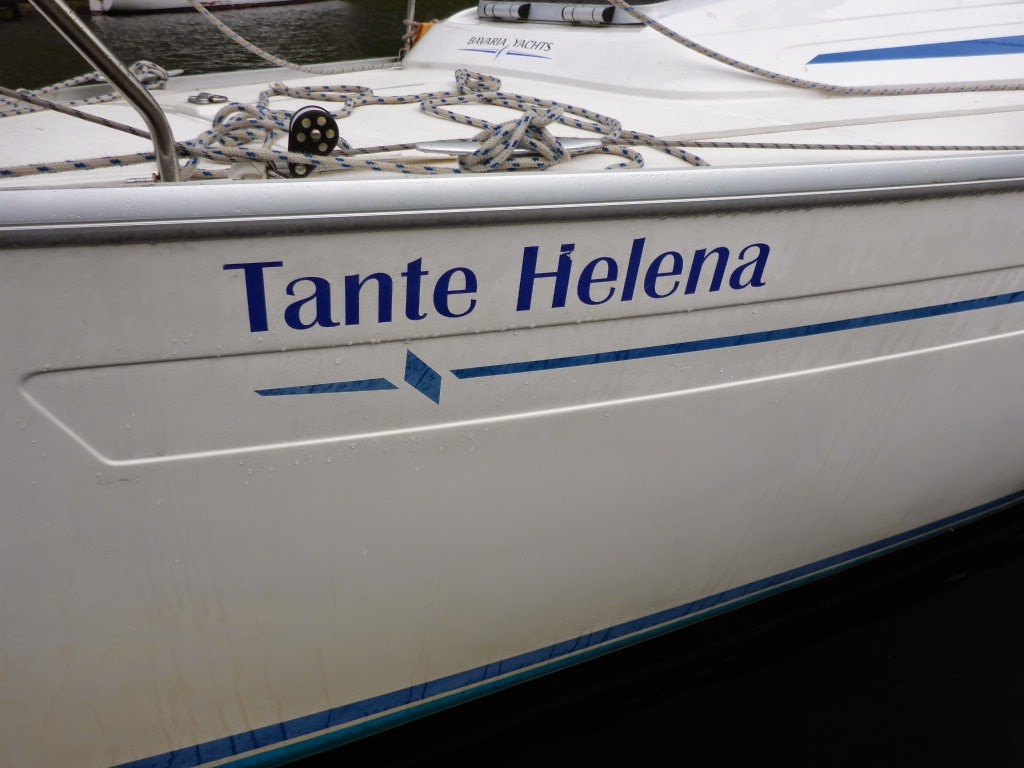
Sans commentaire, hein Helena.


La péniche-pub. Laggan
The pub-barge. Laggan


Wednesday, 2 July 2014

01.07.2014. Fort Augustus 57 09 N 04 41 W

Mardi 1er Juillet

Jens va acheter des petits pains frais à Coop. A 9 h nous achetons du diesel à la marina. Nous n’avons utiliser que la moitié du reservoir parce que nous avons fait pas mal de voile en venant. Le pont routier juste après la marina ouvre à 9 h 20, pour ne pas gêner trop la circulation des voitures. Nous passons et un autre voilier passé après nous. Après le pont, nous montons cinq écluses, l’une après l’autre, comme un escalier. Nous tirons Maja, Jens et moi, d’écluse en écluse. Cette fois, nous sommes tous les deux des bateliers de la Volga. Cela va très bien. Nous continuons et croisons une famille de cygnes. Papa et maman portent leurs petits sur le dos!
Après une écluse, nous nous arrétons pour déjeuner à un ponton. Nous faisons une petite promenade et admirons un très joli jardin. La vieille dame qui habite là doit y passer des heures et des heures. Elle a même trois tortues … depuis 43 ans! Elle pense qu’elles ont plus de cent ans. L’hiver, les tortues hibernent dans un frigidaire réservé à cet usage.
Nous entrons ensuite le redouté Loch Ness. Nous arrétons le moteur et allons à la voile, avec notre “gennaker”, une voile hybride ente génois (un grand foc) et spinnaker (la voile ballon aux jolies couleurs). Il fait très beau et on se croirait (presque) en Méditerannée. Le monstre ne daigne pas se montrer. Le vent force, on descend le gennaker et hissons le foc. Le soleil se cache et il se met à pleuvoir. En une heure on passe d’un beau soleil et un temps relativement chaud à un temps gris, pluvieux et froid.
Nous arrivons à Fort Augustus, le village qui est la capitale du Loch Ness. Nessy est omniprésent. Il y a beaucoup de touristes. En hiver le village a 400 habitants. Nous dinons dans un petit restaurant et faisons une promenade après diner. Il refait beau mais un voisin de bateau nous annonce du mauvais temps pour demain. On ne suit pas la météo de près quand on est sur un canal. On verra.

Tuesday, July 1st

Jens buys fresh rolls at Coop. At 9 am we buy diesel at the marina. We used only half the tank because we did a lot of sailing when we came from Norway. The highway bridge just after the marina opens at 9:20 am, not to interfere too much with early car traffic. We pass the bridge and another boat follows us. After the bridge, we climb five locks, one after another, like a staircase. We pull Maja, Jens and I from lock to lock. This time, we're both Volga boatmen. This is fine. We continue and cross a family of swans. Mom and Dad carry their young on their backs!
After a lock, we stop for lunch at a pontoon. We make a stroll and admire a beautiful garden. The old lady who lives there must spend hours and hours in her garden. She even has three turtles ... she had had them for 43 years! She thinks they are over hundred years old. In winter, the turtles hibernate in a fridge reserved for this purpose.
We then enter the dreaded Loch Ness. We stop the engine and sail, with our "gennaker", a hybrid genoa  sail between a genoa (a big jib) and spinnaker (sail ball with pretty colors). The weather is  very beautiful and it feels (almost) like the Méditeranean. The monster does not deign to show himself. The wind forces so we take down the gennaker and hoist the jib. The sun is hiding and it starts to rain. In an hour we pass from a sunny and relatively warm weather to cold, rainy and gray weather.
We arrive at Fort Augustus, the town which is the capital of Loch Ness. Nessy is omnipresent. There are many tourists. In winter the village has 400 inhabitants. We have dinner in a small restaurant and take a walk after dinner. Now it is sunny again but a neighbor announces us bad weather for tomorrow. We do not follow the weather forecast so closely when we are on a canal. We'll see.


Dans une écluse
In a lock


Papa et maman cygne avec leur petits sur le dos
Mum and Dad swan with their babies on their back


La vieille dame et ses trois tortues
The old lady with her three turtles


Jens range dans la cale
Jens is organising the hold


A la voile sur le Loch Ness
Sailing on the Loch Ness


Le temps change
The weather is changing


Et maintenant il pleut
And now it is raining


Le canal et le Loch Ness là-bas. Fort Augustus
The canal and the Loch Ness overthere. Fort Augustus


Fort Augustus


Un lapin
A rabbit


Le monstre, Nessy
The monster, Nessy


L'abbaye. Fort Augustus
Monastery. Fort Augustus