Sunday, 26 October 2014

25.10.2014 Arrifana

Samedi 25 Octobre 2014

Nous partons à 7 h 15, il ne fait pas encore jour mais cela ne va pas tarder. Nous passons des navires qui attendent pour entrer dans le port et voyons le soleil se lever. Nous prenons le petit-déjeuner en route, la mer est calme, juste un peu de houle. Le vent est sud-est, Forece 2-3, pas assez pour nous, nous avons voile et moteur. La houle est de 1m à peu près mais parfois il arrive une vague plus haute. Nous longeons la côte d’assez près, la région est sauvage, grandes dunes de sable, falaises, rouleaux et personne. Nous passons le Cabo (cap) Sardaò et je fais une photo du phare, là-haut. A un moment, quand nous regardons tous les deux, nous voyons bien un casier mais on en loupe un! Jens pousse un cri et je crois qu’il a vu des dauphins, mais c’est un casier qui passe à 20 cm du bateau! Nous pouvons aller jusqu’à Lagos, notre but, d’un coup mais cela veut dire qu’on passerait le Cabo Saò Vicente, le coin sud-ouest du Portugal, de nuit. On a envie de le voir. Nous mettons donc le point de destination à la baie de Arrifana, conseillée dans le guide comme sûre en cas de vent du nord ou de l’est, mais déconseillée en cas de forte houle: ”Quand les surfeurs arrivent, il est grand temps de lever l’ancre!” Nous y arrivons à 15 h 30, il fait beau, la mer est calme mais il y a toujours de la houle, pas très grande mais assez pour faire rouler Maja. On s’ancre dans 8 m d’eau. La plage parait assez près avec ses rouleaux mais en fait on en est loin, mais on entend nettement le bruit des rouleaux. Un bateau à moteur vient nous voir, ce sont des Anglais. Quand ils vont à terre, dans le tout petit port, ils remontent leur bateau en haut de la route avec leur voiture, un 4x4 puissant: on voit la route qui est très en pente. Nous mettons l’annexe à l’eau et Jens rame jusqu’au petit port qui est vraiment tout petit.  Là nous tirons l’annexe sur la rampe qui est très inclinée et glissante en bas mais des jeunes qui remontent des cayacks nous aident. Nous la tirons bien sur la rampe et la laissons là. C’est si escarpé que la route qui monte du port est taillée à flan de falaise et ne sert qu’au port. Il y a une autre route qui dessert le village, un peu plus au sud mais on ne peut pas passer du port au village au niveau de la mer: il faut monter et redescendre. Et c’est haut et raide. Nous montons à pied la route du port et de là-haut, on a une vue magnifique. Nous redescendons à notre annexe et discutons avec un habitant d’ici, en un mélange de portuguais et d’espagnol. Il a habité un temps en Algarve, la région sud du Portugal, plus douce, plus chaude mais il préfère la côte ouest, plus sauvage. Il nous raconte que lorsque la mer est mauvaise, ils ont un tracteur qui remorque les bateaux en haut de la route. Il nous parle aussi d'un Russe qui est venu de Russie ... en planche à voile! Nous repartons vers Maja, je fais le blog, cela roule mais ca va, Jens fait le diner et nous dinons dehors au bruit de la mer qui se brise sur la plage. Maja roule mais pas trop. Et cette fois, ayant appris de notre expérience à l’ile de Berlenga, nous remontons l’annexe sur Maja.

Saturday, October 25, 2014

We start at 7:15 am, it is not yet daylight, but it will not be long. We pass ships waiting to enter the harbor  and see the sunrise. We breakfast on the way, the sea is calm, just a little swell. The wind is southeast, Force 2-3, not enough for us, so we sail and motor. The swell is about 1m but sometimes a higher wave is passing. We sail along the coast near enough, the area is wild, large sand dunes, cliffs, the sea breacking and nobody. We pass Cabo (Cape) Sardão and I take a photo of the lighthouse up there. At one point, when we are looking both of us, we see a lobster pot but we miss another one! Jens makes anoise and I think that he saw dolphins, but this is not that, it is a pot passing 20 cm from the boat! We can go to Lagos, our destination, but it means that we  will pass the Cabo Sao Vicente, the south-west corner of Portugal at night. We want to see it. So we put the way-point at the Bay of Arrifana, recommended in the guide as safe in case of wind from the north or east, but not recommended in heavy swell "When surfers arrive, it is time to sail away ."We are there at 3:30 pm, it is fine, the sea is calm but there is always  swell, but big enough to makes Maja roll. We anchore in  8 m of water. The beach looks pretty close with the swell rolling but actually it is far away, but the sound of the sea breacking is heard clearly. A motorboat comes to see us, they are English. When they go ashore in the tiny port, they pull their boat up the road with their car, a powerful 4x4: we can see the road is very steep. We put the tender in the water and Jens rows to the small harbor which is really tiny. Here we comes on the ramp which is very steep and slippery at the bottom but that some young cayack people help us. We pull the tender well on the ramp and leave it here. It is so steep that the road up from the port is cut into the side of the cliff and only desserves the port. There is another road that serves the village, a little further south but we can not pass from the port to the village at sea level, one must go up and go down. And it is high and steep. We climb up the road from the harbor and up there the view is really beautiful. We go down to our tender and talk with a resident here, in a mixture of Portuguese and Spanish. He lived a time in the Algarve, the warmer and  softer southern region of Portugal, but he prefers the west coast, it is wilder. He tells us that when the sea is rough, they have a tractor that trails the boats up the road. He also talks about a Russian guy who came all the way from Russia on ... a windsurf! We leave to Maja, I write the blog, it's rolling but it's just Ok, Jens makes the dinner and we dine outside at the sound of the sea breaking on the beach. Maja rolls but not too much. And this time, having learned from our experience in the island Berlenga, we take the tender on  Maja.


Navires qui attendent pour entrer au port de Sines
Ships waiting to enter Sines harbor


Le soleil se lève
Sunrise


Jens prépare le petit-déjeuner
Jens is preparing the breakfast


Phare de Sardaò
Sardaò lighthouse


La houle se casse sur des rochers
The swell is breacking on some rocks


Le village à Arrifana
Arrifana village


Le port et la route qui monte (à gauche)
The harbor and the road up (on the left)


Les Anglais 
The English people
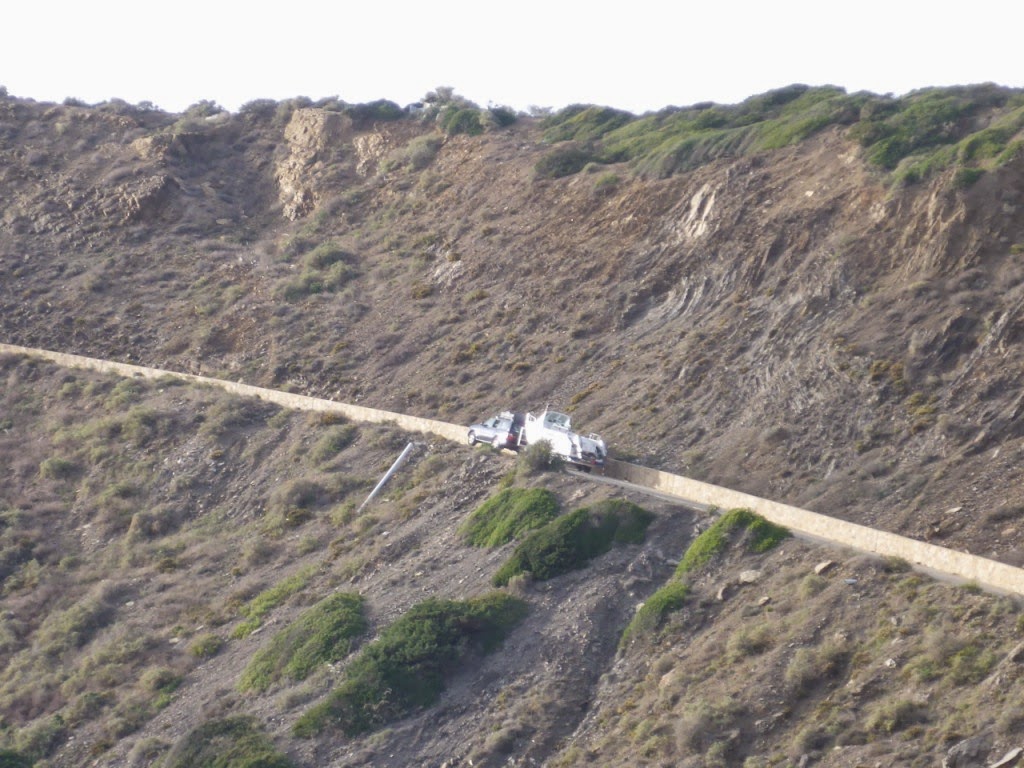

Ils remontent leur bateau
They pull their boat up the road


Le petit port
The little harbor


Notre annexe
Our tender


Belle vue sur la mer, d'en haut
Beautiful sea view, from the top


Le port et le village
The harbor and the village


Maja, vue du port
Maja, seen from the harbor


Arrifana, photo du guide
Le village et le port à droite
Arrifana, pictured in the guide:
The village and the harbor on the right


Arrifana de nuit
Arrifana by night


Saturday, 25 October 2014

24.10.2014 Sines

Vendredi 24 Octobre 2014

Quand nous nous réveillons Fitou est déjà parti et le gars espagnol aussi. Nous restons encore un jour à Sines, Jens nettoye l'hélice avec une brosse attachée à la gaffe et change l'huile du moteur pendant que je fais le blog puis nous faisons une balade vers l’ouest en vélo, la côte est sauvage. En rentrant nous faisons des courses à un Lidl. Lunch au bateau. Plusieurs bateaux arrivent dans l'après-midi, un Belge avec une famille de trois enfants assez jeunes, un Français, un grand beau voilier en bois norvégien qui ancre et un motor-sailor français avec un équipage agé. Le monsieur vient me demander si je parle français et à ma réponse affirmative, bavarde avec moi. Il a 81 ans et sa femme à peu près autant. Le bateau s’appelle Miss Froggy parce que sa femme, quand elle était jeune passait beaucoup de temps dans l’eau et un ami australien l’avait surnommée Miss Froggy (Miss Grenouille). Jacques, c’est son nom, travaille toujours: il est capitaine sur un super-yacht de 110 pieds (33 m) aux Etats-Unis avec quatre marins professionnels sous ses ordres. Le propriétaire de ce yacht lui paye le voyage en avion de France aux Etats-Unis, quand il a envie de faire une croisière. Bonhomme intéressant, mais très bavard. Nous allons diner en ville dans un petit café-restaurant. Nous mangeons comme des rois, salade, poissons frais plus un peu de calamar pour gouter, légumes, dessert, bière, café et liqueur pour 32 € pour nous deux. Demain nous partons de bonne heure. La météo est bonne et nous avons un grand bout à faire (74 MN ou 133 km, 14 heures minimum), ou autre possibilité, un ancrage à mi-chemin dans une baie sauvage.On verra. 

Friday, October 24, 2014

When we wake Fitou is already gone and also the Spanish guy. We remain one more day in Sines, jens cleans the propeller with a brush tied to the long hook and changes the oil in the engine while I write the blog and then we ride westward, towards the east coast which is quite wild. On returning we go shopping at Lidl. Lunch on the boat. Several boats arrive in the afternoon, a Belgian one with a family of three fairly young children, a French one, a big beautiful Norwegian wooden sailboat which anchors and a French motor-sailor with an old crew. The man comes to ask me if I speak French and at my affirmative answer, starts chatting with me. He is 81 years old and his wife almost as much. The boat is called Miss Froggy because his wife, when she was young spent much time in the water and an Australian friend had called her Miss Froggy. Jacques it is his name, is still working: he is captain on a super-yacht of 110 feet (33 m) in the United States with four professional sailors under his command. The owner of this yacht pays his trip from France to the United States, when he wants to take a cruise. Interesting guy, but very talkative. We dine out in a small coffee. We eat like kings, salad, fresh fish plus a little squid to taste it, vegetables, dessert, beer, coffee and liqueur for € 32 for two. Tomorrow we leave early. The weather is good and we have a long leg to make (74 NM or 133 km, minimum 14 hours), or alternatively, anchoring halfway in an open bay.We’ll see.


Sines


Vasco de Gama est né ici
Vasco de Gama was born here


Un ascenceur pour monter sur la falaise
(Il ne marche pas)
An elevator to climb the cliff
(It doesn't work)


Maja bien seule sur son ponton
Maja all alone on her pontoon


A la marina: on croyait que c'était un café, mais c'est où on jette les huiles usées
At the marina: we thought it was a café, but it is the place to throw away used oils


Chats
Cats


Côte sauvage
Unexploited beach


Piste cyclable
Bike path


C'est l'automne ici aussi
It is fall here too


Bon diner
Good dinner


Friday, 24 October 2014

23.10.2014 Sines

Jeudi 23 Octobre 2014

Jens va acheter du pain, je vais prendre une douche et Jens va payer la marina. Nous voulons aller dire bonjour à Francis et Yolande … mais ils sont déjà partis. Nous partons, nous, à 9 h 50, beau temps, petit vent de l’est. Nous essayons à la voile mais on n’avance vraiment pas vite alors on combine voiles et moteur. Je mets une photo de notre destination sur la carte, en ligne droite de Sesimbra à Sines, 30 MN. (54 km). Belle traversée, notre souci du moment, c’est les mouches! Nous en avons quelques unes au départ et elles arrivent de plus en plus nombreuses. Je comprends qu’elles soient contentes de faire escale sur Maja, mais on n’est pas d’accord. Armés du “Diáro de Notícias” (journal portuguais), nous menons bataille. Nous voyons des dauphins et apparemment une sorte spéciale de dauphins habite cet estuaire. A la marina de Sesimbra, un dépliant en Portuguais et Anglais expliquait ce qu’il fallait faire et ne pas faire pour aller observer les dauphins: ne pas s’approcher trop près etc… mais ce n’est pas notre problème, ce sont eux qui viennent nous observer. Nous baissons la grand voile, le vent a encore baissé. Nous voyons des fous de bassan et je me demande où ces grands et beaux oiseaux ont leurs nids. Jens m’appelle à un moment, il a vu un grand animal dans l’eau. C’est plus grand et plus massif qu’un dauphin et très clair. Je fais des photos, mais ce n’est pas facile de voir ce que c’est. Nous arrivons à Sines à 17 h. Sines est un très grand port et neuf navires font la queue pour entrer dans le port. Deux systèmes de digues protègent le port et la marina est tout à l’intérieur. Un gars nous attend sur le ponton et nous indique une place, mais en fait la marina est à moitié vide. Nous sommes le seul bateau sur un long ponton. Un gars espagnol vient nous dire bonjour et dit du bien de Maja. Il plaisante avec le nom: Maja en espagnol veur dire sorcière. Et qui voyons-nous, ancré à l’entrée de la marina: Fitou de Francis et Yolande. Nous allons nous baignés et marcher un peu dans la vieille ville. Sines est la première ville où nous ne voyons pas des hôtels, restaurants, bloc d’appartements de vacances. La vieille ville et sa petite plage sont restées authentiques, du moins ce qu’on en voit.

Thursday, October 23, 2014

Jens goes to buy bread, I take a shower and Jens pays the marina. We want to say hello to Francis and Yolande ... but they are already gone. We leave, at 9:50 am, with a light breeze from the east. We try to sail only but it goes really slowly so we combine sail and motor. I put a picture of our destination on the map, in a straight line from Sesimbra to Sines, 30 NM (54 km). Beautiful crossing our worry right now is the flies! We have some from the start and they come more and more. I understand that they are happy to make a stop in Maja, but we do not agree. Armed with the "Diario de Noticias" (a Portuguese newspaper), we conduct a valiant battle. We see dolphins and apparently a special kind of dolphins lives in this estuary. A Sesimbra marina, a leaflet in Portuguese and English explained  what to do and not to do when dolphin watching: do not get too close etc ... but it's not our problem, it is the dolphins who are watching us. We lower the sail, the wind dropped further. We see gannets and I wonder where these big, beautiful birds have their nests. Jens called me at one point, he saw a large animal in the water. It's bigger and more massive than a dolphin and very light in color. I  take pictures, but it is not easy to see what it is. We arrive at Sines at 5 pm. Sines is a major harbor and nine ships line up to enter the port. Two systems of dikes protect the harbor and the marina is well inside. A guy is waiting for us on the pontoon and shows us a place, but in fact the marina is half empty. We are the only boat on a long pontoon. A Spanish guys comes to say hello and speaks well of Maja. He jokes with the name: Maja in Spanish means witch. And who do we see anchored at the entrance to the marina: Fitou with Francis and Yolande. We go swimming and walk a little in the old town. Sines is the first city where we do not see hotels, restaurants and block of hollidays apartments. The old town and its small beach remain authentic, at least what we see.


50 mouillages qui doivent être pleins l'été
50 moorings which are full in sommer, I suppose


Bye, bye, Sesimbra


Notre destination
Our destination


Des dauphins
Dolphins


Fous de bassan (photo empruntée à un livre)
Gannets (picture found in a book)


Jens, armé du journal, est prêts a attaquer
Jens, armed with the newspaper, is ready to attack


Jens nettoye la grande fenêtre du toit 
Jens is cleaning the big window on the roof


Maja


Galopin
Naughty boy


La bête
The beast


Des navires qui attendent 
Waiting ships


Sines


Coucher de soliel
Sunset


Thursday, 23 October 2014

22.10.2014 Sesimbra

Mercredi 22 Octobre 2014

Pas de grandes expéditions aujourd’hui ni en vélo ni à pied. On va se promener en ville, allons acheter des cartes postales et des timbres à la poste. Nous suivons les indications ”Correios” et montons puis redescendons, en fait on fait un grand détour. C’est que ces indications sont pour les voitures, et comme toutes les rues, étroites, sont à sens unique, cela rallonge le chemin. Nous allons à la plage, rentrons déjeuner “à la maison”, puis travail au bateau, re-plage. C’est là que je fais ma BA (bonne action): je vois une famille anglaise avec deux enfants qui sont à l’endroit où il y a de grands rouleaux. Les enfants ne peuvent pas se baigner. Alors je m’approche et leur indique l’autre bout de la plage, plus près du port, où la mer est beaucoup plus calme. Ils me remercient et déménagent.Quand nous rentrons à la marina, un bateau français vient d’arriver, c’est Fitou (Francis et Yolande, je crois) que nous avions vu à Moaña en Août!  Bon petit diner pour bien terminer notre séjour à Sesimbra au Café Filipe (ce n’est pas Casa Felipe) où nous dégustons un excellent poisson, un “robalo” (loup de mer?). Nous partons demain pour Sines, plus au sud. Nous nous rappellerons de Sesimbra avec plaisir, ville agréable, belle plage et très beau temps.

Wednesday, October 22, 2014

No big expeditions today, neither by bike or on foot. We go for a walk around town, buy postcards and stamps at the post office. We follow the signs "Correios" (postoffice) and then walk up and go down, in fact we make ​​a long detour. It is that these signs are for cars, and as all the narrow streets are one-way, the distance is much longer. We go to the beach, lunch  "at home", work on the boat and back to the beach. This is where I do my BA (bonne action, good deed): I see an English family with two children who are at the point where the sea is breaking, the children can’t go swimming. So I approached them and indicates to them the other end of the beach, closer to the harbor, where the sea is much calmer. They thank me and move there. When we return to the marina, a French boat has just arrived, it's Fitou (Francis and Yolande, I think) that we had seen in Moaña in August! Nice dinner, to end our stay in Sesimbra at the Café Filipe (not Casa Felipe) where we enjoy a good fish, "robalo" (sea bass). We leave tomorrow for Sines, further south. We will remember Sesimbra with pleasure, nice town, beautiful beach and great weather.


Sesimbra est un port de pêche actif
Sesimbra is an active fishing harbor


Une vieille quincaillerie: les tiroirs sont en bois
An old  hardware store: the drawers are in wood


La Fortaleza


La place
The square


L'église
The church


La plage
The beach


Une libellule qui se repose sur la manche de Jens
A dragonfly which is resting on Jens' sleeve


La plage
The beach