Monday, 20 April 2015

19.04.2015 Isla de Tabarca

Dimanche 19 Avril 2015

Je me lève à 4 h 20 et je vois que le voilier voisin est déjà parti. Jens se réveille vers 5 h et tous les deux, on remarque que Maja bouge pas mal, les vagues rentrent un peu dans le port, le vent a tourné. Donc on décide de la tirer un peu le long du quai et de prendre la place du voilier qui est parti. Le quai fait un coude et on sera un peu plus à l’abri comme ça. On démarre le moteur, Jens monte sur le quai en pyjama et tire Maja et moi je donne un petit coup de moteur pour l’aider, c’est contre le vent. En 5 mn, c’est fait, Maja est amarrée à sa nouvelle place et on se recouche. Nous avions pensé rester une nuit ici, mais on décide, en prenant le petit-déjeuner, de rester encore un jour ici. Le matin, nous allons à la découverte de l’ile de Tabarca. Une partie est fortifiée et construite et une autre, plus grande, est une lande. Nous allons sur la lande jusqu’au bout, à peu près 2 km, nos seuls compagnons sont des mouettes et des chats. Nous rentrons, et vers 11 h, les touristes commencent à arriver en ferries et en bateau privés. Nous trouvons qu’ils sont nombreux, mais un policier avec lequel nous discutons, dit que ce n’est rien par rapport à l’été. Un poste de police est toujours ouvert et trois policiers veillent sur … 15 habitants (l’hiver) ! On est en sécurité ici. Nous voulons soutenir l’économie locale et allons au restaurant, il y a au moins 20 restaurants, on a de quoi choisir. Nous allons au « Almadraba » qui a une belle vue sur le port et la mer. Une grande table est occupée par des Norvégiens. Ensuite, nous allons au musée locale et, étant plus de 65 ans, nous rentrons gratuitement. L’ile a été occupée par les pirates, abandonnée puis repeuplée au 18 ème siècle par des prisonniers de pirates rachetés à la Tunisie par l’Espagne. Pauvres gens, on les met là sur une ile aride, sans eau, mais ils ont survécu, apparemment. L’ile a été fortifiée et a servi de poste de défense aussi. La pêche a été la principale ressource et une des techniques était donc cette « almadraba », un labyrinthe de filets d’où les thons ne pouvaient plus sortir. Maintenant, l’ile et ses alentours sont une réserve naturelle où on ne peut pas pêcher. Vers 17 h, les touristes commencent à repartir et vers 20 h, les derniers à partir sont les employés des restaurants. A 20 h 30, nous avons pratiquement l’ile pour nous. Nous allons voir le soleil se coucher puis faisons de même.  
     
Sunday, April 19, 2015

I get up at 4:20 am and I see that the neighbor sailboat is gone. Jens wakes up at around 5 am and both, we note that Maja is  moving more, waves are entering a little in the harbor, the wind has turned. So we decide to pull Maja a little along the dock and take the place of the boat which is gone. The dock makes a bend and it will be a little quieter there. The engine is started, Jens climbs on the dock in pajamas and pulls Maja while I give a little push with the engine to help, it's against the wind. In 5 minutes, it's done, Maja is moored to her new place and we go back to bed. We had planned to stay one night, but we decide, while eating breakfast, to stay one more day here. In the morning, we are going to explore the island of Tabarca. One part is fortified and built and another larger one is a moor. We are going to the end of the moor, about 2 km, our only companions are seagulls and cats. We return, and at around 11 am, tourists began arriving in ferries and private boats. We find that they are many, but a policeman with whom we talk, says it is nothing compared to the summer. A police station is  open and three police officers take care of ... 15 inhabitants (in winter)! We are safe here. We want to support the local economy and go to a restaurant, there are at least 20 restaurants, we have enough to choose from. We go to the "Almadraba" which has a beautiful view of the harbor and the sea. A large table is occupied a group of Norwegians. Then we go to the local museum and being over 65 years, we don’t pay. The island was occupied by pirates, abandoned then repopulated in the 18th century by prisoners taken by  pirates and bought back from Tunisia by Spain. Poor people, they were put here on a barren island, where there was no water, but they survived, apparently. The island was fortified and served as a defense post too. Fishing was the main resource and a technic used was this "almadraba", a labyrinth of nets where the tuna fish could not escape. Now the island and its surrounding area are a nature reserve where fishing is not allowed. At around 5 pm, the tourists begin to leave and at 8 pm, the last to leave are the restaurant employees. At 8:30 pm, we have the island (almost) just for us. We go to see the sunset and then go home to Maja.

Jens, en pyjamas, sur le quai, à 5 h du matin
Jens, in his pajamas, on the dock, at 5 am


Dimanche matin
Sunday morning


La lande et le phare
The moor and the lighthouse


La côte
The coast


Le point le plus à l'est de l'ile
The eastern end of the island


Un nid de mouette
A seagull's nest


Un des ferries
One of the ferries


Dimanche après-midi
Sunday afternoon


L'entrée du village
The village entrance


Une rue
A street
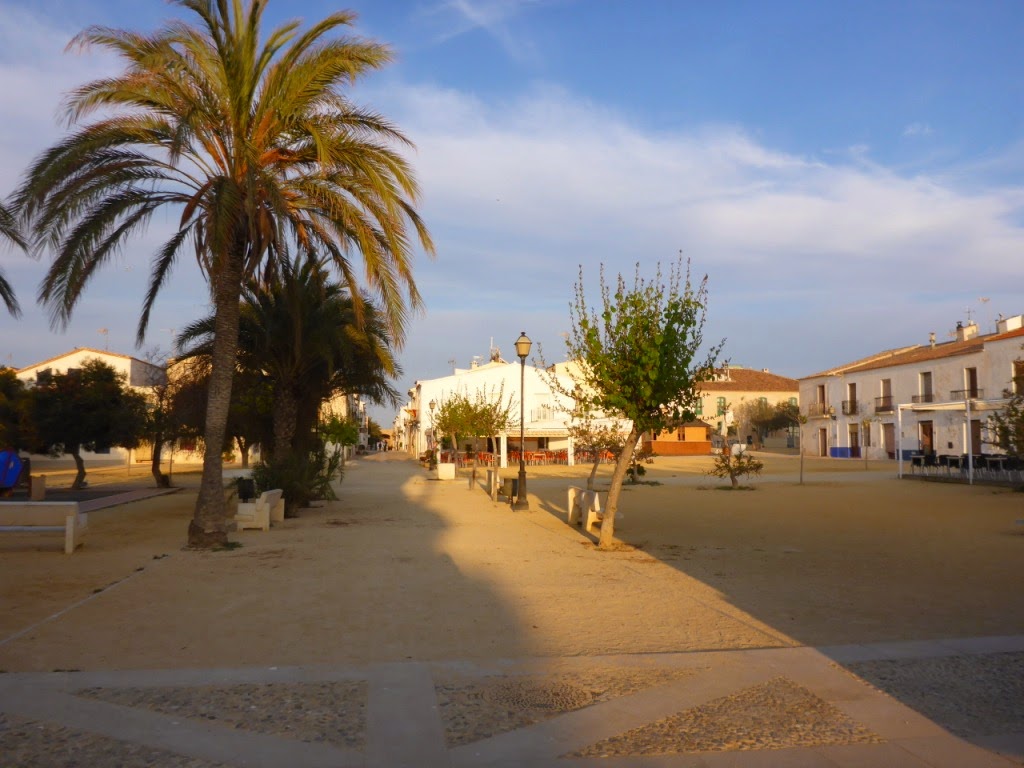

La grand place
Main square


L'église
The church


La muraille
The wall


Un petit chat sur une grande muraille
A little cat on a big wall


Dimanche soir
Sunday evening


Tabarca


Sunday, 19 April 2015

18.04.2015 Isla de Tabarca

Samedi 18 Avril 2015

Nous partons à 9 h 20 sous un beau ciel bleu et sur une mer toute calme. La côte est rude, montagneuse et donc non construite.  Nous allons d’abord vers l’est, passons le Cabo de Palos et son haut phare puis montons nord vers Alicante.  Juste après ce cap, nous longeons « El Mar Menor », une mer intérieure séparée de la vraie mer par une étroite bande de terre toute construite d’hôtels et d’immeubles. Les bateaux peuvent rentrer dans cette Mar Menor par un canal, mais nous ne nous y arrêtons pas. Le vent se lève un peu, il fait beau et on se sent, pour la première fois depuis que nous sommes redescendus, en Méditerranée. Nous pensions aller directement à Santa Pola, un peu avant Alicante. Jens a commandé une pièce pour le moteur qui sera livrée à un atelier à Santa Pola, mais en route, en regardant le guide, il lui vient l’idée d’aller à une ile en face de Santa Pola, l’ile de Tabarca. Je suis d’abord un peu sceptique, mais le temps étant beau, je me laisse convaincre. Le port est tout petit et, comme on est samedi, ce n’est pas sûr qu’il y ait de la place. On essaye. Nous faisons un grand détour, l’ile est entourée de rochers et récifs. Nous y arrivons à 7 h 20, et par chance, seul un autre voilier est au quai. Les autres bateaux appartiennent à des résidents. Il faut rentrer dans ce port avec précaution, ce n’est pas profond partout. On demande si on peut se mettre à couple sur l’autre voilier, mais le gars nous dit que c’est assez profond juste derrière lui, donc on se met là. Ce n’est pas un port bien protégé par vent du nord-ouest mais le vent étant du sud, ça va. D’après notre voisin, le vent va tourner cette nuit, mais il va rester  raisonnable. Lui et ses deux équipiers vont partir cette nuit à 4 h du matin pour aller à la Mer Menor. Nous allons faire un petit tour, ile très particulière au village fortifié, puis nous dinons du reste de poulet, avec de la salade, c’est bon.

Saturday, April 18, 2015

We start at 9:20 am under a beautiful blue sky and on a calm sea. The coast is rugged, mountainous and thus not built. We first go eastward, pass the Cabo de Palos and its high lighthouse and then turn north towards Alicante. Just after this cap, we follow "El Mar Menor", an inland sea separated from the real sea by a narrow strip of land all built by hotels and buildings. Boats can enter the Mar Menor by a canal, but we don’t  stopt. The wind picks up a bit, it's nice and we feel, for the first time since we came down again, on the  Mediterranean. We thought to go to Santa Pola, just before Alicante. Jens has ordered a piece for the engine to be delivered at a workshop in Santa Pola, but on the way, looking at the guide, he comes up with the idea of ​​going to an island in front of Santa Pola, the island of Tabarca . I am initially a bit skeptical, but the weather is beautiful, and I let myself be convinced. The harbor on this island is very small and, as it is Saturday, it is not sure that there is room. We try. We make a wide detour, the island is surrounded by rocks and reefs. We get there at 7:20 pm, and luckily, there is only one other sailboat at the dock. The other boats are owned by residents. We must go into this port with caution, it is not deep everywhere. We ask if we may tie along the other sailboat, but the guy tells us it is deep enough just behind him, so we go there. This harbor is not protected property by northwest wind, but the wind is from the south, so it’s OK. According to our neighbor, the wind will turn tonight, but it will stay reasonable. He and his two teammates are going to leave tonight at 4 am to go to the Mar Menor. We go for a walk, it is a very special island with a fortified village, then dine of cold chicken,  eaten together with salad it is very good.


Bye, bye Cartagena


Le port de Cartagena, bon port naturel
Cartagena harbor, a good natural harbor


Elevage de poissons
Fish farming


Côte montagneuse
Mountainous coast


Cabo de Palos


El Mar Menor


"Un mur de béton"
"A wall of concrete"


La belle vie
Good life


Isla de Tabarca


On entre dans le port
We are arriving in the harbor


Le/the quai


Tabarca


Tabarca


17.04.2015 Cartagena

Vendredi 17 Avril 2015

Quand on se réveille, on voit vers le sud un mur noir ! C’est un super bateau de croisière hollandais le « Eurodam » qui est arrivé cette nuit , et on n’a rien entendu. Un peu plus tard arrive un autre, hollandais aussi, l’ »Amsterdam ». Nous allons faire une promenade à pied pour voir la vieille ville. A 100 m l’un de l’autre, on peut voir un amphithéatre romain, une église, une ruine carthaginoise et un immeuble moderne. Nous montons voir le château sur une colline, la montée est ombragée, fleurie et, en haut, on voit même un paon qui nous fait l’honneur de faire la roue. Dans le château, une exposition présente l’œuvre de Leonardo da Vinci. Quel génie, il avait imaginé un vélo, un parachute, une sorte d’hélicoptère, un bateau à roue … Nous redescendons et rentrons déjeuner au bateau. L’après-midi est calme, Jens bricole et je fais le blog. Vers 17 h, je mets un poulet et des pommes de terre au four. Je sors pour poster une carte postale et suis surprise de voir une foule bruyante et enthousiste : c’est l’arrivée d’une course d’enfants. Nous dinons de notre excellent poulet, au soleil puis allons faire notre petit tour de la soirée, et sur une grande place près de la mer, nous assistons à la cérémonie de la descente du drapeau espagnol au son de l’hymne national (je présume). La météo est bonne, nous partons demain. Cartagena nous beaucoup plu, ville historique et moderne, animée, propre et fleurie et en plus au port très bien protégé et au cœur de la ville.

Friday, April 17, 2015

When we wake up, we see a black wall south of us! It's a huge Dutch cruise ship, the "Eurodam" which arrived last night, and we heard nothing. Later comes another one, Dutch, too, the "Amsterdam". We take a walk  to see the old town. 100 m from each other, we can see a Roman amphitheater, a church, Carthaginian ruins and a modern building. We go up to see the castle on a hill, the climb is shaded, flowered, we even see a peacock that makes us the honor of spreading its tail. In the castle, an exhibition presents the work of Leonardo da Vinci. What a genius, he had imagined a bicycle, a parachute, a kind of helicopter, a boat with wheel ... We return to Maja to eat lunch. The afternoon is quiet, Jens is working on the boat and I do the blog. At around 5 pm, I put a chicken and potatoes in the oven. I go to post a postcard and am surprised to see a noisy and enthousiastic crowd: it is the finish line of a children's race. We dine of our excellent chicken, in the sun and do our small walk of the evening, and on a large square near the sea, we witness the ceremony of the descent of the Spanish flag as the national anthem (I presume) is played. The weather is good, we leave tomorrow. We really liked Cartagena, historical and modern city, vibrant, clean and flowered, and in addition with a harbor very well protected and in the heart of the city.


Eurodam


L'ancienne Plaza de toros
The old Plaza de toros


Amphithéatre romain et église
Roman amphitheater and church


Montée vers le château
Going up to the castle


Il lave le bassin aux canards
He is washing the ducks bassin


Le port vu d'en haut
The harbor seen from the top of the hill


Maja est au centre de la photo
Maja is in the center of the picture


Le paon 
The peacock


Le vélo de Leonardo da Vinci
Leonardo da Vinci's bike


Un Fisher catamaran!


Il y a beaucoup de méduses dans le port
There are many jellyfish in the harbor


Le mat fait au moins 50 m
The mast measures at least 50 m


L'arrivée de la course des enfants
The finish line of the children's race


Miam, miam


La descente du drapeau
The flag is taken down


Monarda?
Cartagena


Saturday, 18 April 2015

17.04.2015 Cartagena

Samedi 18 Avril 2015

Arrivés ce soir à 19 h 20 à l'ile de Tabarca, en face de Santa Pola, un peu au sud d'Alicante. Pas le temps d'écrire le blog de vendredi, je le ferai demain.
Bonne nuit

Saturday, April 18, 2015

Arrived late this evening, at 7:20 pm on the island of Tabarca, in front of Santa Pola, a liitle south of Alicante. No time to write fridays blog, I'll do it tomorrow.
Good night


Cartagena


Friday, 17 April 2015

16.04.2015 Cartagena

Jeudi 16 Avril 2015

Bonne nuit tranquille. Nous commençons à prendre le petit-déjeuner, bien emmitoufflés parce qu’il ne fait pas chaud quand on voit arriver un super voilier, le « Wind Star » qui se met à un quai. Nous mordons une bouchée de tartine et on voit arriver un bateau de croisière « Aida », c’est drôle je suis sure de l’avoir déjà vu, à Bergen je crois. Il se met juste derrière nous. On a du spectacle, ce matin. Nous allons nous enregistrer à la marina et on peut rester à la place où nous sommes. Nous allons nous promener en ville, il fait beau mais pas très chaud à cause du vent. Vers 11h, nous cédons à la tentation : depuis que nous sommes en Espagne du sud, nous rêvons d’une « tostada de tomate », du pain grillé avec des tomates crues concassées et de l’huile d’olive. Et on ne l’a pas encore eu. Donc aujourd’hui, on prend un second petit-déjeuner. C’est bon !  Rentrés au bateau, nous demandons à déménager: « Aida » a un moteur qui marche tout le temps pour faire de l’électricité et cela fait du bruit. On change donc de place en fin de matinée, mais on est, bien sûr, le long d’un ponton. Jens va mettre une lessive à laver et cela sèche bien avec le vent. L’après-midi, nous faisons un tour en vélo dans la Cartagena moderne, sur une bonne piste cyclable. Quand nous rentrons, « Aida » est en train de partir et « Wind Star » est déjà parti. Ils ne restent pas longtemps dans une ville. Bon petit diner au soleil sur Maja et soirée calme.

Thursday, April 16, 2015

Good quiet night. We begin to take breakfast outside although with a lot of cloths because it's quite chilly when we see a super yacht, the "Wind Star" coming in the harbor. We bite a mouthful of bread and see a cruise ship "Aida", it's funny I'm sure I have already seen her, in Bergen I think. She berths right behind us. Good untertainment, this morning. We go to register at the marina and we can stay in the place where we are. We walk around town, the weather is nice but not very hot because of the wind. Around 11 am, we give in to temptation: since we are in southern Spain, we dream of a "tostada de tomate", a toast with crushed raw tomatoes and olive oil. And we did not had it yet. So today we take a second breakfast. This is good! Back to the boat, we ask to move: "Aida" has an engine that runs all the time to make electricity and it is noisy. Thus we change place in the late morning, but we are, of course, along a pontoon. Jens puts on a laundry and it dries well with the wind. In the afternoon, we take a bike ride in the modern Cartagena, on a good bike path. When we come back, "Aida" is about to leave and "Wind Star" is already gone. They do not stay long in a city. Good diner in the sun on Maja and calm evening.


Il ne fait pas chaud
It's not very warm


Wind Star


Aida


Catagena


L'homme sans tête
The man without a head


La tostada de tomate


Aida, Maja


Le linge sèche bien
The laundry is drying well


Une rue
A street


Une rue piétonne
A pedestrian street


Catagena