Friday, 3 October 2014

30.09.2014 Cascais

Mardi 30 septembre 2014

Nous nous couchons donc et nous sentons assez rapidement que les vagues augmentent, Maja roule et roule de plus en plus. C’est curieux, le vent est du nord-ouest et nous sommes à l’abri au sud-est. Mais les vagues doivent tourner autour de l’ile et nous prendre sur le côté est. Le mouvement est si important que nous devons nous cramponner pour ne pas tomber du lit. Et les deux couchettes à l’avant n’ont pas de poignées puisqu’on ne les utilise jamais en mer. Tout cogne et bouge, et pourtant c’était bien calé. Jens s’endort quand même mais pas moi. Il fait noir comme dans un four mais toutes les 8 secondes le phare émet une grande lueur blanche. Et la sarabande continue. Vers 3 h du matin, le vent a un peu tourné et l’annexe qui est amarrée derrière Maja est bien près de cogner une bouée d’un casier. Jens se réveille, évalue la situation, et décide de remonter l’annexe sur Maja. Plus facile à dire qu’à faire. Maja roule mais l’annexe cabriole dans tous les sens. Nous la tirons parallèle à Maja et Jens descend dedans. Je la tiens avec une corde mais elle bouge beaucoup quand même et cogne Maja. J’essaye de mettre une défense entre Maja et elle, mais elle cogne soit au dessus soit en dessous de la défense. Jens se tient d’une main à Maja et de l’autre essaye de détacher les rames qui sont sécurisées pour ne pas tomber à l’eau. Cela ressemble plus à du rodeo qu’à autre chose. Au bout de deux minutes, je lui ordonne (ah mais!) de remonter, je ne veux pas perdre mon bonhomme à Berlenga. Il remonte et a une idée: il va s’assurer avec son harnais. Il met donc son harnais sur son pyjama (don’t il a retrousser les jambes), l’accroche à un point fort de Maja et y retourne. Il réussit à me passer les rames, les dames de nage et l’écope. Bon. Il remonte sur Maja et on arrive à tirer l’annexe et à la monter sur Maja. Nous nous recouchons mais c’est une nuit avec peu de sommeil.
Nous partons à 9 h 30, par un beau soleil et un bon vent du nord-nord-ouest, force 4-5, avec pointes à 6. Nous allons à la voile toute la journée avec foc et mizaine, le vent à 10-20 degrés sur le côté et nous avons une bonne vitesse. Les vagues sont un peu grosses mais régulières, soulèvent Maja par derrière et passent dessous. Une très bonne journée de voile. On ne peut rien faire donc on écoute de la musique. Nous passons le Cabo da Roca (point le plus à l’ouest d’Europe) puis le Cabo Raso et tournons le coin pour aller vers l’est, vers Lisbonne. Il est tard et nous nous arrêtons à Cascais, juste après “le coin”. Il est 19 h 45 et le bureau de la marina ferme à 20 h. On a de la chance, à partir de demain, premier octobre, il fermera à 18 h. Nous amarrons Maja et allons fair un petit tour en ville qui parait méditerranéenne et en plus, même si tard il fait chaud. Cascais est une station balnéaire huppée depuis que le roi du Portugal en avait fait sa ville de vacances au dix-neuvième siècle et est très touristique aujourd’hui. La marina a plusieurs restaurants chics, avec maitre d’hôtel et serviteurs en long tabliers. Non, non, on ne dine pas là. On va en ville et mangeons bien pour  moitié prix.

Tuesday, September 30, 2014

So we go to bed and we feel pretty quickly that the waves are becoming bigger, Maja rolls and rolls more. It's funny, the wind is from the northwest and we are sheltered southeast. But the waves must run around the island and take us on the east side. The movement is so important that we must hold on for not falling out of bed, and the two berths in the front have no handles because we never use them at sea. Everything is crashing and moving, and yet it was stalled. Jens is still asleep but not me. It's very dark, but every 8 seconds the lighthouse emits a powerful white glow. And the sarabande continues. At around 3 am, the tide has turned a little and the tender which is tied behind Maja is very close to hitting a lobster pot. Jens wakes up, assesses the situation and decides to take the tender back on Maja. Easier said than done. Maja is rolling but the tender is jumping in all directions. We pull it parallel to Maja and Jens goes down in it. I keep it with a rope but it moves a lot anyway and knocks Maja. I try to put a fender between Maja and the tender, but it hits either above or below the fender. Jens stands with one hand on Maja and the other trying to detach the oars which are secured to avoid falling into the water. It's more like a rodeo than anything else. After two minutes, I order him (!) to come  back on Maja, I don't want to lose my man in Berlenga. He goes up and gets an idea: he'll put on his harness. So he put his harness on his pajamas (he has rolled up it legs), secures the harness on Maja and returns in the tender. He managed to give me the oars, oarlocks and the scoop. Good. He goes up on Maja and we manage to pull the tender on Maja. We go back to bed but it's a night with little sleep.

We start at 9: 30 am, with a bright sun and a strong wind from the north-northwest, force 4-5, with peaks up to 6. We will sail all day with jib and mizaine, wind at 10 to 20 degrees to the side and we have good speed. The waves are a bit big but regular, raising Maja from behind and passing underneath her. A very good day of sailing. We can’t do anything so we listen to music. We pass the Cabo da Roca (furthest west point in Europe) and the Cabo Raso and turn the corner to go east towards Lisbon. It's late and we stop in Cascais, just after "the corner." It is 7:45 pm and the marina office closes at 8. We are lucky, starting tomorrow, October 1st, it will close at 6 pm. We tie Maja and go for a walk in town that seems méditerranean and even so late, it is still hot. Cascais is a posh seaside resort since the King of Portugal made it his holiday town in the nineteenth century and today is very touristy. The marina has several upscale restaurants, with butler and servants in long aprons. No, no, we did not dine there. We go into town and eat well for half the price.


Trois heures du matin: Jens avec son harnais sur son pyjama.
Il tient l'annexe
Three o'clock am: Jens with his harness on his pyjamas.
He is holding the tender


L'annexe est remontée sur Maja
The tender is again on Maja


Bye, bye Berlenga


Sous voile
Plain sailing


Les vagues
The waves


Cabo da Roca


Le phare à Cabo da Roca
Cabo da Roca lighthouse
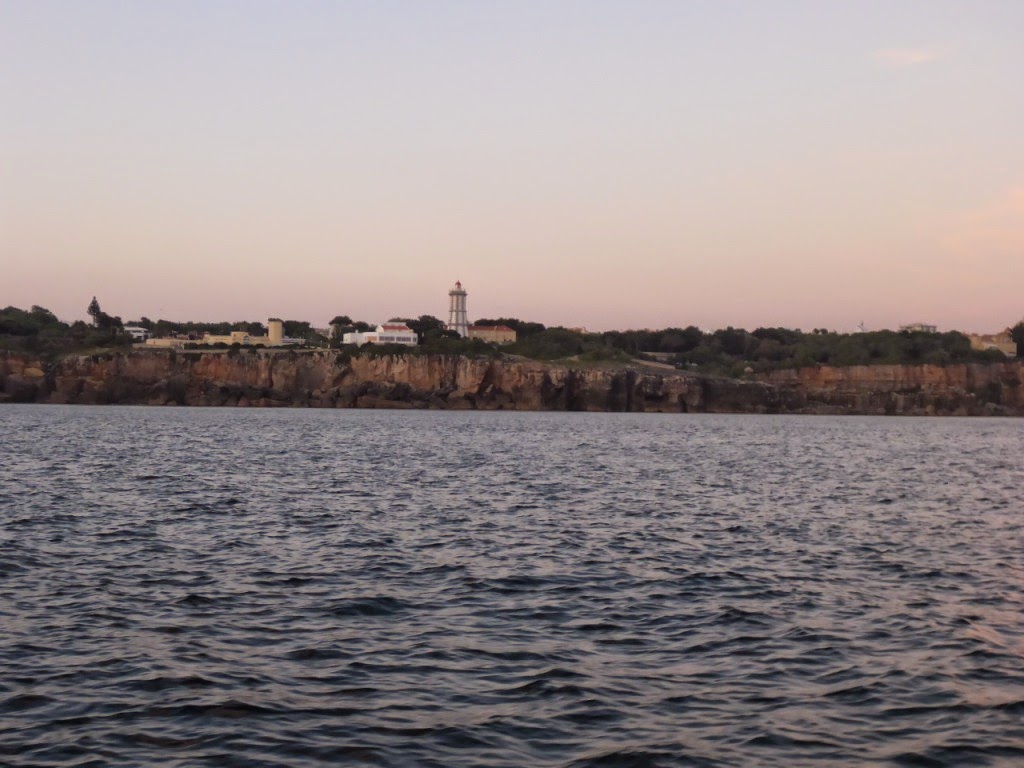

Juste après le coin, c'est plus calme
just after the corner, it is quieter


Arrivée à Cascais


Thursday, 2 October 2014

29.09.2014 Ilha de Berlenga 39 24 N 9 30 W

Lundi 29 septembre 2014

Très beau temps, très calme. Deux officiels du port viennent demander tous nos documents, personnels et du bateau. Ils sont souriants et parlent bien anglais. Fritz et Margret viennent nous dire au revoir et nous partons à 9 h. C’est si calme que nous décidons d’aller à une ile en face du port de Peniche, l’ile de Berlenga. Le guide dit bien qu’il ne faut y aller que par temps très calme. Nous sommes au moteur, il n’y a pas un souffle. Journée calme, relax, juste un peu de houle nous berce, d’ailleurs nous faisons une sieste à tour de rôle. Nous admirons les mouvements gracieux d’un groupe de dauphins et cela mettrait le plus grincheux de bonne humeur. Nous arrivons à Berlenga à 13 h 30 h. Pas un autre voilier en vue. Nous nous approchons d’une grosse vedette à un mouillage où un homme est en train de pêcher. Jens demande s’il parle anglais, non, mais il parle un peu espagnol. Jens demande si on peut ancrer, il dit que oui et encore mieux nous propose un mouillage. Il n’y a que trois mouillages au sud-est de l’ile, à l’abri d’une falaise, deux assez forts et le troisième pour un petit bateau. Quelle chance. Nous nous mettons donc à l’autre mouillage et nous mangeons notre lunch. Puis nous allons à terre avec l’annexe. L’ile est sauvage, aride, les rochers sont roses et elle abrite une colonie de mouettes. Quelques maisons, construites dans les années vingt par un bienfaiteur, toutes blanches, sont maintenant utilisées comme maisons de vacances. Au seizième siècle, un monastère se trouvait sur l’ile et était pillé régulièrement par les pirates. Un fort fut donc construit pour défendre le monastère. Le monastère a disparu mais le fort est toujours là. Nous tirons l’annexe sur la petite plage et nous nous baignons, l’eau est au moins à 22 ⁰ et l’eau est très claire. L’ile étant un parc naturel, il faut suivre les sentiers et ne pas cueillir de fleurs ni déranger les oiseaux. Nous montons au phare, admirons Maja de loin et redescendons. A cinq heure la vedette (celle du mouillage) vient chercher les touristes et les emmène à Peniche, nous avons donc l’ile pour nous tout seuls. C’est si calme que nous décidons de rester dormir ici cette nuit. Nous retournons sur Maja, je travaille au blog et Jens fait le diner. Maja roule, de petites vagues nous arrivent sur le côté, mais c’est supportable. Diner très romantique, mais je ne peux pas dire au calme: les mouettes piaillent à qui mieux mieux  et les vagues se brisent sur les rochers en faisant un grand vacarme. Tout va bien … si on savait ce qui nous attend cette nuit! A suivre.
 
Monday, September 29, 2014

Great weather, very quiet. Two port officials come to us to ask all our documents, personal and from the boat. They are nice and speak good English. Fritz and Margret come to say goodbye and we leave at 9 am. It is so quiet that we decide to go to an island, opposite the port of Peniche, the island of Berlenga. The guide said that one should go there only by very calm weather. We motor, there is not a breath. Calm day, relax, just a little swell rocks us, and we nap in turn. We admire the graceful movements of a group of dolphins and this would make a grumpy person smile. We arrive at Berlenga at 1:30 pm. Not another sailboat in sight. We are approaching a passenger boat at a mooring where a man is fishing. Jens asks if he speaks English, no, but he speaks a little Spanish. Jens wonder if we can anchor, he said yes and even better offers us a mooring. There are only three moorings southeast of the island, under a cliff, two strong enough and the third one for a small boat. What luck. So we pick up the mooring and we eat our lunch. Then we go ashore with the tender. The island is wild, arid rocks are pink and is home to a colony of seagulls. Some houses built in the twenties by a benefactor, all white, are now used as holiday homes. In the sixteenth century, a monastery was on the island and was regularly raided by pirates. A fort was built to defend the monastery. The monastery has disappeared but the fort is still there. We pull the tender on the small beach and we swim, the water is at least 22 ⁰ and the water is very clear. The island is a nature park, so we must follow the trail and do not pick flowers or disturb the birds. We climb to the lighthouse, we admire Maja from afar and descend. At 5 pm, the passenger boat (the one which was at the mooring) picks up the tourists and leave to Peniche, so we have the island to ourselves. It is so quiet that we decide to stay tonight here. We return on Maja, I work on the blog and Jens makes ​​dinner. Maja rolls, small waves come to us on the side, but it's bearable. Dinner very romantic, but I can not say calm: the seagulls are squawking and the waves breaking on the rocks are making a great noise. All is well ... if we knew what to expect tonight! To be continued.


Bye, bye Nazaré


La houle: il est en haut
The swell, this boat is up


Il est en bas
She is down


Mer calme
Calm sea


Dauphins
Dolphins


L'ile de Berlenga
Berlenga island


Berlenga


Jens va parler avec l'homme de la vedette
Jens goes to talk with the man on the passenger boat


Nous déjeunons. Le fort derrière moi
We eat lunch. The fort is back me


Maja au mouillage
Maja at the mooring


Nous allons à terre
We row to land


Berlenga


Un petit bateau, la vedette et Maja
A little boat, the passenger boat and Maja


Le phare
The lighthouse


Sol caillouteux
Rocky soil


La seule plante qui pousse bien: une plante grasse aux grosses fleurs jaunes ou roses
The only plant which grows well there: a succulent with big pink or yellow flowers


Curieux: la plante s'arrête au chemin
Strange: the plant stops at the path


La vedette vient chercher les touristes
The passenger boat comes for the tourists


Belle soirée
Nice evening


La plante qui pousse bien ici
The plant growing well here


Wednesday, 1 October 2014

28.09.2014 Nazaré

Dimanche 28 septembre 2014

Le beau temps est revenu. Nous allons, à pied voir la plage au sud du port. Nous passons un mur où les visiteurs en bateau font une peinture, comme à Horta aux Azores. Uwe et Dorothea ont fait une peinture en 1993 et ont ajouté une nouvelle date à chaque passage: 1993, 2002 et maintenant 2014. La plage où nous allons a un gros rouleau et personne ne s’y baigne. Mais deux gars font du surf. Nous pédalons ensuite en ville et allons au marché. Les femmes de Nazaré sont célèbres pour leur costume, qu’elles portent encore. Elles ont sept jupons et ces jupes et jupons sont courts. Les couleurs sont vives et la jupe de dessus est souvent écossaise. Les vieilles dames ont le même costume mais en noir. Et sur la tête elles portent soit un foulard soit une sorte de turban comme les femmes à la Martinique. Nous rencontrons Dorothea et bavardons un peu. Baignade et comme personne ne se baigne en monokini ici, je remets un vieux bikini acheté il y a … quarante ans. Nous déjeunons au bateau puis je travaille un peu au blog. Jens est sur le ponton et, tout à coup, m’appelle. Je sors et, surprise, nous voyons arriver “Longway”, Fritz et Margret. Nous sommes tous heureux de nous revoir. Et ils n’arrivent pas seuls, ils sont avec “Conquistador”. Ils nous avient parlé de ce bateau, qu’ils avaient rencontré plusieurs fois. Nous faisons donc connaissance avec son équipage, Jacob et Vicky, deux jeunes Danois. Enfin un couple jeune! La majorité des gens qui voyagent en bateau sont dans les soixante ans ou plus. Jacob et Vicky, ayant le plus grand bateau (44 pieds), nous invitent tous à boire un verre. Ils ont acheté ce bateau il y a 6 ans, em mauvais état. Ils ont travaillé 6 ans pour le retaper et le rendre présentable puis ils sont partis. Nous passons un bon moment ensemble puis Jens propose que nous mangions tous ensemble en faisant un “pot luck”, en apportant chacun quelque chose. Uwe et Dorothea, qui rentrent de Nazaré, sont invités aussi. Nous nous retrouvons donc à 19 h 30 sur Conquistador et nous nous rappèlerons longtemps de ce diner et de cette soirée si agréables. Merci à tous. 

Sunday, September 28, 2014

The good weather is back. We're going on foot to see the beach south of the harbor. We pass a wall where visitors by boat make a painting, as in Horta in the Azores. Uwe and Dorothea made a painting in 1993 and have added a new date each time: 1993, 2002 and now 2014 The beach where we go have a big wave and no one can swim. But two guys are surfing. We then ride into town and go to the market. Women of Nazaré are famous for their costumeand they still wear it. They have seven petticoats and skirts and these are short. The colors are bright and the overskirt is often like the material Scottish. Old ladies have the same costume but in black. And on the head they wear either a scarf or a kind of turban like women in Martinique. We meet Dorothea and chat a bit. We go swimming but nobody swims topless here, so I put on an old bikini bought ... forty years ago. We lunch at the boat and I work a little on the blog. Jens is on the pontoon and suddenly he calls me. I go out and, surprise, a boat is coming in, "Longway" with Fritz and Margret. We are all happy to see each other. And they don’t come alone, they are with "Conquistador." They talked befor about this boat they had met several times. So now we meet her crew, Jacob and Vicky, two young Danes. Finally a young couple! The majority of people who travel by boat like us are sixty or older. Jacob and Vicky, with the biggest boat (44 feet), invite us all to a drink. They bought the boat 6 years, in bad shape. They worked 6 years for restauring her and make her presentable and then they left. We spend a good time together and Jens suggest we all eat together making a "pot luck", each of us bringing something. Uwe and Dorothea, who return from Nazaré, are invited too. So here we are at 7:30 pm on Conquistador and we will remember for a long time this dinner and this good evening. Thank you to all.


Les peintures sur le mur
The paintings on the wall


La peinture de Uwe et Dorothea. Aquaria
Uwe and Dorothea's painting. Aquaria


Les deux surfeurs
The two surfers


Surf


Femme portant le costume traditionnel de Nazaré
Woman wearing the traditional Nazaré costume


Même costume en noir
Same costume in black


Longway arrive


Jens, Fritz, Margret


Vicky, Jacob


Le diner: Vicky, Margret, Fritz


Jacob, Vicky


Jens, Dorothea


Dorothea, Uwe


Monday, 29 September 2014

27.09.2014 Nazaré

Samedi 27 septembre 2014

Jens va acheter du pain en vélo, la ville est à peu près à 2 km d’ici. Nous avons, vers 11 h, la visite de Uwe et Dorothea, l’équipage d’Aquaria. Nous connaissons Uwe de Baiona, quand il était venu sur Maja avec Margret, Fritz et Thomas. Mais nous faisons connaissance avec Dorothea. Ils ont beaucoup navigué et loin, jusqu’aux Caraïbes. Ils connaissent bien la côte du Portugal et de l’Espagne atlantique et nous montrent de nombreux endroits intéressants sur la carte. Puis nous allons visiter Aquaria, 32 pieds. Très bon bateau, agréable et qui, choses rare, a un moteur électrique. Nous rentrons chez nous manger le lunch et partons en ville en vélo. Nazaré a un plan assez spécial: de nombreuses rues étroites et parallèles descendent vers la mer, et ces rues ne sont séparées que par la largeur d’une (petite) maison. Nous allons ensuite prendre le funiculaire, avec les vélos. En haut, la vue est magnifique. Nous allons jusqu’au fort et redescendons vers la ville a toute vitesses, c’est raide. Nous sommes prêts à aller nous baigner quand le ciel devient tout noir et qu’un orage éclate. Nous pédalons comme des dératés pour entrer au bateau. Nous recevons quelques gouttes mais la pluie sérieuse commence quand nous arrivons au ponton. Ouf! Et il se met à pleuvoir des cordes.
Diner au bateau, à l’intérieur. Il fait sombre comme en novembre mais c’est bien “koselig” (chaleureux, agréable) dans le bateau. 

Saturday, September 27, 2014

Jens rides his bike to buy bread, the city is about 2 km from here. At around 11 am we have the visit of Uwe and Dorothea, the crew of Aquaria. We know Uwe from Baiona, when he came on Maja with Margret, Fritz and Thomas. But this is the first time that we meet Dorothea. They have sailed much and long, even to the Caribbean. They know the coast of Portugal and Atlantic Spain and show us many interesting places on the map. Then we go to visit Aquaria, 32 feet. Very good boat, nice and, a rarity, she has an electric motor. We go home and eat lunch and leave to visit a little the town by bike. Nazaré has a rather special plan: many narrow, parallel streets go down to the sea, and the streets are only separated by the width of a (small) house. Then we take the funicular, with our bikes. At the top, the view is magnificent. We're going to the fort and ride back down to the town at a good speed, it's steep. We are ready to go swimming when the sky turns all black and a thunderstorm breaks out. We pedal like madmen to go back to the boat. We get a few drops but the serious rain starts when we arrive at the dock. Whew! And it starts raining like crazy.
Dinner at the boat inside. It's dark as in November but it is "koselig" (warm, pleasant) in the boat.


Dorothea, Uwe


Plan de Nazaré, la plage à gauche
Plan of Nazaré, the beach on the left


Petite rue étroite
Narrow street


Une autre, la mer au fond
Another one, the sea overthere


Funiculaire


Funiculaire


On se croise
We cross each other


La vue sur Nazaré
The view over Nazaré


Des gens pêchent en bas
Some people are fishing down there


Le fort-phare
The fort which is also a light house


L'orage arrive
The thunderstorm is coming


Il pleut
It is raining