Mardi 2 Décembre 2014
J’ai mal dormi, le vent soufflait et
le courant … courait, l’un contre l’autre au début de la nuit, vent du nord et
courant du sud,c’est à dire marée montante. Cela faisait des vagues, pas bien
grandes mais Maja bougeait un peu et les cordes et les défenses (ces boudins
qu’on met entre le bateau et le quai) grinçaient et couinaient. J’ai demandé au
moins cinq fois à Jens si on était bien amarré puis il s’est endormi, mais moi
pas.
Vers minuit, changement de scénario, le vent est
toujours du nord mais le courant tourne, maintenant vent et courant viennent du
nord. Tout devient plus calme, cela ne couine plus mais autre inquiétude, c’est
plus fort. La marée s’ajoute au courant naturel du fleuve et cela fait un
courant plus fort. Dans l’autre
sens, le courant naturel du fleuve se soustrait à la marée et le courant est
moins fort. J’ai fini par m’endormir et Jens, sympa, me laisse dormir un peu
plus longtemps ce matin. Il a même fait une photo de João, le gars qui est venu
nous voir hier, en train de vider ses casiers avant que je me réveille. Ce même
João nous offre un seau de citrons, clémentines et oranges, frais cueillis des
arbres, c’est drôlement gentil. Nous allons visiter le Musée de la rivière,
mais la femme responsable est en train de boire un café au café donc nous
allons en boire un aussi. Elle nous raconte qu’il n’y a que trente habitants
dans le village et seulement deux enfants (dont sa fille) qui vont à l’école à
Alcoutim. Pourtant le village fait vivant mais d’après elle la population
baisse et elle est pessimiste pour l’avenir. Le musée est bien fait, très
intéressant et montre en particulier, une trentaine de maquettes de bateaux
traditionnels faites par un seul homme.
Le Guadiana mesure
830 km et a été très navigué au cours des siècles, depuis les Romains, les
Musulmans et par la suite. Un film raconte la contrebande qui était effectuée
entre le Portugal et l’Espagne. Les
hommes nageaient en tirant des ballots de café, de tabac, de viandes … Certains
vieux contrebandiers racontent leur histoire, c’était cela ou la misère. Un
vieux douanier raconte aussi qu’il n’était pas trop sévère.
Puis nous quittons Guerreiros do Rio pour Alcoutim, avec le courant.
Il fait très beau et c’est rapide et agréable. Jens essaye d’apponter avec le
courant mais ce n’est pas possible, le courant nous pousse loin du ponton. Donc
on apponte contre courant sans problème. Mais on a le cockpit, où nous avons la
table dehors, au nord, à l’ombre. Donc nous faisons pivoter le bateau avec des
cordes, tous les deux sur le ponton, cela se passe bien et voilà, nous pouvons
déjeuner sur Maja au soleil. Nous mettons ensuite l’annexe sur le ponton et
Jens veut monter le moteur électrique puis il va l’essayer sur l’eau. Il marche
bien et est tout à fait silencieux. Il revient me chercher et nous partons tous
les deux. Tout va bien. Jens, toujours scientifique, emporte le GPS et mesure
la vitesse à la quelle nous allons. Nous
rentrons, Jens retire le moteur et nous repartons à la rame, cela prend dix
minutes de traverser en Espagne.
Nous montons au
château, bonne grimpette, mais il est fermé. Nous voyons aussi un cable que l’on
peut emprunter avec un harnais et qui descend jusqu’au Portugal, mais il ne
fonctionne pas en ce moment. Sanlúcar de Guadiana, le village côté espagnol,
parait bien mort comparé à Alcoutim, on ne peut même acheter un journal. Retour
au Portugal et soirée tranquille.
Tuesday, December 2, 2014
I have not slept very well, the wind was blowing and the
current was running against each other at the beginning of the night, the wind from
the north and current from the south, ie rising tide. There were waves, not
very big but Maja moved a little and the ropes and the fenders (these kind of
sausages we put between the boat and the pontoon) creaked and squeaked. I asked
at least five times Jens if we were well moored and then he fell asleep, but I
didn’t. Around midnight, change of scenario, the wind is still from the north
but the current turns, and comes also from the north. Everything becomes more quiet,
the ropes and the fender don’t make noise anymore but another concern is that
the current is stronger now. The tide is added to the natural flow of the river
and it makes a stronger current. In the other direction, the natural flow of
the river is substracted from the tide and the current is less strong. I fell
asleep and Jens, nice man, let me sleep a little longer this morning. He even
made a picture of João, the guy who came to see us yesterday, emptying his nest
before I wake up. This same João offers us a bucket of lemons, clementines and
oranges, fresh picked from the trees, this is awfully nice. We go to visit the Museum of
the river, but the woman in charge is drinking coffee at the café so we'll
drink one too. She tells us that there are only thirty people in the village
and only two children (her own daughter and a little boy) who go to school in
Alcoutim. Yet the village seems is alive but she tells us the population is on decline
and she is pessimistic about the future. The museum is well done, very
interesting and shows in particular, about thirty traditional model boats made
by one man. The Guadiana measures 830 km and was very sailed over the
centuries, from the Romans, Muslims and thereafter. A film tells about the smuggling
that was done between Portugal and Spain. The men swam pulling bales of coffee,
tobacco, meat ... Some old smugglers tell their story, it was that or misery. An
old customs officer also said that he was not too severe. Then we leave
Guerreiros do Rio for Alcoutim, with the current. It is very beautiful, fast
and pleasant. Jens tries to approach the pontoon with the flow but that is not
possible, the current pushes us away from it. So we approach against the current
without problem. But we have now the cockpit, where we have the table outside,
facing north, in the shade. So we rotate the boat with ropes, both of us on the
pontoon, it goes well and like that we can eat lunch on Maja in the sun. We
then put the tender on the pontoon and Jens wants to install the electric motor
then he'll try it on the water. It works well and is completely silent. He
picks me up, and we leave. All is well. Jens always a scientist carries the GPS
and measures the speed at which we are going. We go back to Maja, Jens removed
the engine and we leave again, rowing, it takes ten minutes to cross to Spain.
We go up to the castle, a good climb, but it is closed. We also see a cable
that you can use with a harness and slide down to Portugal, but it is not
working at the moment. Sanlúcar de Guadiana, the Spanish village looks dead
compared to Alcoutim, we can’t even buy a newspaper. Back in Portugal, rowing
and quiet evening.

João vide son filet
He empties his net
Le seau de fruits
The bucket of fruit
Une décoration de la Saint-Jean
A decoration from midsummer night
Le musée
The museum
Une maquette
A model
Communications
Bye, bye Guerreiros do Rio
Le Guadian
The Guadiana river
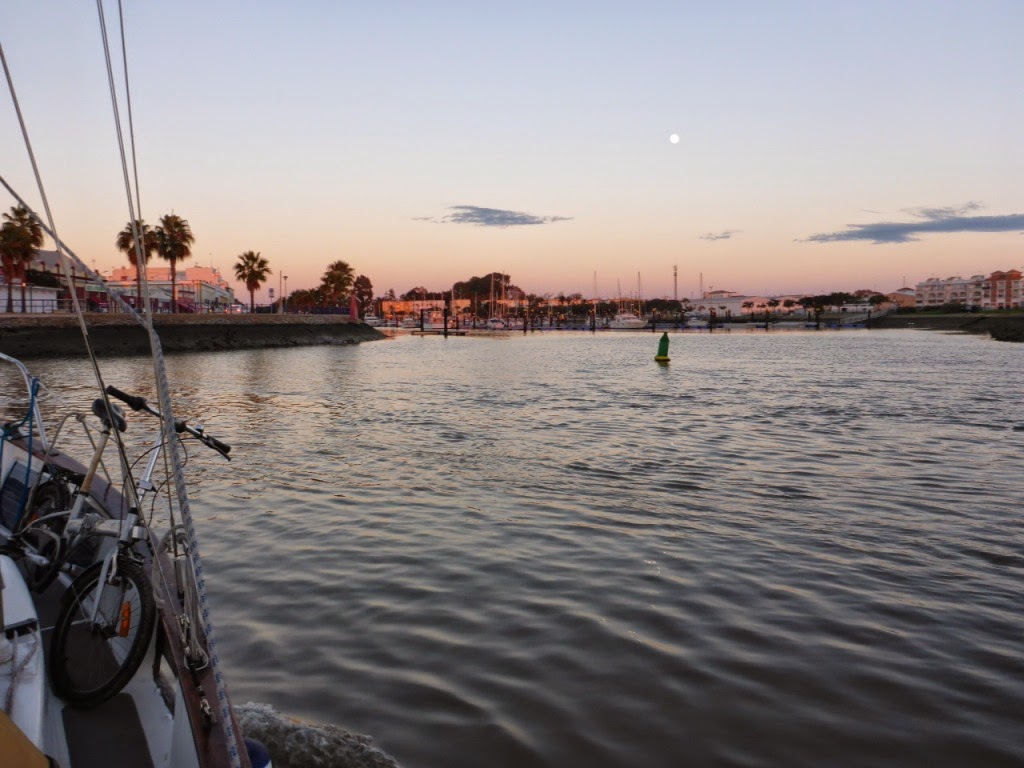
Nous arrivons à Alcoutim
Jens essaye le moteur électrique
Jens tries the electric motor
Ça marche
It's working
Jens mesure la vitesse avec le GPS
Jens is measuring the speed with the GPS
Sanlúcar de Guadiana
Eux aussi ont fait une plage (l'eau est claire en été)
They have also a beach (the water is clear in sommer)
On monte au château
(En short! Mais après des nuages arrivent et on a froid)
We climb to the castle
(In short! But later on clouds come and we are cold)
Alcoutim
Le départ du cable
The cable start
Le cable
Un gars sur un jet d'eau (on a dejà vu cela à Nazaré)
A guy on a water jet (seen before in Nazaré)
Sanlúcar de Guadiana