Sunday, 5 October 2014

02.10.2014 Lisbonne/Lisbon

Jeudi 2 octobre 2014

Jens porte du linge à laver à une laverie, deux gros sacs, en vélo puis nous partons visiter Lisbonne. La marina est à 3 km du vieux centre, piste cyclable toute droite et toute plate en longeant la mer (ou le Tage, ou un mélange des deux). Il fait très chaud, 30 . Nous ne sommes pas les seuls touristes, on entend parler pleins de difféentes langues, beaucoup le français. Nous laissons les vélos et montons par de petites rues ou même des escaliers, sans but précis. Nous montons, montons et arrivons sur une place avec une belle vue sur la ville. Nous redescendons en tournant à droite et à gauche et, par chance, nous nous retrouvons sur une place où un petit restaurant sent bon les sardines grillées. Il est l’heure de déjeuner, cela tombe bien. Malheureusement, le “grilleur” nous fait comprendre que le poisson, c’est terminé. Mais nous voyons dans l’assiette d’un client de forts belles brochettes. Nous nous installons sous la tonnelle et savourons la nourriture et l’ambiance. Tous les gens se connaissent, on ne voit pas bien qui est client, qui est serviteur, une vieille dame sert puis  s’assoit à une table avec les clients. On se croirait dans un village. C’est bon, copieux, sympa et nous payons, pour deux repas complets, 19 € (152 kr). Requinqués, nous retournons au bateau que nous avions bien fermé ce matin! Il fait 36 dedans. On aère, on met le “bimini”, l’espèce de toile qui fait de l’ombre dans le cockpit et on se déshabille, puis nous travaillons, Jens en sismologie (mais il s’endort!) et moi au blog. Nous cherchons le linge en fin de soirée, à pied et traversons un quartier très modeste, derrière la marina. Diner de salade et de yaourt.

Thursday, October 2, 2014

Jens rides to give our laundry at a laundromat, carrying two large bags of clothes on his bike and then we go to visit Lisbon. The marina is 3 km from the old center, straight and flat bikepath, all along the sea (or the Tagus, or a mixture of both). It is very hot, 30 . We are not the only tourists, we hear lots of different languages, specially French. We leave the bikes and climb through small streets and even stairs aimlessly. We go up, go up and get to a place with a beautiful view of the city. We descend by turning right and left and fortunately, we find ourselves in a square where it smells like grilled sardines at a small restaurant. It's time for lunch, so it is just the right time. Unfortunately, the "grill man" makes us understand that there is no more fishdone. But we see in the plate of a client some pretty skewers. We sit under the pergola and savor the food and the atmosphere. All people know each others, it is not clear who is the customer, who is a servant, an old lady is serving then sits at a table with customers. It's like a village. It's good, hearty, friendly and we pay for two full meals, 19 € (152 kr). Happy, we return to the boat that we had closed this morning! It is 36 inside. Wwe open all the windows, put the "bimini" on, the kind of fabric that makes shade in the cockpit, we undress, and then we work, Jens in seismology (but he falls asleep!) and me the blog. We walk to the laundromat in the late evening, walking through a modest neighbohood, behind the marina. Dinner tonight is salad and yogurt.


Jens va à la laverie
Jens rides to the laundromat


Un beau bateau suédois
A beautiful Swedish boat


La place monumentale 


L'arc


La dame bloque toute la circulation pour demander son chemin à un policier local
(Un tuk-tuk en premier plan: scooter collectif pour touristes)
The lady is bloquing the traffic because she asks her way to a local police officer
(A tuk-tuk, a collectif scooter in the foreground)


Il y a une longue queue derrière le camion
There is a long line of cars behind the lorry


Les fameux tramways de Lisbonne
Lisbon's famous streetcars


Belle vue sur la ville
Beautiful view over the city


La chanteuse de fado Maria Severa Onofriana a vécu ici.
Elle est morte en 1846 à 28 ans.
The fado singer Maria Severa Onofriana lived there.
She died in 1846, 28 years old.


Bazar Severa


Nos brochettes
Our skewers


Le monsieur en bleu est le "grilleur"
The man in blue is the grill master


Le petit restaurant
The little restaurant


Jens attend patiemment quand je fais des photos
Jens is waiting patiently when I take pictures


Une grosse méduse dans le port
A big jellyfish in the harbor


La marina by night


01.10.2014 Lisbonne/Lisbon

Mercredi 1 er octobre 2014

Beau et chaud. Uwe et Dorothea sont arrivés ici aussi sur leur Aquaria et font une lessive. Nous, nous allons marcher un peu en ville, prenons un café à l’ombre  puis allons nous baigner. Nous prenons du diesel, nous n’en avons pas pris depuis San Vicente do Mar le 14 août, et nous continuons vers Lisbonne. Nous partons à 13 h et mangeons le lunch en route. Il fait chaud, 28 . C’est spécial d’arriver dans une grande ville par la mer. Un bateau de recherche océanographique qui passe près s’appelle Noruega! (Norvège). Nous voyons les deux forts qui gardaient Lisbonne, la Torre de Belem, le monument aux Découvertes, le grand Jésus sur la rive sud du Tage et le grand pont métalique 25 do Abril. La circulation sur le pont métalique (train et voitures) fait un vacarme incroyable. Nous remontons le Tage encore un peu après le pont et rentrons dans la marina de Alcântara, un ancien dock transformé en marina. Une passerelle doit s’ouvrir pour laisser rentrer les bateaux et nous n’attendons que 5 minutes, ammarrés à un petit remorqueur  vert. Et là, je dois avouer ma faute: je perds la gaffe (un grand manche avec un crochet au bout) et elle coule si vite qu’on n’a pas le temps de la repêcher. La marina est très grande et nous sommes placés parmi les bateaux portuguais. Le quartier est un ancien quartier undustriel transformé en promenade, cafés et restaurants. Mais avec la crise ce n’est guère animé. Après diner nous marchons un peu sur les ponrons et voyons un voilier avec un nom bien de Bergen!

Wednesday, 1 October 2014

Nice and warm. Uwe and Dorothea arrived here too on their Aquaria and make a laundry. We, we go to walk a little in the city, have a coffee in the shade and then go for a swim. We take  diesel, we have not taken it from San Vicente do Mar on the 14 August, and we continue to Lisbon. We leave at 1 pm and have lunch under way. It's hot, 28 . It's special to arrive in a big city by sea. An oceanographic research vessel that passes near us is called Noruega! (Norway). We see the two forts that guarded Lisbon, the Torre de Belem, the Monument to the Discoveries, the great Jesus on the south bank of the Tagus river and the large metallic bridge 25 do Abril. The dobbel traffic on the bridge (train and cars) makes an incredible metallic din. We motor a little after the bridge and got in the marina de Alcântara, a former dock turned into marina. A footbridge should open to let boats go in and we don’t wait more than 5 minutes, tied on a small green tug. And here I must confess my fault: I lost the gaff (a big stick with a hook on the end) and it sunk so quickly that we didn’t have time to recover it. The marina is very large and we are placed among the Portuguese boats. The area is an old industriel neighborhood turned into an area of promenade, cafes and restaurants. But with the crisis it is hardly busy. After diner we walk a little on the ponrons and see a sailboat with a name from Bergen!


Cascais


Carcais


Bye, bye Carcais


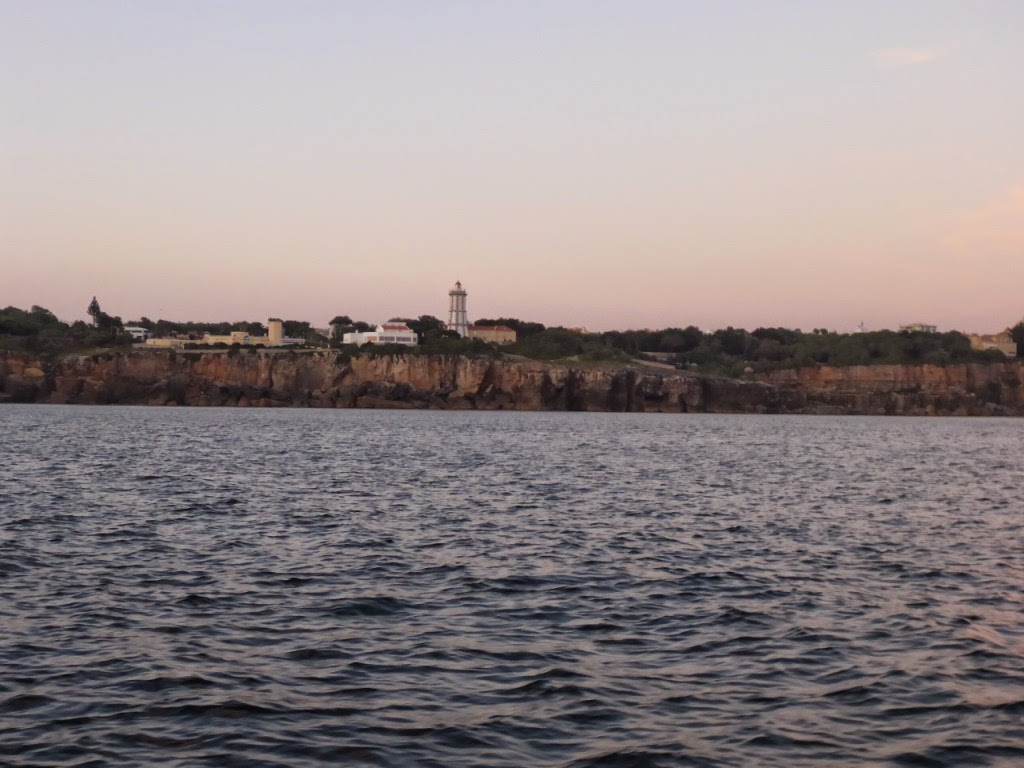
Le fort à gauche
The left hand fort


Le fort à gauche
The right hand fort


Le navire "Noruega"
The ship "Noruega"


La Torre de Belem et des Optimistes
The Torre de Belem and Optimists,  small sailing boats


Monument aux Découvertes
Dicoveries monument


Le pont 25 do Abrill
The bridge 25 do Abril


La satue du Christ
Christ statue


Nous attendons que la passerelle ouvre
We are waiting for the footbridge to open


La passerelle
The footbridege


Un nom bien de Bergen
A name from Bergen


Friday, 3 October 2014

30.09.2014 Cascais

Mardi 30 septembre 2014

Nous nous couchons donc et nous sentons assez rapidement que les vagues augmentent, Maja roule et roule de plus en plus. C’est curieux, le vent est du nord-ouest et nous sommes à l’abri au sud-est. Mais les vagues doivent tourner autour de l’ile et nous prendre sur le côté est. Le mouvement est si important que nous devons nous cramponner pour ne pas tomber du lit. Et les deux couchettes à l’avant n’ont pas de poignées puisqu’on ne les utilise jamais en mer. Tout cogne et bouge, et pourtant c’était bien calé. Jens s’endort quand même mais pas moi. Il fait noir comme dans un four mais toutes les 8 secondes le phare émet une grande lueur blanche. Et la sarabande continue. Vers 3 h du matin, le vent a un peu tourné et l’annexe qui est amarrée derrière Maja est bien près de cogner une bouée d’un casier. Jens se réveille, évalue la situation, et décide de remonter l’annexe sur Maja. Plus facile à dire qu’à faire. Maja roule mais l’annexe cabriole dans tous les sens. Nous la tirons parallèle à Maja et Jens descend dedans. Je la tiens avec une corde mais elle bouge beaucoup quand même et cogne Maja. J’essaye de mettre une défense entre Maja et elle, mais elle cogne soit au dessus soit en dessous de la défense. Jens se tient d’une main à Maja et de l’autre essaye de détacher les rames qui sont sécurisées pour ne pas tomber à l’eau. Cela ressemble plus à du rodeo qu’à autre chose. Au bout de deux minutes, je lui ordonne (ah mais!) de remonter, je ne veux pas perdre mon bonhomme à Berlenga. Il remonte et a une idée: il va s’assurer avec son harnais. Il met donc son harnais sur son pyjama (don’t il a retrousser les jambes), l’accroche à un point fort de Maja et y retourne. Il réussit à me passer les rames, les dames de nage et l’écope. Bon. Il remonte sur Maja et on arrive à tirer l’annexe et à la monter sur Maja. Nous nous recouchons mais c’est une nuit avec peu de sommeil.
Nous partons à 9 h 30, par un beau soleil et un bon vent du nord-nord-ouest, force 4-5, avec pointes à 6. Nous allons à la voile toute la journée avec foc et mizaine, le vent à 10-20 degrés sur le côté et nous avons une bonne vitesse. Les vagues sont un peu grosses mais régulières, soulèvent Maja par derrière et passent dessous. Une très bonne journée de voile. On ne peut rien faire donc on écoute de la musique. Nous passons le Cabo da Roca (point le plus à l’ouest d’Europe) puis le Cabo Raso et tournons le coin pour aller vers l’est, vers Lisbonne. Il est tard et nous nous arrêtons à Cascais, juste après “le coin”. Il est 19 h 45 et le bureau de la marina ferme à 20 h. On a de la chance, à partir de demain, premier octobre, il fermera à 18 h. Nous amarrons Maja et allons fair un petit tour en ville qui parait méditerranéenne et en plus, même si tard il fait chaud. Cascais est une station balnéaire huppée depuis que le roi du Portugal en avait fait sa ville de vacances au dix-neuvième siècle et est très touristique aujourd’hui. La marina a plusieurs restaurants chics, avec maitre d’hôtel et serviteurs en long tabliers. Non, non, on ne dine pas là. On va en ville et mangeons bien pour  moitié prix.

Tuesday, September 30, 2014

So we go to bed and we feel pretty quickly that the waves are becoming bigger, Maja rolls and rolls more. It's funny, the wind is from the northwest and we are sheltered southeast. But the waves must run around the island and take us on the east side. The movement is so important that we must hold on for not falling out of bed, and the two berths in the front have no handles because we never use them at sea. Everything is crashing and moving, and yet it was stalled. Jens is still asleep but not me. It's very dark, but every 8 seconds the lighthouse emits a powerful white glow. And the sarabande continues. At around 3 am, the tide has turned a little and the tender which is tied behind Maja is very close to hitting a lobster pot. Jens wakes up, assesses the situation and decides to take the tender back on Maja. Easier said than done. Maja is rolling but the tender is jumping in all directions. We pull it parallel to Maja and Jens goes down in it. I keep it with a rope but it moves a lot anyway and knocks Maja. I try to put a fender between Maja and the tender, but it hits either above or below the fender. Jens stands with one hand on Maja and the other trying to detach the oars which are secured to avoid falling into the water. It's more like a rodeo than anything else. After two minutes, I order him (!) to come  back on Maja, I don't want to lose my man in Berlenga. He goes up and gets an idea: he'll put on his harness. So he put his harness on his pajamas (he has rolled up it legs), secures the harness on Maja and returns in the tender. He managed to give me the oars, oarlocks and the scoop. Good. He goes up on Maja and we manage to pull the tender on Maja. We go back to bed but it's a night with little sleep.

We start at 9: 30 am, with a bright sun and a strong wind from the north-northwest, force 4-5, with peaks up to 6. We will sail all day with jib and mizaine, wind at 10 to 20 degrees to the side and we have good speed. The waves are a bit big but regular, raising Maja from behind and passing underneath her. A very good day of sailing. We can’t do anything so we listen to music. We pass the Cabo da Roca (furthest west point in Europe) and the Cabo Raso and turn the corner to go east towards Lisbon. It's late and we stop in Cascais, just after "the corner." It is 7:45 pm and the marina office closes at 8. We are lucky, starting tomorrow, October 1st, it will close at 6 pm. We tie Maja and go for a walk in town that seems méditerranean and even so late, it is still hot. Cascais is a posh seaside resort since the King of Portugal made it his holiday town in the nineteenth century and today is very touristy. The marina has several upscale restaurants, with butler and servants in long aprons. No, no, we did not dine there. We go into town and eat well for half the price.


Trois heures du matin: Jens avec son harnais sur son pyjama.
Il tient l'annexe
Three o'clock am: Jens with his harness on his pyjamas.
He is holding the tender


L'annexe est remontée sur Maja
The tender is again on Maja


Bye, bye Berlenga


Sous voile
Plain sailing


Les vagues
The waves


Cabo da Roca


Le phare à Cabo da Roca
Cabo da Roca lighthouse


Juste après le coin, c'est plus calme
just after the corner, it is quieter


Arrivée à Cascais


Thursday, 2 October 2014

29.09.2014 Ilha de Berlenga 39 24 N 9 30 W

Lundi 29 septembre 2014

Très beau temps, très calme. Deux officiels du port viennent demander tous nos documents, personnels et du bateau. Ils sont souriants et parlent bien anglais. Fritz et Margret viennent nous dire au revoir et nous partons à 9 h. C’est si calme que nous décidons d’aller à une ile en face du port de Peniche, l’ile de Berlenga. Le guide dit bien qu’il ne faut y aller que par temps très calme. Nous sommes au moteur, il n’y a pas un souffle. Journée calme, relax, juste un peu de houle nous berce, d’ailleurs nous faisons une sieste à tour de rôle. Nous admirons les mouvements gracieux d’un groupe de dauphins et cela mettrait le plus grincheux de bonne humeur. Nous arrivons à Berlenga à 13 h 30 h. Pas un autre voilier en vue. Nous nous approchons d’une grosse vedette à un mouillage où un homme est en train de pêcher. Jens demande s’il parle anglais, non, mais il parle un peu espagnol. Jens demande si on peut ancrer, il dit que oui et encore mieux nous propose un mouillage. Il n’y a que trois mouillages au sud-est de l’ile, à l’abri d’une falaise, deux assez forts et le troisième pour un petit bateau. Quelle chance. Nous nous mettons donc à l’autre mouillage et nous mangeons notre lunch. Puis nous allons à terre avec l’annexe. L’ile est sauvage, aride, les rochers sont roses et elle abrite une colonie de mouettes. Quelques maisons, construites dans les années vingt par un bienfaiteur, toutes blanches, sont maintenant utilisées comme maisons de vacances. Au seizième siècle, un monastère se trouvait sur l’ile et était pillé régulièrement par les pirates. Un fort fut donc construit pour défendre le monastère. Le monastère a disparu mais le fort est toujours là. Nous tirons l’annexe sur la petite plage et nous nous baignons, l’eau est au moins à 22 et l’eau est très claire. L’ile étant un parc naturel, il faut suivre les sentiers et ne pas cueillir de fleurs ni déranger les oiseaux. Nous montons au phare, admirons Maja de loin et redescendons. A cinq heure la vedette (celle du mouillage) vient chercher les touristes et les emmène à Peniche, nous avons donc l’ile pour nous tout seuls. C’est si calme que nous décidons de rester dormir ici cette nuit. Nous retournons sur Maja, je travaille au blog et Jens fait le diner. Maja roule, de petites vagues nous arrivent sur le côté, mais c’est supportable. Diner très romantique, mais je ne peux pas dire au calme: les mouettes piaillent à qui mieux mieux  et les vagues se brisent sur les rochers en faisant un grand vacarme. Tout va bien … si on savait ce qui nous attend cette nuit! A suivre.
 
Monday, September 29, 2014

Great weather, very quiet. Two port officials come to us to ask all our documents, personal and from the boat. They are nice and speak good English. Fritz and Margret come to say goodbye and we leave at 9 am. It is so quiet that we decide to go to an island, opposite the port of Peniche, the island of Berlenga. The guide said that one should go there only by very calm weather. We motor, there is not a breath. Calm day, relax, just a little swell rocks us, and we nap in turn. We admire the graceful movements of a group of dolphins and this would make a grumpy person smile. We arrive at Berlenga at 1:30 pm. Not another sailboat in sight. We are approaching a passenger boat at a mooring where a man is fishing. Jens asks if he speaks English, no, but he speaks a little Spanish. Jens wonder if we can anchor, he said yes and even better offers us a mooring. There are only three moorings southeast of the island, under a cliff, two strong enough and the third one for a small boat. What luck. So we pick up the mooring and we eat our lunch. Then we go ashore with the tender. The island is wild, arid rocks are pink and is home to a colony of seagulls. Some houses built in the twenties by a benefactor, all white, are now used as holiday homes. In the sixteenth century, a monastery was on the island and was regularly raided by pirates. A fort was built to defend the monastery. The monastery has disappeared but the fort is still there. We pull the tender on the small beach and we swim, the water is at least 22 and the water is very clear. The island is a nature park, so we must follow the trail and do not pick flowers or disturb the birds. We climb to the lighthouse, we admire Maja from afar and descend. At 5 pm, the passenger boat (the one which was at the mooring) picks up the tourists and leave to Peniche, so we have the island to ourselves. It is so quiet that we decide to stay tonight here. We return on Maja, I work on the blog and Jens makes ​​dinner. Maja rolls, small waves come to us on the side, but it's bearable. Dinner very romantic, but I can not say calm: the seagulls are squawking and the waves breaking on the rocks are making a great noise. All is well ... if we knew what to expect tonight! To be continued.


Bye, bye Nazaré


La houle: il est en haut
The swell, this boat is up


Il est en bas
She is down


Mer calme
Calm sea


Dauphins
Dolphins


L'ile de Berlenga
Berlenga island


Berlenga


Jens va parler avec l'homme de la vedette
Jens goes to talk with the man on the passenger boat


Nous déjeunons. Le fort derrière moi
We eat lunch. The fort is back me


Maja au mouillage
Maja at the mooring


Nous allons à terre
We row to land


Berlenga


Un petit bateau, la vedette et Maja
A little boat, the passenger boat and Maja


Le phare
The lighthouse


Sol caillouteux
Rocky soil


La seule plante qui pousse bien: une plante grasse aux grosses fleurs jaunes ou roses
The only plant which grows well there: a succulent with big pink or yellow flowers


Curieux: la plante s'arrête au chemin
Strange: the plant stops at the path


La vedette vient chercher les touristes
The passenger boat comes for the tourists


Belle soirée
Nice evening


La plante qui pousse bien ici
The plant growing well here