Friday, 26 September 2014

23.09.2014 Póvoa de Varzim

Mardi 23 september 2014

Nous nous réveillons au son de la corne de brûme. Nous prenons notre temps, le soleil apparait, Jens va reconnaitre la ville et je fais le blog. Nous partons ensuite le long de la mer. Une très longue promenade et une piste cyclable la longe et tout le long ce ne sont qu’immeubles de vacances. De la musique nous environne. D’abord je pense que cela vient des nombreux bars mais non: cela sort des lampadaires! Chaque lampadaire a un micro et diffuse des chansons. De la vraie pollution sonore. Nous nous baignons, et allons boire une clara à un bar sur la plage, ici, cela s’appelle un “panache”, comme en français. Nous prenons un sandwich, rentrons au bateau et repartons explorer la campagne. Et on se perd, on prend de petites routes pavées, pas très confortable en vélo et “tournicotons” pas mal. Les gens sont aimables quand on demande notre chemin, mais on a un problème de langue, et comble de bonheur, il se met à pleuvoir. Nous nous abritons sous un tunnel qui passe sous l’autoroute et attendons, cela na dure pas. Nous revenons vers la mer et nous rebaignons. Quand nous rentrons, le gars  qui avait communiqué avec Jens hier et pris des photos de Maja est arrivé ici aussi. Nous les invitons à boire un thé après le diner. Ils s’appellent Uwe et Anne, sont allemands et leur bateau est “Anduril”, si j’ai bien compris c’est le nom d’une épée dans ”Le seigneur des anneaux”. Il nous donne les photos de Maja et Jens lui donne les photos d’Anduril. Encore un moment sympa.

Tuesday September 23, 2014


We wake to the sound of the foghorn. We take our time, the sun appears, Jens will recognize the city and I do the blog. Then we go down to the sea. A very long walk and a bike path go along the sea and all along are built blocks of apartments for holiday. Music surrounds us. First I think it comes from the many bars but no, it comes out streetlights! Each lamp has a microphone and broadcast songs. A real noise pollution. We bathe, and drink a clara in a bar on the beach, here it is called a "panache", like in French. We take a sandwich, return to the boat and set off again to explore the countryside. And we get lost, we take small paved roads, not very comfortable on bike and turn and turn. The people are friendly when asked our way, but we have a language problem, and to crown it all, it starts to rain. We take shelter in a tunnel under the highway and wait, it doesn’t. We return to the sea and we swim again. When we come back, the man that had contacted Jens yesterday and took pictures of Maja arrived here too. We invite them to drink tea after dinner. They are called Uwe and Anne, are German and their boat is "Anduril", if I understand rightly it is the name of a sword in "The Lord of the Rings." They gives us pictures of Maja and Jens gives them pictures of Andureil. Another nice moment.


Mosaiques sur le port
Mosaics on the harbor


Promenade et piste cyclable
Promenade and cycle path


La plage
The beach


Hard life


Jolis trottoirs
Nice sidewalk


Par là
This way


Les pavés
The pavement


Mêmes berzas qu'en Galice
The same plants as in Galicia, the berzas


Village


Il pleut
It is raining


Un arc en ciel
A rainbow


Anne, Uwe


Maja


Tuesday, 23 September 2014

22.09.2014 Póvoa de Varzim (Portugal) 41 22 N 8 46 w

Lundi 22 septembre 2014

Nous voyons partir Longway à 8 h 20 et nous, nous partons à 9 h 20. Il faut sortir de la baie de Baiona et tourner sud sur la “grande mer”. Nous avons un temps un peu gris d’abord puis très beau, peu de vent du sud-est et pas de vague. Même la houle, qui peut être impressionante ici, est toute petite. Nous ne sommes pas les seuls à naviguer vers le sud, les voiliers défilent. Navigation très relaxe, au soleil, je peux même faire des sudokus. Le seul “danger” sont les casiers (à homards ou crabes) mal signalés. Certains ont juste un petit bidon en plastique qui flotte. La plupart on un baton vertical et un petit drapeau, mais parfois le drapeau manque ou le baton est à moitié coulé. C’est difficile de les voir, et pourtant il fait beau et la mer est calme. Qu’est-ce que ça doit être quand il y a des vagues et mauvaise visibilité. La danger est de passer dessus et de se prendre une corde dans l’hélice. Nous devons plusieurs fois nous détourner pour en éviter. Nous passons à hauteur de la rivière qui marque la frontière entre l’Espagne et le Portugal et je change le pavillon de courtoisie. Nous longeons la côte qui est construite presque tout le long. Je fais une petite sieste dans l’après-midi et pendant ce temps là, Jens prend contact, en criant (et je n’entends rien) avec un voilier allemand qui passe tout près. Les deux capitaines prennent le bateau de l’autre en photo. La capitaine allemand appelle ensuite Jens par radio pour lui donner son mail afin que Jens envoie les photos de son bateau.  
Nous entendons plusieurs messages des autorités espagnoles qui demandent à un voilier sa position et où il va. Une dame du voilier répond (en anglais) et cela recommence une heure après. Pourquoi? Mystère.
Longway s’arrête à Viana do Castelo, Portugal, vers 15 h. Nous continuons jusqu’à Póvoa de Varzim et y arrivons à 19 h 40 (heure espagnole) ou 18 h 40 (heure portugaise). C’est un port de pêche et aussi une marina. Mais ce n’est pas un petit village de pêche: nous sommes surpris par la vue de grands immeubles sur plusieurs km, le long d’une grande plage. On voit même un casino. L’accueil à la marina est sympa, il y a de la place et presque tous les bateaux sont étrangers, dont plusieurs voiliers américains.
Il est assez tard, on est un peu fatigués et nous allons manger en ville. Il fait nuit mais on sent qu’on n’est plus en Espagne. Comme nous connaissons Les Azores où nous étions en 2010, cela nous y fait penser. Même style de maisons, parfois couvertes de careaux de faïence, même revêtement de petits pavés carrés sur les trottoirs, même système de plusieurs portes si une maison à plusieurs appartements, et bien sûr, la langue. La ville parait grande, en partie “vraie” ville et en partie touristique. Un métro la relis à Porto.
Dans le restaurant, la télévision montre les nouvelles: inondations très importantes à Lisbon, rues transformées en torrents, voitures emportées … et beau temps calme ici.
Contents, fatigués, nous nous couchons pour dormir notre première nuit au Portugal.

Monday, September 22, 2014

We see Longway leaving at 8:20 am and we leave at 9:20 am.We must get out of the Bay of Baiona and turn south on the "great sea." The weather is a little gray at first, then very good weather, little wind from southeast and no wave. Even the swell, which can be impressive here is very small. We are not the only ones to sail south, several sailboats are going the same way. Navigation is very relaxed, in the sun, I can even make sudokus. The only "danger" are pots (lobster or crab) improperly marked. Some just have a small plastic container that floats. Most of then have a vertical stick and a small flag, but sometimes lack the flag or the stick is half sunk. It's hard to see them, and yet it's nice weather and calm seas. What it must be like when there are waves and poor visibility. The danger is to pass on them and to take a rope in the propeller. We must turn away several times to avoid them. We pass the estuary of the river that marks the border between Spain and Portugal and I change the courtesy flag. We navigate along the coast which is built almost everywhere. I take a nap in the afternoon and during that time, Jens made ​​contact, directly, shouting, (and I didn’t hear it!) with a German boat passing nearby. The two captains took pictures from the other boat. The German captain then calls Jens by radio later onto give him his mail so Jens can send him  photos of his boat.
We hear several messages from the Spanish authorities that require a boat's position and where she goes. A lady from the sailboat answered (in English) and it started again one hour later. Why? Mystery.
Longway stops in Viana do Castelo, Portugal, at around 3 pm. We continue to Povoa de Varzim and we are getting  there at 7:40 pm(Spanish time) or 8:40 (Portuguese time). It is a fishing port and also a marina. But this is not a small fishing village, we are surprised by the sight of large buildings on several kilometers along a long beach. We even see a casino. The welcome at the marina is nice, there is room and almost all boats are foreigners, including several American yachts.
It is quite late, we are a little tired and we eat in town. It's dark but we feel that we are not in Spain anymore. We had been to The Azores in 2010, and it reminds us of there. Same style of houses, sometimes covered with earthenware careaux,  same small square pavers on sidewalks, same system of several doors if a house has several apartments, and of course, same language. The city looks big, part "real" and part tourist area. A metro goes from here to Porto.
In the restaurant, the TV is showing the news: important  inondations in Lisboa, streets transformed in rivers, cars taken by the water … and the weather is so nice and calm here.
Happy and tired, we go to bed to sleep our first night in Portugal.


Bye, bye Baiona


Baiona. Le/the fort


Nombreux petits pêcheurs
Many small fisher boats


Le phare que nous avons vu dimanche
The light house we saw on Sunday


On n'est pas les seuls à partir
Others are leaving too


Un casier
A lobster pot


La Guardia, ville frontière
La Guardia, border city


Pavillon de courtoisie portugais
Portuguese guest flag


Jens a pris une photo de son bateau et il a pris une photo de Maja
Jens took a picture of his boat and he took a picture of Maja


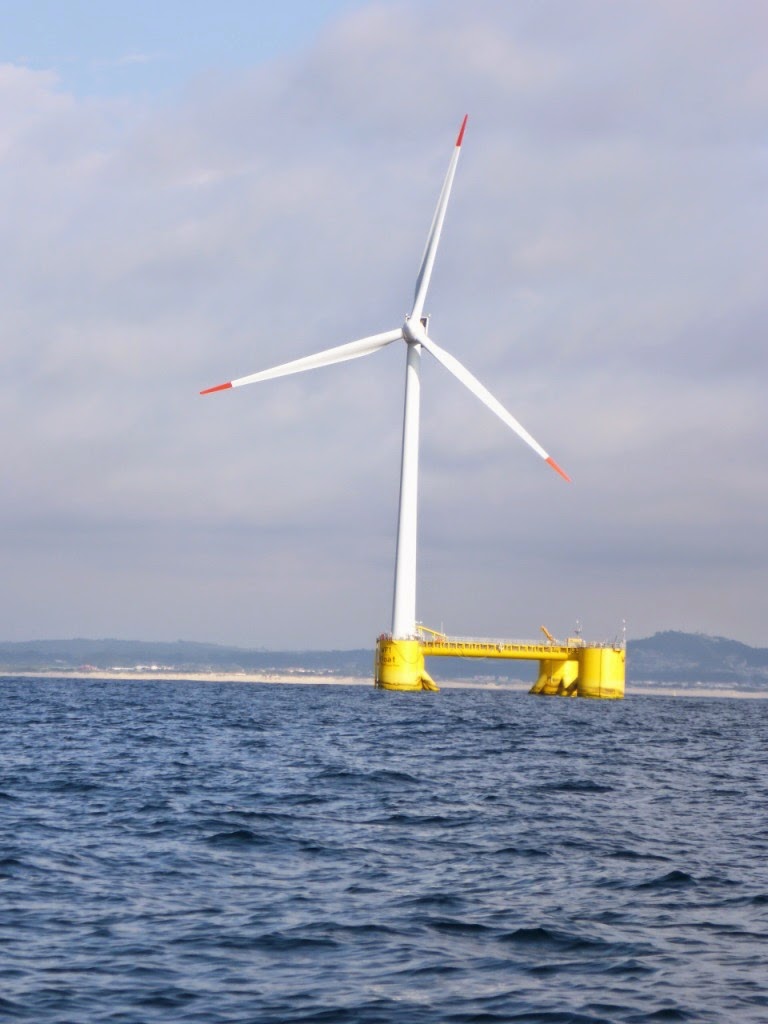
Une éolienne en mer
A windmill in the sea


Póvoa de Varzim, Portugal


Entrée du port
Harbor entrance


Photo prise dimanche
Picture taken on Sunday


21.09.2014 Baiona

Dimanche 21 septembre

Très beau temps. On ne l’a pas volé apès toute la pluie qu’on a eu.
Nous sommes loin dans la marina donc nous faisons du vélo sur le ponton. Nous allons visiter La Pinta, la reproduction d’une des Caravelles de Christophe Colombe. La coque est très haute, mais la partie inférieure est basses et sombre. Puis nous partons en vélo cette fois vers l’est, en longeant la baie. C’est dimanche et la promenade et la piste cyclable sont bien occupées. Nous allons à 7 km à peu près sur une immense plage de sable. De nombreuses familles sont à la plage mais il n’y a pas tant de monde dans l’eau. Les gens marchent le long de la mer, c’est un vrai mouvement de foule, et ils marchent vite, ce doit être leur exercice. Nous nous baignons et c’est très agréable de nager parallèle à la plage.
Lunch au bateau et à 3 h, re-baignade avec Fritz et Margret à la même petite plage qu’hier, sous les fortifications. Les vagues sont plus grandes ici et il y a des rochers sous l’eau, les hommes nagent bien mais nous, les femmes, sommes plus “prudentes”. En contrepartie, on trouve, Margret et moi, de nombreux et jolis bouts de verre. Ils nous invitent à prendre un apéritif à 5 h sur ”Longway”, leur bateau. Et quel apéritif! Fromage, jamon serrano, œufs durs, carottes, noix, gateau  etc. Le tout bien arrosé. Cet apéritif nous sert de repas. Ils avaient avant un Corsaire, un bateau en contreplaqué de 5,5 m et allaient en vacances avec sur les lacs suisses avec leur deux enfants. Leur Fisher 25 a un cockpit bien plus large que le nôtre à l’arrière et une toile pour faire de l’ombre très bien. Nous passons encore un très bon moment. Eux et nous vont partir demain: bonne météo, peu de vent et peu de vagues.     

Sunday, September 21

Beautiful weather. We think that we deserve it after all the rain we had.
We are far from land in the marina so we are riding on the pontoon. We visit La Pinta, the reproduction of one of the caravels of Christopher Columbus. The hull is very high, but the lower part is low and dark. Then we go on bike this time to the east, along the bay. It's Sunday and the boardwalk and bike path are occupied. We go to about 7 km on a sandy beach. Many families are on the beach but there are not so many people in the water. People walk along the sea, it's a real stampede, and they walk fast, it must be their exercise. We swim and it's very nice to swim parallel to the beach.
Lunch at the boat and at 3 pm, we swim again with Margret and  Fritz at the same small beach as yesterday, under the fortifications. The waves are bigger here and there are rocks under the  water, the men swim well but we women, are more "careful". In return, we find Margret and myself many beautiful pieces of glass. They invite us to take a drink at 5 am on "Longway" their boat. And what appetizer! Cheese, jamon serrano, boiled eggs, carrots, nuts, cake etc and with good drink, of course. This serves as our meal. Before, they had a Corsair, a plywood boat of 5.5m and went on holiday with it on Swiss lakes with their two children. Their Fisher 25 has a much wider cockpit than ours in the back and a nice canvas to overshadow the cockpit. We spend a again a great time together. They and we are leaving tomorrow: good weather forecast, little wind and small waves.


On fait du vélo sur le ponton
Riding our bikes on the pontoon


Il faut monter l'escalier
We have to go up the stairs


La Pinta


A l'intérieur (photo prise avec le flash)
Inside (picture taken with blitz)


Ils avaient ramené des Indiens et des perroquets
They took back Indians and parrots


Sur la grande plage
On the long beach


Les gens marchent
The people are walking


Un "horreo" bien utilisé: corbeille de basket et fil à linge sur le côté
A still used "Horreo": basket to play basket ball and line to dry clothe on the side


Les fortifications, Baiona


Sur la petite plage
On the little beach


Longway, Fisher 25


Margret, Jeannette, Fritz


Jens, Fritz, Margret


Sunday, 21 September 2014

20.09.2014 Baiona

Samedi 20 septembre 2014

Il pleut ici aussi. Nous restons sur le bateau, journal et vers 11 h Jens va rendre visite au Fisher 25 suisse. Il reste longtemps parti puis il revient accompagné de Fritz et Margret, le couple suisse et de deux Allemands, Owe et Thomas qui étaient eux aussi en visite sur le Fisher suisse. Nous offrons un café à tout le monde et passons un bon moment ensemble. C’est toujours sympa de rencontrer des gens différents mais tous navigateurs. Chacun a une expérience spéciale ou drôle à raconter. Quand ils sont partis, nous déjeunons puis partons en vélo vers l’ouest, vers la mer. Il ne pleut plus mais il souffle un bon vent. La mer est calme dans le baie mais sur la “vraie” mer c’est tout blanc de moutons. Nous longeons la côte et passons un phare que nous allons passer quand nous partirons. En rentrant, nous rencontrons Fritz et Margret qui vont se baigner sur une petite plage. Nous nous baignons ensemble, mais je ne fais pas de photo car la batterie de mon appareil photo est vide. Nous sympathisons vraiment. Quand nous sommes que nous quatre nous parlons français, bien qu’ils soient suisses allemands. Margret aime aussi ramasser des morceaux de verre polis par la mer, cela nous rapproche. Nous les invitons à diner ce soir. Nous rentrons au bateau, Jens va faire des courses et je fais le blog. Jens fait une pizza et moi la salade. Ils arrivent à 19 h 30 et nous passons une très agréable soirée. Ils sont passés par des canaux puis la Seine de Suisse au Havre, contourné la pointe du Cotentin, allés aux iles Anglo-Normandes, la Bretagne, traversée la Baie de Gascogne et arrivés en Espagne. Tout cela sur un bateau plus petit que nous et c’est leur premier grand voyage en mer. Chapeau. Nous sympathisons bien et nous espérons les revoir. Ce soir il fait beau, enfin.  

Saturday, September 20, 2014

It's raining here too. We stay on the boat, read the newspaper and at 11 am Jens goes to visit the Swiss Fisher 25. He remains long there then returns along with Fritz and Margret, the Swiss couple and two Germans, Owe and Thomas, who were also visiting the Swiss Fisher. We offer coffee to everyone and spend a good time together. It's always nice to meet different people but all mariners. Everyone has a special or funny experience to tell. When they left, we have lunch and then go on bike westward to the sea. It stopped raining but it blows a strong wind. The sea is calm in the bay but the "real" sea is all white. We ride along the coast and see a lighthouse that we will pass when we leave. On returning, we meet Fritz and Margret who go swimming on a small beach. We bathe together, but I don’t take pictures because the battery in my camera is empty. We really sympathize. When we are the four of us together we speak French, although they are Swiss German. Margret also like to find pieces of  glass polished by the sea, it brings us together. We invite them to dinner tonight. We return to the boat, Jens goes shopping and I do the blog. Jens makes ​​a pizza ansd I make a salad. They arrive at 7:30 pm and we spend a very pleasant evening. They went through canals and the river Seine from Switzerland to Le Havre, rounded the tip of the Cotentin peninsula, went to the Channel Islands, then Brittany, crossed the Bay of Biscay and arrived in Spain. All this on a smaller boat that ours and this is their first big trip at sea. Well done. We sympathize well and we hope to see them again. Tonight the weather is fine, finally.


Jeannette, Margret


Fritz, Owe, Thomas


Vers l'ouest
Toward west


La côte
The coast


La phare 
The light house


Jens et la mer
Jens and the sea


Une maison de vacances
A cottage


Jeannette, Margret


Saturday, 20 September 2014

19.09.2014 Baiona 42 07 N 08 50 W

Vendredi 19 septembre 2014

Désolée, mais même temps, pluie, pluie, pluie. C’est incroyable comme il pleut. Et, mauvaise nouvelle locale, les pauvres éleveurs de moules ne peuvent plus vendre leurs coquillages parce qu’il y a une bactérie dedans qui les rend impropres à la consumation. Nous allons faire des courses le matin, en ciré des pieds à la tête. Mais il n’y a pas de vent, au moins, donc les vagues doivent se calmer sur la mer. La météo est meilleur pour l’après-midi donc nous décidons de partir pour Baiona après déjeuner. Nous allons payer la marina et les remercier du bon service et de leur amabilité. Nous avons passé de bons moments à Moaña mais nous sommes contents de partir. Nous disons aussi au revoir à Francis-Nicole et à Francis-Yolande.
Quand nous partons à 14 h 35, il ne pleut plus, il y a même un timide rayon de soleil et la mer est plate. Mais quand nous reculons de notre place le vent se lève, la pluie revient et la mer se forme. Et nous allons avoir un très fort vent et des vagues de face tout le long. Ce n’est pas loin, dix miles nautiques (16 km) mais nous mettons presque trois heures. Les vagues sont d’abord moyennes, un mètre, mais augmentent plus on s’approche de l’ouverture de la ría et en plus, là elles se combinent avec la houle d’ouest. Maja danse bien et le moteur travaille. Heureusement j’ai bien tout calé, et pourtant je pensais que ce serait une petite traversée tranquille. Le vent passes de force 5 à force 6 et même des pointes à 7. Ce qui me rassure c’est que c’est une traversée courte et qu’à la fin nous serons à l’abri de la côte.Mais j’avoue que je n’en mène pas large quand les vagues arrivent de deux côtés. Pour éviter un détour qui serait plus exposé, nous prenons un chenal entre une ile et la terre. Dans le guide, il est précisé qu’on ne peut le prendre que par bonne visibilité et temps calme. La visibilité, on l’a à peu près (il pleut) et le temps calme, on ne l’a pas. Mais le vent est orienté du sud-est, moins fort à l’abri de la terre, donc on y va quand même. De plus la marée est haute, ce qui aide là où il y a un haut-fond. Cela se passe bien, mais c’est impressionant de voir la mer se briser sur les rochers à quelques mètres de nous. Nous arrivons enfin à Baiona, Jens a prévenu et un gars nous attend et nous montre notre place. Ouf! Bien contents d’arriver. Cette marina est beaucoup plus internationale que Moaña. Nous voyons un voilier américain, des Anglais, un Danois, un Norvégien et un Fisher suisse. Certains voiliers sont ancrés près de la marina.
Nous allons nous enregister et faire un petit tour en ville. Il ne pleut plus, enfin. Baiona est une très vieille ville et a la gloire d’être le premier port en Europe continentale qui apprit l’existence du nouveau monde en 1493 lorsque Christophe Colombe y fit escale en rentrant de son grand voyage. Une réplique de la caravelle ”La Pinta” est dans le port.
Nous allons nous baigner à une plage près du port mais ce n’est pas très agrèable, il y a des algues. Nous allons dire bonjour au Fisher suisse, le couple suisse a l’air très sympa. C’est un Fisher 25, plus petit que le nôtre.
Diner à l’intérieur, il y a trop de vent pour le faire dehors.

Friday, September 19, 2014

Sorry, but it is the same story, rain, rain, and rain. It's amazing how it rains. And bad local news, the poor mussel growers can’t sell their shells because there is a bacteria in it that makes them unfit for consummation. We go shopping in the morning, with rain clothes from head to toe. But there is no wind, at least, so the waves are calming down. The weather is better for the afternoon so we decide to leave after lunch for Baiona. We pay the marina and thank them for the good service and their friendliness. We had a great time in Moaña but we are happy to leave. We also say goodbye to Francis-Nicole  and Francis-Yolande.
When we leave at 2:35 pm, it stopped raining, there is even a timid ray of sunshine and the sea is flat. But when we are backing from our place the wind picks up, the rain returnsd and the sea starts forming waves. And we have a very strong wind and waves from the front all along. It's not far, ten nautical miles (16 km) but we spend almost three hours to get there. The waves are first one meter in average, but increase the closer we get to the opening of the ría and in addition, there they combine with the swell from the west. Maja is dancing well and the engine works hard. Fortunately I have all stalled, yet I thought it would be a quiet crossing. The wind increases to force 5 then to force 6 and even 7 in the guts What reassures me is that it's a short trip and at the end we will be protected from the land. But I confess I did not like it very much when the waves come from both sides. To avoid a detour that would be more exposed, we take a channel between an island and the land. In the guide, it is written that we can take it only in good visibility and calm weather. Visibility is not too bad (it is raining) and calm weather it is not. But the wind is oriented southeast, weaker near land, so here we go anyway. Also the tide is high, which helps where there is a shoal. It goes well, but it's impressive to see the sea crashing on the rocks a few meters from us. We finally arrive in Baiona, Jens phoned and a guy waiting for us and shows us our place. Whew! Very happy to arrive. This marina is much more international than Moaña. We see an American yacht,  English, a Dane, a Norwegian and a Swiss Fisher. Some boats are anchored near the marina.
We register and we take a walk in town. It stopped raining, finally. Baiona is a very old city and has the glory of being the first port in continental Europe which learned about the new world in 1493 when Christopher Columbus made a stop there on the way back of his big journey. A replica of the caravel "La Pinta" is in the port.
We swim at a beach near the port, but it's not very nice, there are algae. We say hello to the Swiss Fisher, the Swiss couple looks very sympathic. It is a Fisher 25, smaller than ours.
Diner inside, it is too windy to eat outside.


Pluie
Rain


On fait les courses
We go shopping


Bye, bye Moaña


Il pleut et ceal souffle bien
It is raining and blowing


Les vagues
The waves


On approche, enfin, du port de Baiona
We are near to Baiona harbor, at least, 


Jens prépare l"ankerdram"
Jens is preparing the "ankerdram"


Le fort de Baiona
Baiona fort


La plage
The beach