Wednesday, 6 August 2014

05.08.2014 Finisterre

Mardi 5 août 2014

Pour une fois, c’est moi qui vais acheter les journaux. J’en profite pour fair un petit tour en ville. Finisterre est une jolie petite ville, très ancienne et bien entretenue. C’est jour de marché et je m’achète un nouveau T-shirt. Puis nous partons, en vélo vers le phare, 3,5 km, surtout de montée. Il fait gris. Le phare de Finisterre est très touristique, les gens veulent aller “à la fin de la terre”. Beaucoup de monde et, bien sûr, des boutiques de souvenirs. Nous rentrons en roue libre, c’est pratiquement une grande descente tout le long. Nous repérons une petite plage à l’entrée de la ville. On va se baigner là. Un groupe de jeunes marcheurs du chemin de Santiago se repose et nous offre, gentiment, des biscuits. Une des filles est française et est encore toute éberluée d’avoir marché si longtemps, 600 km! Une belle expérience. Lunch au bateau, un petit repos et nous repartons en vélo, cette fois vers l’Est, vers un village qui s’appelle Sardiñeiro à 7 km. Là aussi, ça monte. Nous admirons des “horreos”, ces greniers sur pilotis, le joli petit port et la plage. Mais il fait frais et on ne se baigne pas. Nous reconnaissons un voilier irlandais ancré en face de la plage, il était à Camariñas en même temps que nous.  Nous voyons deux personnes qui paraissent venir de ce bateau et rament vers la plage avec leur annexe. Nous les attendons sur la plage, parlons un peu avec eux, mais il y quelque chose qui cloche, je ne reconnais pas l’homme du tout. Et pour cause: ces deux personnes viennent d’un autre voilier ancré un peu plus loin! Ils étaient juste en visite sur le bateau irlandais. Lui est hollandais et elle allemande. Nous rentrons, pleins de km dans les pattes, 7 le matin et 14 l’après-midi, 21 en tout. Pendant que je prépare le diner, un monsieur espagnol s’intéresse au bateau. Il dit que Maja est belle, est un vrai bateau … Je l’invite à venir à bord. Il est sympa mais très bavard, il parle de tout, de l’Histoire avec un grand H, et je ne sais pas quand il va s’arrêter. Mais il part quand même. Bon petit diner et au lit. Nous partons demain.

Tuesday, August 5, 2014

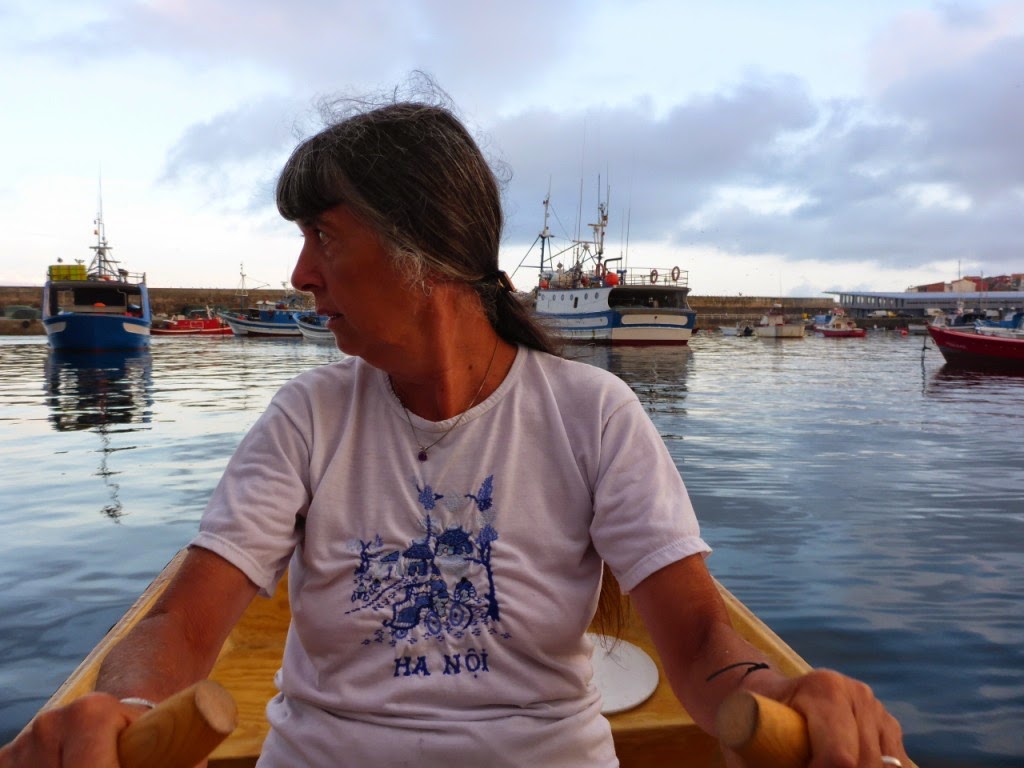
For once, it is I who go and buy the newspapers. I walk a little in the town. Finisterre is a nice little town, very old and well maintained. It is market day and I buy a new T-shirt. Then we leave, to bike to the lighthouse, 3.5 km, mostly uphill. The weather is gray. Finisterre lighthouse is very touristy, people want to go "at the end of the earth." Many people and, of course, souvenir shops. To come back is freewheeling, it's practically a long descent throughout. We see a small beach at the entrance of the town. We swim there. A group of young walkers from the Santiago trail rests and offers us, nicely, some biscuits. One of the girls is French and is still quite flabbergasted to have walked so long, 600 km! A great experience. Lunch at the boat, a little rest and we leave by bike agian, this time to the east, to a village called Sardiñeiro at 7 km. Again, it goes up. We admire the "horreos" these granaries on stilts, the pretty harbor and the beach. But it's too cool and we don’t bathe. We recognize an Irish sailboat anchored in front of the beach, she was in Camariñas along with us. We see two people who seem to come from the boat and are rowing out to the beach with their tender. We are waiting for on the beach, and we talk a little with them, but there's something wrong, I don’t recognize the man at all. And for good reason: these people come from another sailboat anchored a little further! They were just visiting the Irish boat. Het is Dutch and she is German. We return, having done a good distance by bike today, 7 km in the morning and 14 km in the afternoon, 21 in all. While I prepare dinner, a Spanish gentleman shows interest in our boat. He says Maja is beautiful, is a real boat ... I invite him to come on board. He is nice but very chatty, he talks about everything mainly about history with a capital H, and I do not know when it will stop. But he went anyway after a while. Nice dinner and in bed. We leave tomorrow.


Finisterre


Espagnol et Galicien
Spanish ans Galician


La marque de chemin de Santiago de Compostelle
Santiago de Compostela trail's symbol


La route du phare
The light house road


Le phare du cap Finisterre
Cap Finisterre light house


Nous sommes passés entre ce rocher et le cap
We went between this rock and the cape


Jens Cap Finisterre


La petite plage
The little beach


Horreos. Sardiñeiro


La plage. Sardiñeiro. The beach


Le port. Sardiñeiro. The harbor


Le voilier irlandais
The Irish yacht


Tuesday, 5 August 2014

04.08.2014 Finisterre


Lundi 4 août 2014

Repos ce matin puis plage. C’est vraiment une plage magnifique et nous y restons presqu’une heure. L’eau n’est pas chaude, mais sur le sable il fait bon. Nous prenons une “clara” en rentrant et Jens demande une assiette de ”mejillones”, pensant qu’on aurait des moules. Mais le serveur nous apporte des ”longueirones”, les fameux couteaux. C’est assez ”interesting” et heureusement qu’il y a du bon pain avec. C’est notre lunch. Puis petite sieste, on se met aux coutumes locales et travail: blog pour moi et changement du moteur du pilote automatique pour Jens. Bien sûr, nous en avons un de rechange. Il est monté dans la cale derrière, qu’il faut vider. Jens travaille, travaille et a chaud. Il a des problèmes pour monter le nouveau: le joint n’est pas étanche. Il essaye plusieurs fois et s’aperçoit que le nouveau moteur se monte orienté d’une autre façon, et là le joint est étanche. Nous allons de nouveau à la plage, l’eau est maintenant à 21 ⁰, c’est très agréable. Nous rentrons au bateau et décidons d’aller, en annexe, rendre visite à des Norvégiens sur un catamaran ancré un peu plus loin. Nous les avions rencontrés le première fois à La Coruña. Jens rame en allant (10 mn) et moi en revenant. Ils nous offrent une bière et nous passons un bon moment ensemble sur leur bateau. Il y a de la place sur un catamaran. Nous rentrons et allons diner au restaurant d’un plateau de fruits de mer … et on a encore des couteaux, mais aussi d’autres coquillages, le tout arrosé d’un vin blanc local. La télé marche et retransmet un rally en Finlande. Très bonne soirée, juste nous deux.

Monday, August 4, 2014

Rest this morning and beach. It is really a beautiful beach and we stay almost an hour. The water is cool, but the sand is warm. We take a "clara" in returning and Jens asks a plate of "mejillones", thinking that would be mussels. But the waiter brings us "longueirones", the famous knives. They are "interesting" and fortunately, they come with good bread. This is our lunch. Then nap, we follow the local customs and work: blog for me and change of the autopilot engine for Jens. Of course, we have a spare one. It is mounted in the big storage at the back, so first it must be emptied. Jens works and works and is warm. He has problems to mount the new engine: the seal is not tight. He tries several times and finds that the new engine is oriented in a different way than the old one, and when he understood that the seal is tight. We go back to the beach, the water is now at 21 ⁰, it is very nice. We go back to the boat and decide to go and visit some Norwegians on a catamaran anchored a little further. We put the tender on the water and Jens is rowing to them. We met them the first time in La Coruña. They offer us a beer and we spend a good time together on their boat. There is space on a catamaran. It is my turn to row on the way back, 10 minutes. Then we dine at a restaurant with a plate of seafood ... and we have, again, the long shells (knives?), but also other shellfish, washed down with a local white wine. The television is on and retransmits a rally in Finland. Good evening, just the two of us.


On est juste entre deux poteaux, les grands voiliers ne peuvent pas se mettre là
We are just between two pilars, the big yachts can't be here


Tito, notre voisin espagnol, montre à Jens des bons endroits sur la carte
Tito, our Spanish neighbor, shows Jens good places on the map 


Nirvana, le bateau de Tito
Tito's boat, Nirvana


Il y a pleins de petits poissons sous Maja
There are many small fish under Maja


La plage
The beach


Le moteur de l'autopilote
The autopilot engine


Jens monte le nouveau moteur
Jens is installing the new engine


Jens travaille
Jens is working


Jens travaille et a chaud
Jens is working and is warm


Une pélerine sur la plage
A pilgrim on the beach


Visite aux Norvégiens sur leur catamaran 
Visit to the Norwegians on their catamaran


C'est moi qui rame en rentrant
I am rowing on the way back


Au restaurant


Oeillets sauvages près de la plage
Wild carnations near the beach


Monday, 4 August 2014

03.08.2014 Finisterre 42 54 N 09 15 W


Dimanche 3 août 2014

Je me lève à 7 h et on ne voit pas à 50 m, un épais brouillard cache tout. Quand nous nous levons un peu plus tard, il s’est un peu levé mais on ne voit guère. Certains voiliers partent quand même. Une chose que j’ai oublié de dire: la majorité des bateaux dans les ports de la côte de Galice sont français. Nous allons partir aussi, mais attendons que le soleil ait fait disparaitre le brouillard. Nous partons à 11 h et au moins dix bateaux partent aussi. Il n’y a pas de vent, la mer est calme (juste un peu de houle) et bleue et le soleil brille. Nous sortons de la ría de Camariñas et tournons à gauche pour descendre vers le sud. Tout va bien, c’est une traversée idéale. A 13 h, l’auto-pilote tombe en panne, il ne marche plus du tout. Ce n’est pas un grand problème aujourd’hui, nous longeons la côte donc on a des points de repère. Cela serait plus embêtant en pleine mer, c’est plus dur de tenir un cap quand on ne voit que la mer. Nous barrons donc, en vrai. Nous arrivons au Cap Finisterre (en Galicien: Fisterra). Nous passons entre un îlot et le cap, tous les autres (3) passent au large. Mais cela va bien, c’est très calme aujourd’hui. Jens a envie de s’arrêter au petit port du même nom, Finisterre, niché derrière le cap. Mais dans le guide, ils précisent bien qu’il n’y a pas de marina et qu’il n’y a guère de place pour les voiliers. Nous allons voir quand même. Le port est bondé de bateaux de pêche derrière une grande digue très haute et très large. Les tempêtesdu sud-ouest peuvent être sérieuses ici, au bout de la terre. Nous nous faufilons entre les bateaux et au fond du port, nous voyons un voilier espagnol amarré à l’extérieur de la marina des petits bateaux de pêche. Nous lui demandons si on peut se mettre à là nous aussi et il nous dit, pas de problème. Il nous aide à nous amarrer et voilà, nous sommes les deux seuls voiliers dans le port de Finisterre. D’autres voiliers ancrent un peu à l’extérieur du port. Nous allons à terre et, surprise, c’est la fête: fête foraine, musique, buvettes … C’est la fête des ”longueiros”, des couteaux, ces coquillages longs que l’on trouve dans le sable.
Finisterre (5000 habitants), comme Ares et Camariñas, est une vraie petite ville, avec de nombreux immeubles et de nombreux commerçants. C’est touristique, la plage est magnifique et en plus de nombreux pélerins de Santiago de Compostela viennent jusqu’ici, à pied, pour terminer le pélerinage au Cap Finisterre. On les voit en ville, fatigués, le baton de pélerin à la main et la coquille Saint-Jacques sur le sac à dos.
Nous allons nous baignez vers 19 h, la plage, immense, au sable très fin et à l’eau claire, est à 5 mn en vélo du centre mais l’eau n’est qu’à 18 ⁰. Puis diner des restes du poulet et au lit.

Sunday, August 3, 2014
I get up at 7 am and we do not see at 50 meters, a thick fog hides everything. When we get up a little later, it is a little bit better. Some sailboats go anyway. One thing I forgot to say is that the majority of sailboats in the ports along the coast of Galicia are French. We will leave too, but wait until the sun has caused the disappearance of the fog. We start at 11 am and at least ten boats leave too. There is no wind, the sea is calm (just swell) and blue and the sun shines. We leave the ría de Camariñas and turn left to go south. This is an ideal crossing. At 1pm, the autopilot fails, it does not work at all. This is not a big problem today, we follow the coast so we have benchmarks. This would be more annoying at sea, it's harder to take a course when we only see the sea. We steer by hands. We arrive at Cape Finisterre (in Galician: Fisterra). We pass between an island and the cape, all other the boats (3) pass off. But it goes well, it is very quiet today. Jens wants to stop at the small harbor of the same name, Finisterre, nestled behind the cap. But in the guide, they point out that there is no marina and there is little room for sailboats. We'll see anyway. The harbor is crowded with fishing boats behind a large breakwater high and very wide. Southwestern storms can be serious here, at the “end of the earth”. We make our way between the boats and at the harbor bottom, we see a Spanish sailboat moored outside the marina for small fishing boats. We ask him if we can stop there we also and he says no problem. He helps us to tie up and now we are the only two boats in the port of Finisterre. Other sailboats anchored just outside the harbor. We go ashore and, surprise, it's party time: funfair, music, open cafés ... This is the Day of the "longueiros", knives, those long shells found in the sand.
Finisterre (5000 inhabitants), like Ares and Camariñas is a real small town, with many high buildings and many shops. It's touristy, the beach is beautiful and what’s more, some Santiago de Compostela pilgrims come on foot to complete the pilgrimage at Cape Finisterre. We see them in town, tired, the pilgrim stick in hand and a scallop shell on the backpack.
We swim at around 7 pm, the beach, huge, with very fine sand and clear water, is at 5 minutes by bike from the city center but the water is only 18 ⁰. Then dinner of chicken leftovers and to bed.


Le bateau de course de Ingo
Ingo's racer boat


Bye, bye Camariñas


Un bateau qui sort en même temps que nous
Another sailboat is leaving


Un cap
A cape


La houle: Maja est en haut
Swell: Maja is up


La houle: Maja est en bas
Swell: Maja is down


Il y a de la circulation
There is some traffic


L'îlot en face du Cap Finisterre
The rock in front Cape Finisterre


Nous sommes passés entre l'îlot et le cap
We went between the rock and the Cape


Cap Finisterre


 Finisterre, le port


Les bateaux de pêche
Fishing boats


La fête foraine
The fair


Musiciens locaux (avec binioux)
Local musicians (with bagpipe)


La digue
The breackwater


Le port


Bateau de pêche. Finisterre
Fishing boat. Finisterre


Sunday, 3 August 2014

02.08.2014 Camariñas


Samedi 2 août 2014

Il pleut et c’est jour de marché. Des femmes vendent les légumes de leur jardin. Nous achetons des haricots verts, du miel et un fromage. Nous marchons un peu dans Camariñas, c’est un peu bric à brac et de nombreuses maisons sont inhabitées. Depuis que nous sommes en Galice, nous avons remarqué un légume omniprésent dans les jardins. Cette plante ressemble au chou vert à grandes feuilles un peu frisées que nous avons dans le jardin. Nous demandons à une dame ce que c’est. La plante s’appelle berza et est utilisée dans les soupes de Galice, avec du porc fumé et d’autres légumes. Cette dame est bavarde et de la berza nous passons à la situation économique de l’Espagne, à la corruption, à la politique etc … Nous rentrons et avons juste le temps de faire nos adieux à Pia et Ulf, ils partent. Ils ont avec eux deux neveux de Pia qui n’ont jamais fait de voile. Pas très beau temps pour leur première sortie. Nous déjeunons de bonne heure et, malgré le temps gris et menaçant, nous partons en vélo vers le phare de Vilán. Nous suivons la côte et à cet endroit elle mérite bien son nom de ”Costa da morta” (côte de la mort), il y a des écueuils et des rochers partout. Heureusement que nous sommes déjà passés en bateau, c’est au nord de Camariñas, sinon je ne voudrais pas y aller! Nous arrivons au phare, le musée des naufrages (!) est fermé jusqu’à 15 h 30, la siesta. Il se met alors à pleuvoir des cordes et pas un arbre ou un toit pour s’abriter. Mais la jeune fille du musée, bien gentille, nous ouvre la porte et nous fait rentrer dans l’entrée du musée, nous et un autre couple de cyclistes, français. Nous attendons un peu et cela se calme, nous repartons … et il se remet à pleuvoir après 5 mn! Mais il ne fait pas froid. Nous continuons en longeant la mer. Le paysage est grandiose, landes, rochers et même très hautes dunes. Nous passons au “Cimetière des Anglais”. Ce n’est pas un cimetière au sens propre, mais un monument aux 169 Anglais victimes du naufrage du vaisseau “Serpent” en 1890, seuls trois marins avaient survécu. Nous descendons ensuite à une petite plage, la pluie a cessé, et nous nous baignons, eau à 15 ⁰. Et on continue, en tout nous faisons une grande boucle et arrivons à Camariñas à 17 h 45. Jens va faire les courses en rentrant, nous avons un invité ce soir, Ingo, l’Allemand blessé. Moi, je rentre, je suis bien fatiguée. Nous mettons un poulet (3,5 euros!) au four. Il arrive à 20 h et nous dinons dehors. Il nous fait découvrir un monde que nous ne connaissons pas, les régatiers de haut niveau. Il s’est entrainé deux ans, a dépensé beaucoup d’argent et cette régate, la Transquadra solo, était son rêve. Il est très sympathique etnous sommes d’accord sur de nombreux points. Il est, bien sûr très déçu. Il marchait très bien, était en deuxième place et, patatras, tout s’écroule à cause de cet accident. Il veut arrêter la compétition et naviguer en famille avec sa femme et ses enfants. Mais c’est dur de renoncer à ce rêve. Nous lui souhaitons bonne chance. Il part à 23 h 30. Nous avons passé une très bonne soirée avec lui.

Saturday, August 2, 2014

It's raining and it's market day. Women sell vegetables from their garden. We buy green beans, honey and cheese. We walk a little in Camariñas, it is a little bit messy and many houses are uninhabited. Since we are in Galicia, we have noted an ubiquitous vegetable in the gardens. This plant looks like our kale that we have in the garden. We ask a lady what it is. The plant is called berza and is used in soups in Galicia, with smoked pork and other vegetables. This lady talks a lot and from berza we turn to the economic situation in Spain, corruption, politics etc ... We go back to the boat and just have time to say goodbye to Pia and Ulf, they are leaving. They have with them Pia’s two nephews who have never been sailing before. Not very good weather for their first outing. We lunch early and, despite the gray and threatening clouds, we go on bike to the lighthouse of Vilán. We follow the coast and this place deserves its name of "Costa da Morta" (Coast of Death), there are rocks everywhere. Fortunately, we've already done it by boat, it is north of Camariñas, otherwise I would not go there! We arrive at the lighthouse, the museum of shipwrecks (!) is closed until 3:30 pm, the siesta. It starts to rain heavily and not a tree or a roof over our heads. But the girl of the museum, very kindly, opens the door and makes us go into the museum entrance, we and another couple of French cyclists. We wait a bit and it calms down, we leave ... and it starts raining again after 5 minutes! But it's not cold. We continue along the coast. The scenery is magnificent, moors, rocks and even very high sand dunes. We see to the "English Cemetery". This is not a cemetery literally, but a monument to the 169 victims of the sinking of the British ship "Serpent" in 1890, only three sailors survived. We then descend to a small beach, the rain stopped, and we bathe, water at 15 ⁰. We do a big loop and come to Camariñas at 5:45 pm. Jens goes shopping, we have a guest tonight, Ingo, the wounded German. I go home, I'm tired. We put a chicken (3.5 euros!) in the oven. He comes at 8 pm and we dine outon the boat. He introduces us to a world that we do not know, the high-level racers. He has trained two years, spent a lot of money and this race, the Transquadra solo, was his dream. He is very friendly and we agree on many points. He is of course very disappointed. He started the race very well, was in second place, and wham, everything falls apart because of this accident. He wants to stop racing and start sailing with his wife and children. But it's hard to give up that dream. We wish him good luck. He leaves at 11:30 pm We spent a very nice evening with him. 


Même ici il y a des fêtes viking
Even here there is Viking parties


Le marché sous la pluie
Market under rain


Un grenier en pierres sur pilotis
A stone storage house on pilars


Poules
Hens


Berzas


Pia et Ulf s'en vont
Pia and Ulf are leaving


Un cimetière espagnol
A Spanish cementary


La côte
The coast


Le phare de Vilán
The Vilán light house


La côte
The coast


Pluie
Rain


Le phare est dans la brume
The light house is in the fog


A la plage
On the beach


A la plage
On the beach


Le cimetière anglais
The English cementary


Hommage à tous les naufragés
In memory of all the shipwrecked


Ingo